GS 2: GovernanceGS 2: PolityPrelimsGS 2: Government policies and interventions for development in various sectorsGS 2: Statutory, Regulatory and Quasi Judicial Bodies
Amid din, LS passes Bill to set up panel to select chiefs and members of tribunals, Pg6
Amid din, Lok Sabha passes Tribunals Reforms Bill 2026, creating a National Tribunals Commission for selecting quasi-judicial body members.
Practice MCQs
855 Students attempted
Key Highlights:
- The Lok Sabha passed the Tribunals Reforms Bill, 2026, on Monday, August 10, 2026, by a voice vote.
- The Bill aims to establish a National Tribunals Commission to select chairpersons and members for various tribunals.
- This new legislation replaces the Tribunals Reforms Act, 2021, certain provisions of which were previously struck down by the Supreme Court.
- Justice Minister Arjun Ram Meghwal stated that the purpose of tribunals is to strengthen the justice system as specialized, efficient, and effective complementary institutions.
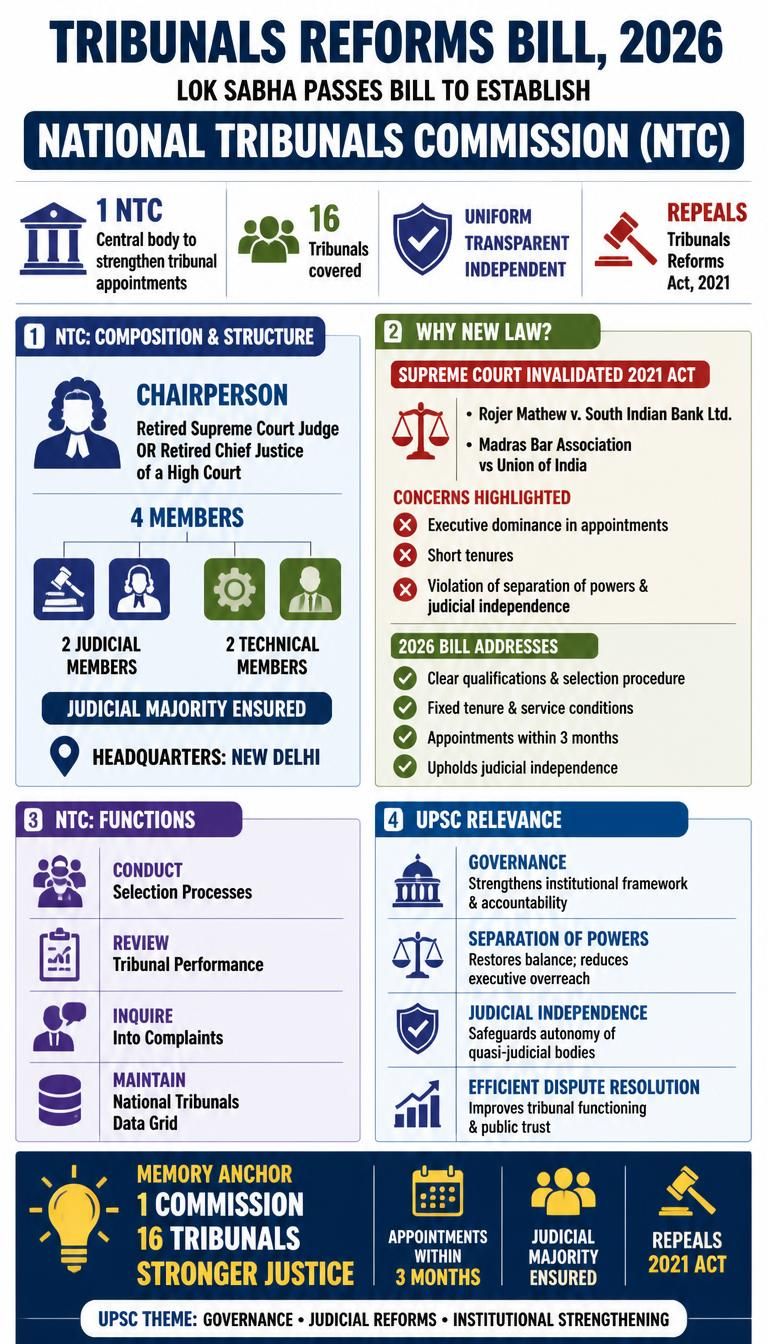
Tribunal Reforms.jpg
Detailed Insights:
- The Tribunals Reforms Bill, 2026, was introduced to address concerns raised by the Supreme Court regarding the independence and appointment process of tribunal members.
- The Supreme Court had struck down key provisions of the Tribunals Reforms Act, 2021, citing excessive executive control over appointments, tenure, and service conditions, which violated judicial independence and the separation of powers.
- The Court deemed the 2021 Act an "impermissible legislative override" as it merely repackaged provisions from a previously invalidated ordinance without rectifying constitutional defects.
- The proposed National Tribunals Commission (NTC) is envisioned as a statutory body to centralize and professionalize the appointment, supervision, and administration of tribunal members.
- The NTC will oversee the selection process, review tribunal performance, inquire into complaints against members, and develop a National Tribunals Data Grid.
- Its composition will include a chairperson (retired Supreme Court Judge or High Court Chief Justice), two judicial members, and two technical members, with appointments for judicial members made in consultation with the Chief Justice of India.
- Tribunals are quasi-judicial bodies established under Articles 323A and 323B of the Constitution to provide speedy, cost-effective, and specialized dispute resolution, thereby reducing the burden on traditional courts.
- Examples of tribunals include the Central Administrative Tribunal, Armed Forces Tribunal, National Green Tribunal, Income Tax Appellate Tribunal, and National Consumer Disputes Redressal Commission.
Key Concepts Involved:
- Tribunals: Quasi-judicial bodies established by law to resolve specific disputes efficiently, reducing the burden on traditional courts.
- National Tribunals Commission (NTC): A proposed statutory body designed to centralize and professionalize the appointment, supervision, and administration of tribunal members.
- Separation of Powers: A constitutional doctrine dividing governmental powers among legislative, executive, and judicial branches to prevent concentration of authority.
- Judicial Independence: The principle that the judiciary must be free from undue influence or control by the executive and legislative branches of government.

SuperKalam is your personal mentor for UPSC preparation, guiding you at every step of the exam journey.
Download the App


STUDY RESOURCES
CONTACT US
ⓒ Snapstack Technologies Private Limited