GS 2: GovernanceGS 2: International RelationsGS 3: EconomyPrelimsGS 2: Bilateral, Regional and Global Groupings and Agreements
BRICS in a fragmented world order, a test of relevance, Pg10
New Delhi BRICS Summit achieves consensus on global reforms, but faces significant relevance test amidst fragmented world order and China's growing dominance.
Practice MCQs
862 Students attempted
Key Highlights:
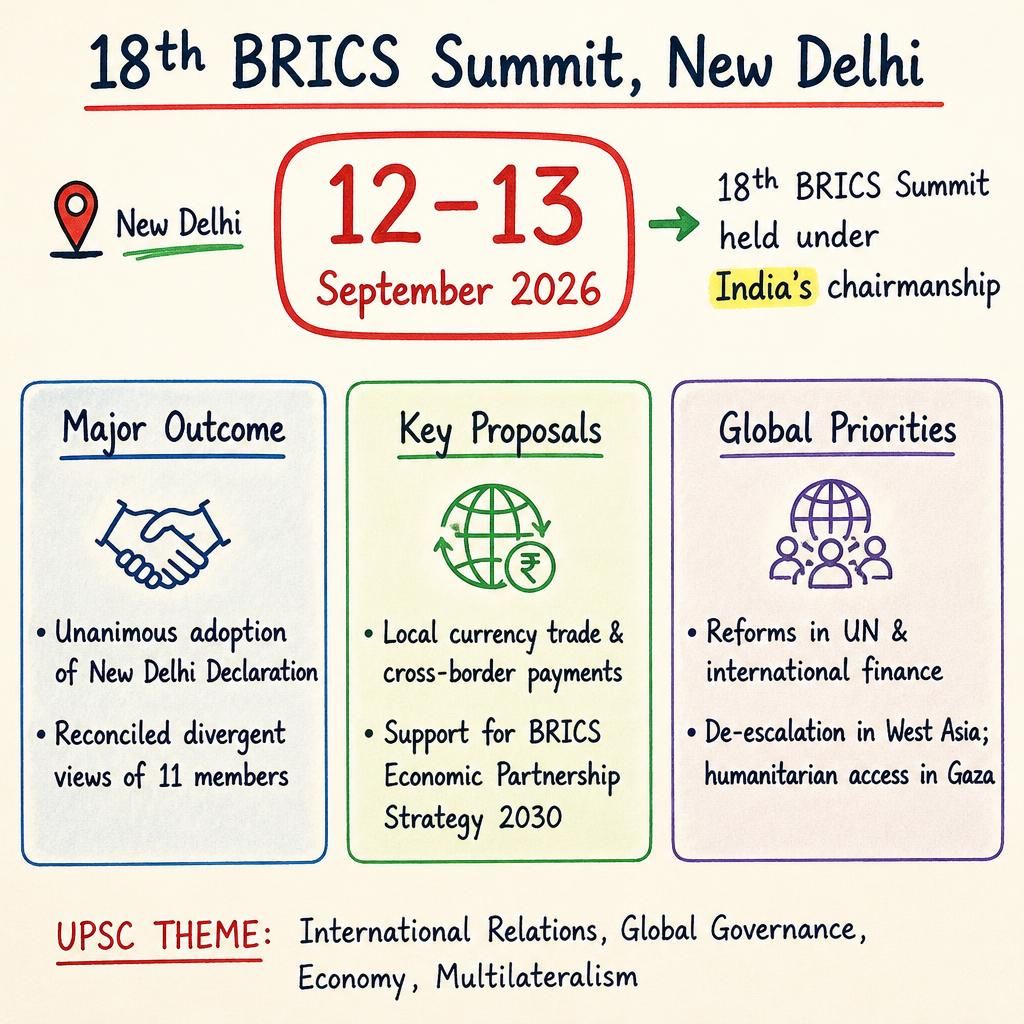
- The 18th BRICS Summit was held in New Delhi on September 12-13, 2026, under India's chairmanship.
- The summit achieved unanimous adoption of the New Delhi Declaration, reconciling divergent views among the 11 member nations.
- The Declaration addressed global governance reform, trade, finance, energy, climate, technology, health, and agriculture.
- Key proposals included local currency trade, inter-operable cross-border payment systems, and support for the BRICS Economic Partnership Strategy 2030.
- The summit also called for a more representative United Nations and international financial system, and supported de-escalation in West Asia and humanitarian access in Gaza.
BRICS Summit.jpg
Detailed Insights:
- The New Delhi Declaration emphasized mutual respect, sovereignty, equality, openness, and consensus among member states.
- It advocated for a stronger voice for emerging markets and developing economies, promoting multi-polarity and reform of Bretton Woods institutions.
- The Declaration supported the World Trade Organization (WTO) and a rules-based multilateral trading system, including a two-tier dispute settlement mechanism.
- It acknowledged the potential of Artificial Intelligence (AI) for economic growth and sustainable development, supporting international cooperation on AI governance.
- Prime Minister Narendra Modi urged BRICS leaders to propose 10 global governance reforms, highlighting the shared right to shape the future.
- The summit's atmosphere of bonhomie and the participation of diverse leaders like Chinese President Xi Jinping and Russian President Vladimir Putin were noted.
- Despite the consensus, a sober assessment suggests the current era is characterized by "variable geometry" rather than deep-seated alliances.
- Long-standing demands of the original BRICS countries, such as reforms of the International Monetary Fund and World Bank, remain unfulfilled.
- China's economic dominance has created an imbalance within BRICS, challenging the group's stance against Western hegemony.
- Tensions between India and China continue to affect the future trajectory and unity of the BRICS grouping.
Key Concepts Involved:
- Multipolarity: A world order where several states possess roughly comparable levels of power, with no single power dominating.
- Bretton Woods Institutions: The International Monetary Fund (IMF) and the World Bank, established in 1944 to regulate the international monetary and financial order.
- Strategic Autonomy: The ability of a state to pursue its national interests and foreign policy independently, without being heavily reliant on other states.
- Multilateralism: Cooperation among three or more countries, often within global institutions, to address common issues based on shared norms and values.
- Plurilateralism: A governance strategy where a subset of countries within a larger multilateral framework negotiate agreements on specific issues.
- Global South: A term referring to countries and regions, primarily in Asia, Africa, and Latin America, that are economically and socially less developed, often sharing experiences of colonialism and development challenges.
- Thucydides Trap: A concept describing the tendency towards war when a rising power threatens to displace an established ruling power.

SuperKalam is your personal mentor for UPSC preparation, guiding you at every step of the exam journey.
Download the App


STUDY RESOURCES
CONTACT US
ⓒ Snapstack Technologies Private Limited