GS 2: GovernanceGS 2: International RelationsPrelimsGS 4: Ethical Issues in International Relations and FundingGS 4: Human Values, Lessons from Leaders, Reformers and Administrators
International jurist Navi Pillay wins Nobel Peace Prize, Pg1
South African jurist Navi Pillay wins Nobel Peace Prize for upholding international law amidst global challenges, notably her work on the Gaza conflict.
Practice MCQs
862 Students attempted
Key Highlights:
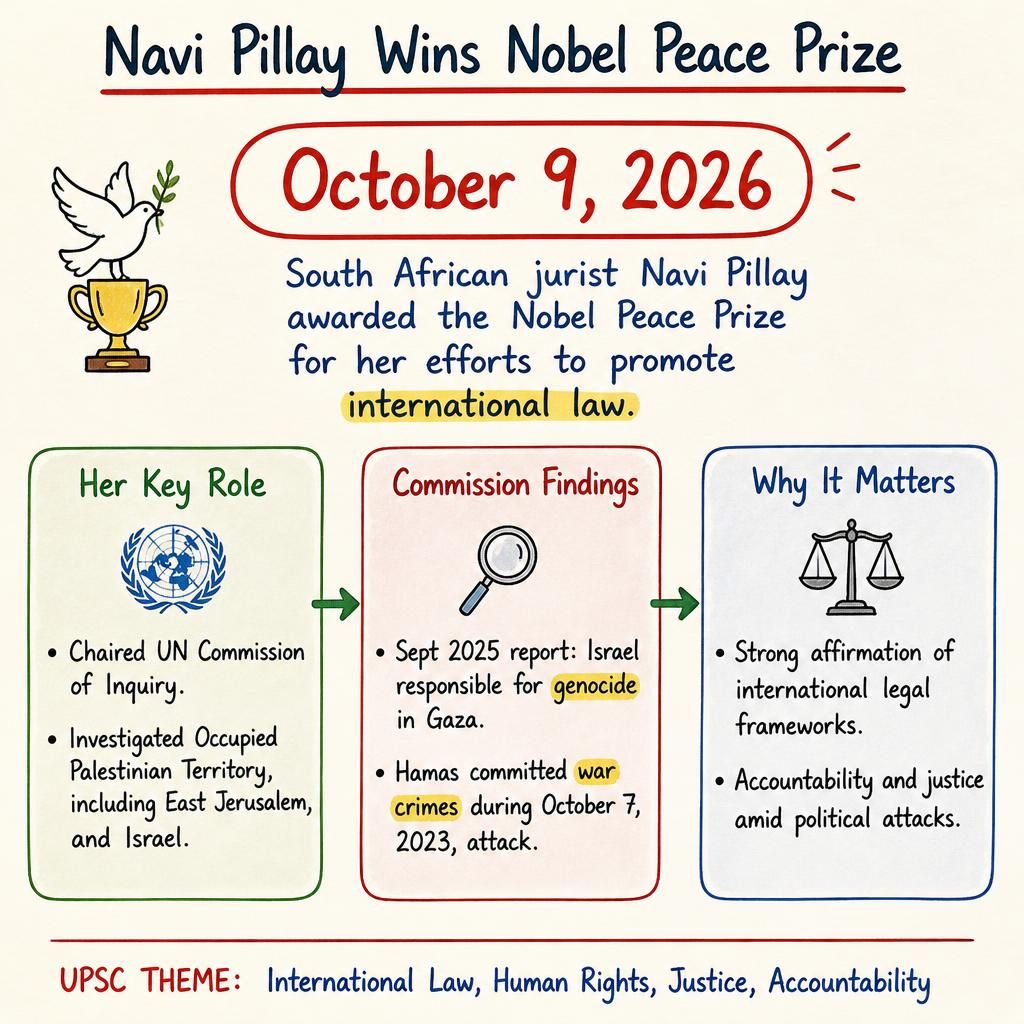
- South African jurist Navi Pillay was awarded the Nobel Peace Prize on Friday, October 9, 2026, for her efforts to promote international law.
- The Norwegian Nobel Committee highlighted her work in upholding the rule of law amidst global challenges.
- Pillay chaired the UN Independent International Commission of Inquiry on the Occupied Palestinian Territory, including East Jerusalem, and Israel.
- This commission concluded that Israel was responsible for genocide in Gaza and that Hamas committed war crimes.
- Her win is seen as a strong affirmation of international legal frameworks, which are currently under significant pressure.
Nobel Peace Prize.jpg
Detailed Insights:
- The Nobel Peace Prize was awarded on its 125th anniversary, emphasizing that "Peace requires justice" and the rule of law.
- Navi Pillay's extensive career includes defending anti-apartheid activists, serving as a judge on the International Criminal Tribunal for Rwanda, and the International Criminal Court (ICC).
- She is currently an ad hoc judge for the International Court of Justice (ICJ).
- The UN Human Rights Council established the Commission of Inquiry in May 2021 to investigate violations by all parties.
- The commission's September 2025 report found Israel committed four of the five acts defined as genocide under the 1948 Genocide Convention.
- It also accused Hamas of war crimes and violations of international humanitarian law during its October 7, 2023, attack.
- The award underscores the importance of accountability and justice at a time when international legal institutions face political attacks.
Key Concepts Involved:
- International Law: A body of rules and principles governing relations between states, international organizations, and other global actors.
- Genocide: Acts committed with intent to destroy, in whole or in part, a national, ethnical, racial, or religious group.
- War Crimes: Serious violations of international humanitarian law during armed conflict, incurring individual criminal responsibility.
- International Humanitarian Law (IHL): Rules that limit the effects of armed conflict, protecting non-combatants and restricting methods of warfare.

SuperKalam is your personal mentor for UPSC preparation, guiding you at every step of the exam journey.
Download the App


STUDY RESOURCES
CONTACT US
ⓒ Snapstack Technologies Private Limited