GS 3: Science & TechnologyGS 2: Social JusticePrelimsGS 3: BiotechnologyGS 3: Science and Technology in Everyday Life
Let There Be Light, Pg6
Nobel Prize awarded for optogenetics, a revolutionary technique illuminating brain function and paving way for Alzheimer's and addiction treatments.
Practice MCQs
840 Students attempted
Key Highlights:
- The 2026 Nobel Prize in Physiology or Medicine was jointly awarded to Karl Deisseroth, Peter Hegemann, and Georg Nagel.
- They were recognized for their discoveries concerning light-gated ion channels and optogenetics.
- Their work provided a significant advancement in understanding brain function and how nerve cells communicate.
- Optogenetics allows scientists to control the activity of individual nerve cells using light, enabling brain mapping and the study of neural circuits.
- This breakthrough has laid the groundwork for potential clinical treatments for neurological and psychiatric disorders like Alzheimer's and addiction.
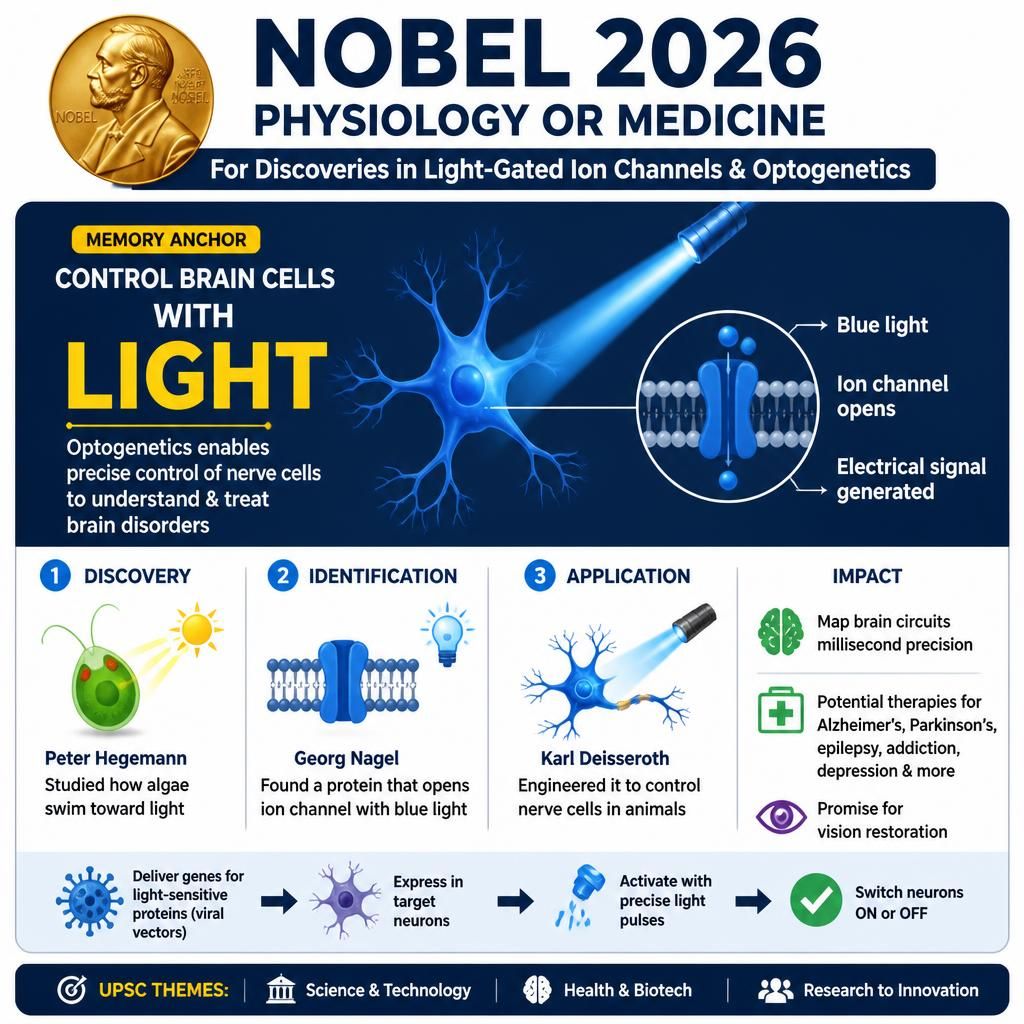
Nobel Prize in Medicine.jpg
Detailed Insights:
- Peter Hegemann initially investigated how the single-celled alga Chlamydomonas swims towards light.
- Georg Nagel subsequently discovered an algal protein that, when illuminated with blue light, opens a channel allowing charged ions to flow and create electrical impulses.
- Karl Deisseroth then adapted this protein to function as a light-controlled switch for nerve cells in more complex organisms.
- The technique involves delivering genes for light-sensitive proteins into specific target cells using harmless viral agents, then activating them with precise light pulses.
- Optogenetics has transformed neuroscience by enabling researchers to switch specific neurons on or off with millisecond precision, revealing neural circuits governing memories, feelings, and behaviors.
- Beyond research, the method holds promise for restoring sight and developing therapies for conditions such as Parkinson's disease, epilepsy, and depression.
- The discovery highlights the importance of translating scientific research into practical therapies accessible to all.
Scientific/Technical Concepts Involved:
- Optogenetics: A biological technique using light to control the electrical activity of specific nerve cells in living tissues, combining optics and genetic engineering.
- Light-gated ion channels: Transmembrane proteins that form pores, allowing ions to pass through cell membranes in response to light, thereby changing the cell's electrical state.
- Chlamydomonas: A genus of single-celled green algae, in which the light-sensitive proteins (channelrhodopsins) fundamental to optogenetics were first discovered.
- Neurons: Specialized cells transmitting electrical and chemical signals, forming the fundamental units of the nervous system.

SuperKalam is your personal mentor for UPSC preparation, guiding you at every step of the exam journey.
Download the App


STUDY RESOURCES
CONTACT US
ⓒ Snapstack Technologies Private Limited