GS 2: GovernanceGS 2: International RelationsGS 3: EconomyPrelimsGS 2: Bilateral, Regional and Global Groupings and Agreements
The China-U.S. rapprochement, Pg6
Despite recent summits, US-China strategic competition continues, marked by fragile trade truces and underlying ideological differences, challenging the G2 concept.
Practice MCQs
840 Students attempted
Key Highlights:
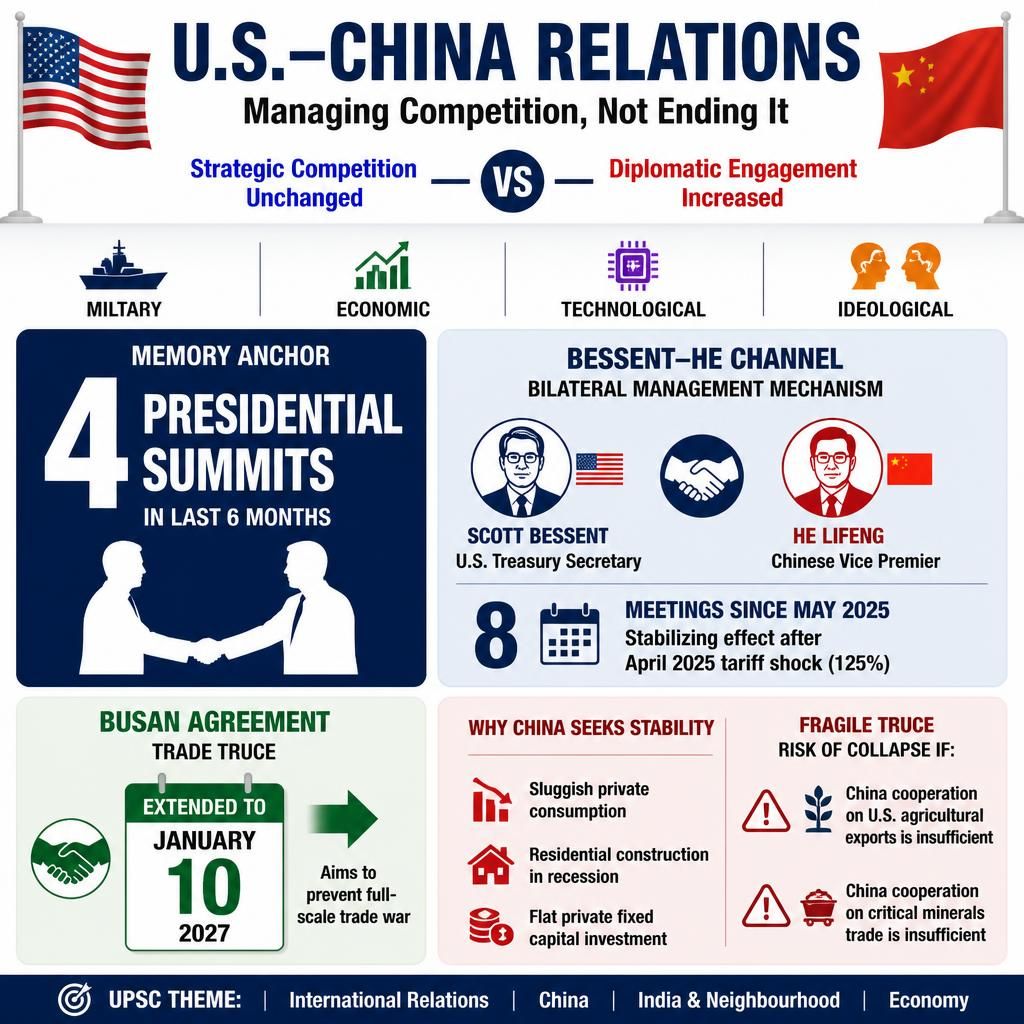
- The United States and China have engaged in four presidential summits in the last six months, signaling a period of increased diplomatic activity.
- Despite recent high-level engagements, the fundamental strategic competition between the two global powers remains unchanged across military, economic, technological, and ideological domains.
- A bilateral management mechanism, known as the Bessent-He channel, was established in May 2025 between U.S. Treasury Secretary Scott Bessent and Chinese Vice Premier He Lifeng.
- This channel has met eight times, contributing to a stabilizing effect on the relationship following significant tariff impositions in April 2025.
- The Busan Agreement, a trade truce reached in October 2025, was recently extended by two months to January 10, 2027, aiming to prevent a full-scale trade war.
- China is actively seeking stability in its foreign relations, particularly with the U.S., as it approaches the 21st Party Congress in late 2027.
US-China Relations.jpg
Detailed Insights:
- The current diplomatic engagements represent a new phase of managing competition rather than a fundamental shift in the U.S.-China strategic architecture.
- Both nations maintain a realist view of their ongoing contest for dominance in the Indo-Pacific and globally for the 21st century.
- The Bessent-He channel emerged after both countries imposed 125% retaliatory tariffs in April 2025, prompting a de-escalation to protect national economic interests.
- China's push for stability is partly driven by domestic economic challenges, including sluggish private consumption, a recession in residential construction, and flat private fixed capital investment.
- Beijing's "constructive strategic stability" framework aims to maximize cooperation, manage competition within defined bounds, and address strategic differences like Taiwan.
- The U.S. has accepted this framework but with the explicit caveat that it must be "fair and reciprocal," indicating potential areas for disagreement.
- The fragility of the Busan Agreement is a key concern, with risks of collapse if China's cooperation on U.S. agricultural exports or critical minerals trade is deemed insufficient.
- The prospect of the European Union imposing similar tariffs on China could significantly impact the export-dependent Chinese economy.
- Despite tactical accommodations in trade, the underlying strategic competition, particularly in critical technologies like AI, suggests that an emerging "G-2" global condominium is unlikely.
Key Concepts Involved:
- Strategic Competition: An ongoing rivalry between major powers across multiple domains, including military, economic, technological, and ideological.
- G-2: A theoretical concept suggesting that the United States and China would jointly lead global governance and decision-making.
- Constructive Strategic Stability: China's proposed framework for managing U.S.-China relations through cooperation, managed competition, and addressing differences.
- Indo-Pacific: A geopolitical region encompassing the Indian Ocean and the Pacific Ocean, central to global trade, security, and power dynamics.

SuperKalam is your personal mentor for UPSC preparation, guiding you at every step of the exam journey.
Download the App


STUDY RESOURCES
CONTACT US
ⓒ Snapstack Technologies Private Limited