GS 3: Science & TechnologyPrelimsGS 3: Space Technology
Pioneer of IceCube neutrino detector wins physics Nobel, Pg1
Physicist Francis Halzen awarded Nobel for IceCube neutrino observatory, discovering high-energy cosmic neutrinos and opening new astronomy.
Practice MCQs
840 Students attempted
Key Highlights:
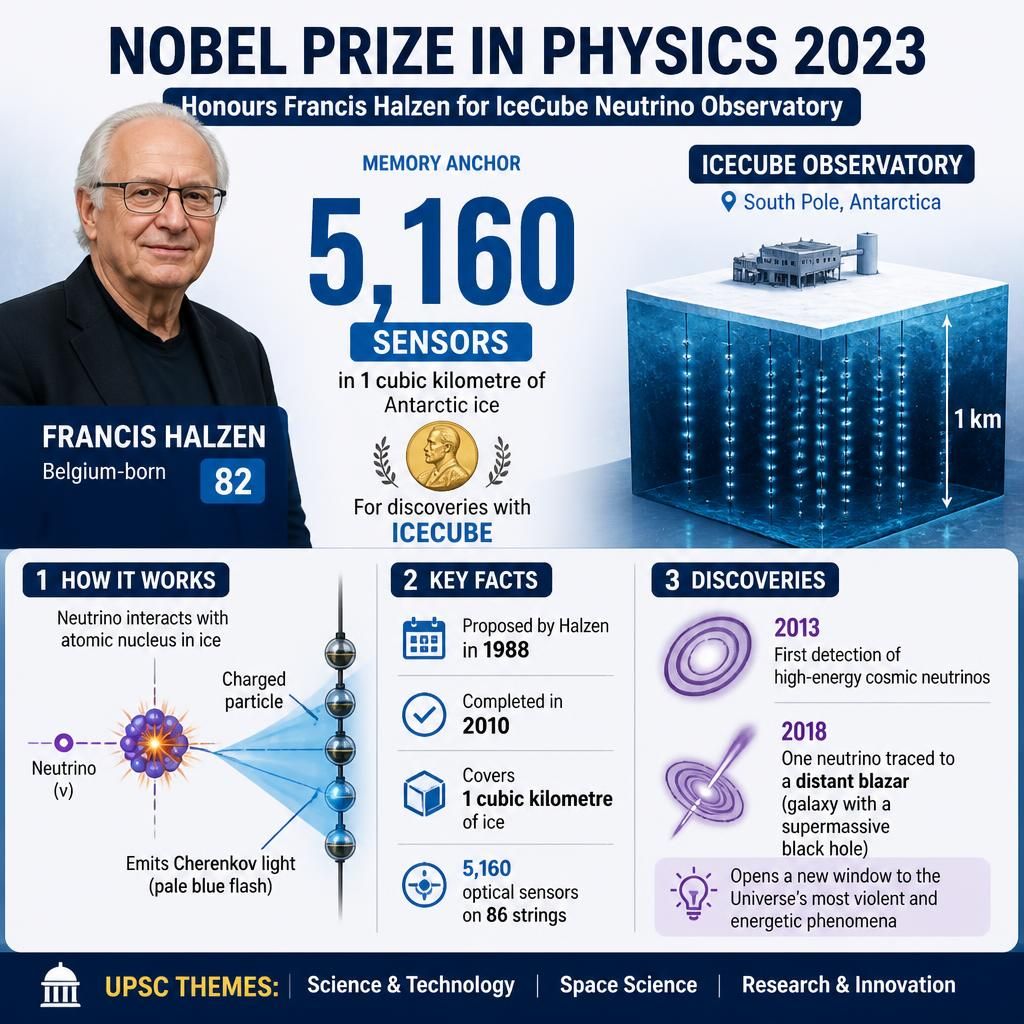
- Belgium-born Francis Halzen, 82, was awarded this year’s Nobel Prize in Physics.
- The award recognizes his contributions to IceCube, a neutrino observatory located at the South Pole.
- Halzen was also honored for the discovery of high-energy neutrinos of astrophysical origin.
- IceCube was completed in 2010 and is designed to detect cosmic neutrinos from energetic collisions in space.
Nobel Prize in Physics.jpg
Detailed Insights:
- IceCube utilizes the pure, undisturbed ice of the South Pole as an ideal medium to capture elusive neutrinos.
- When neutrinos collide with atomic nuclei, they produce charged particles that emit a flash of pale blue light, known as Cherenkov light.
- Francis Halzen first proposed his vision for capturing neutrinos at the South Pole in 1988.
- The observatory covers an entire cubic kilometre and is equipped with 5,160 optical sensors to detect neutrino interactions.
- Researchers first reported high-energy cosmic neutrinos in 2013.
- In 2018, one such neutrino was traced to a distant blazar, a galaxy with a supermassive black hole.
- This discovery has paved the way for a new kind of astronomy, offering insights into violent cosmic settings and potentially revealing unknown cosmic phenomena.
Scientific/Technical Concepts Involved:
- Neutrinos: Extremely elusive, fundamental subatomic particles with very little mass and no electric charge.
- IceCube: A neutrino observatory at the South Pole, designed to detect high-energy neutrinos from cosmic sources.
- Cherenkov light: A blue flash produced when a charged particle travels through a transparent medium faster than the speed of light in that medium.
- Blazar: A type of active galactic nucleus with a supermassive black hole that emits a jet of particles and radiation almost directly towards Earth.

SuperKalam is your personal mentor for UPSC preparation, guiding you at every step of the exam journey.
Download the App


STUDY RESOURCES
CONTACT US
ⓒ Snapstack Technologies Private Limited