GS 2: GovernanceGS 1: World GeographyGS 3: Environment & EcologyPrelimsGS 3: Conservation, Pollution and Degradation
The Amazon is no longer a carbon sink, it is an emitter, Pg II
Shocking study reveals Amazon rainforest, once a vital carbon sink, now emits more CO2 than it absorbs due to rampant deforestation and fires.
Practice MCQs
833 Students attempted
Key Highlights:
- The Amazon rainforest, historically a carbon sink, now emits more CO2 than it absorbs, according to a study published in the journal Nature.
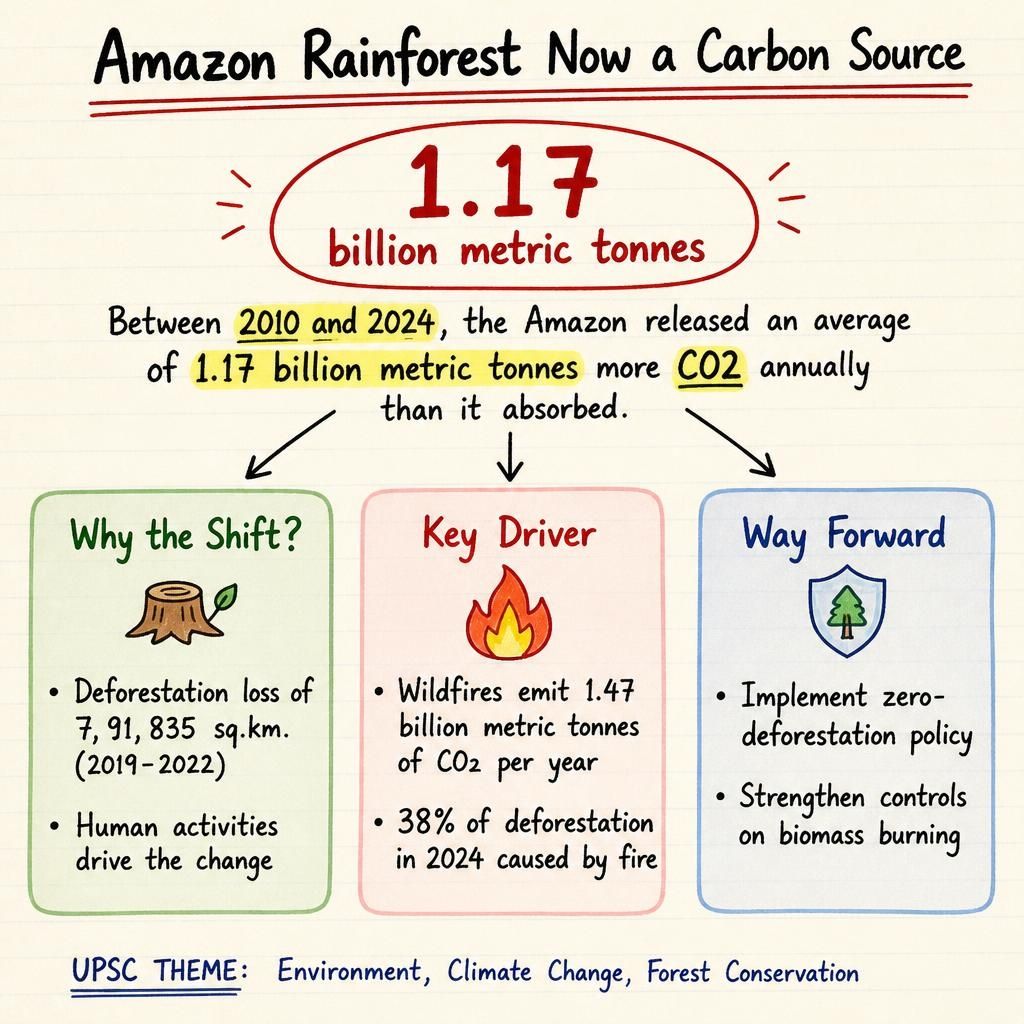
- Between 2010 and 2024, the Amazon released an average of 1.17 billion metric tonnes more CO2 annually than it absorbed.
- Wildfires were identified as the primary cause, contributing 1.47 billion metric tonnes of CO2 emissions per year.
- The study, led by climate scientist Luciana Vanni Gatti, attributes this shift primarily to human activities like deforestation and intentionally set fires.
- Deforestation led to a loss of 7,91,835 sq.km. of forests between 2019 and 2022, alongside significant increases in mining, pasture, and soybean cultivation areas.
Amazon Rainforest.jpg
Detailed Insights:
- Scientists used research airplanes to measure CO2 levels at different atmospheric altitudes across four Amazonian sites from 2010 to 2024.
- Climate stress, exacerbated by deforestation, reduces precipitation by 17% and increases annual temperatures by 0.9°C, making forests more flammable.
- El Niño events and increased drought frequency amplify these conditions, leading to higher carbon emissions, with 38% of deforestation in 2024 caused by fire.
- The study emphasizes that the region's development model, based on destruction, is the core problem, necessitating public policies that value standing forests.
- Recommendations include implementing a zero-deforestation policy, strengthening controls on biomass burning, and prioritizing forest restoration programs.
- The Amazon spans five million sq.km. across nine countries, housing 10% of global plant and animal species and storing approximately 100 billion tonnes of carbon.
Key Concepts Involved:
- Carbon Sink: A natural or artificial reservoir that absorbs and stores more carbon dioxide from the atmosphere than it releases.
- Deforestation: The clearing of forests for other land uses, such as agriculture, logging, or urban development, leading to habitat loss and carbon emissions.
- El Niño: A climate pattern characterized by the unusual warming of surface waters in the central and eastern tropical Pacific Ocean, influencing global weather.

SuperKalam is your personal mentor for UPSC preparation, guiding you at every step of the exam journey.
Download the App


STUDY RESOURCES
CONTACT US
ⓒ Snapstack Technologies Private Limited