GS 2: PolityGS 1: Indian SocietyGS 2: Social JusticePrelimsGS 2: Devolution of Powers and Finances up to Local Levels
Falling fertility has made laws penalising violation of two-child norm outdated: SC, Pg1
Supreme Court deems two-child norm laws outdated due to India's falling fertility rate, impacting political representation and reproductive autonomy under Article 21.
Practice MCQs
833 Students attempted
Key Highlights:
- The Supreme Court observed that laws penalizing citizens for having more than two children have lost their relevance due to India's falling fertility rate.
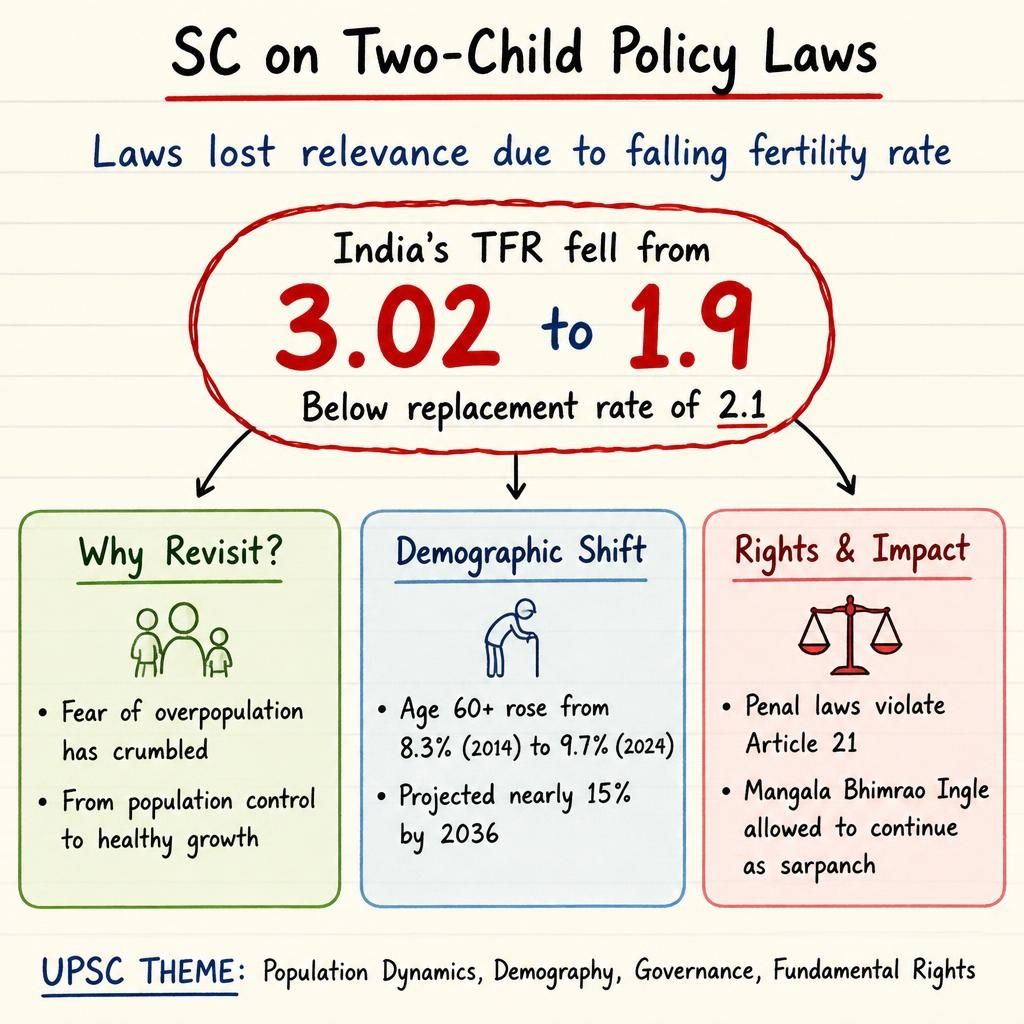
- The court noted India's Total Fertility Rate (TFR) has fallen from 3.02 to 1.9, which is below the replacement rate of 2.1.
- It called for a revisit of its 2003 judgment in Javed v. State of Haryana, which had upheld such penal laws.
- The judgment highlighted a demographic shift towards an older population and a declining share of the working-age population.
- The court linked such laws to a violation of Article 21 (right to life and personal liberty) and reproductive autonomy.
- The observation came during a petition by Mangala Bhimrao Ingle, whose election as sarpanch was set aside for having more than two children.
2 Child Policy.jpg
Detailed Insights:
- The Supreme Court bench, headed by Justice P.S. Narasimha, emphasized that the fear of overpopulation, which was the foundation of such laws, has crumbled due to demographic changes.
- The 2003 Javed v. State of Haryana judgment had drawn inspiration from China's population control measures prevalent at that time.
- The court now suggests that society and courts should focus on encouraging a "healthy growth of population" rather than population control.
- The share of persons aged 60 and above in India has risen from 8.3% in 2014 to 9.7% in 2024, with projections reaching nearly 15% by 2036.
- Penalizing individuals for family size, especially by linking it to political representation, was deemed to impinge on the right to reproductive autonomy under Article 21.
- The court allowed the appellant, Mangala Bhimrao Ingle, to continue in her elected position while staying proceedings against her.
Key Concepts Involved:
- Total Fertility Rate (TFR): The average number of children born to a woman over her lifetime.
- Replacement Rate: The TFR level (approximately 2.1) at which a population exactly replaces itself from one generation to the next.
- Demographic Transition: A shift from high birth and death rates to low birth and death rates as a country develops.
- Article 21: Part of the Indian Constitution guaranteeing the right to life and personal liberty.
- Reproductive Autonomy: The right of individuals to make decisions about their reproductive health and choices, free from coercion.
- Javed v. State of Haryana (2003): A Supreme Court judgment that upheld the validity of laws disqualifying individuals with more than two children from contesting local body elections.

SuperKalam is your personal mentor for UPSC preparation, guiding you at every step of the exam journey.
Download the App


STUDY RESOURCES
CONTACT US
ⓒ Snapstack Technologies Private Limited