GS 2: International RelationsGS 3: Environment & EcologyGS 3: EconomyPrelimsGS 3: Conservation, Pollution and Degradation
What The BRICS Carbon Market Partnership Needs, Pg6
BRICS carbon market partnership needs common rulebook for MRV and pilot projects to counter EU CBAM, strengthening climate action and trade.
Practice MCQs
833 Students attempted
Key Highlights:
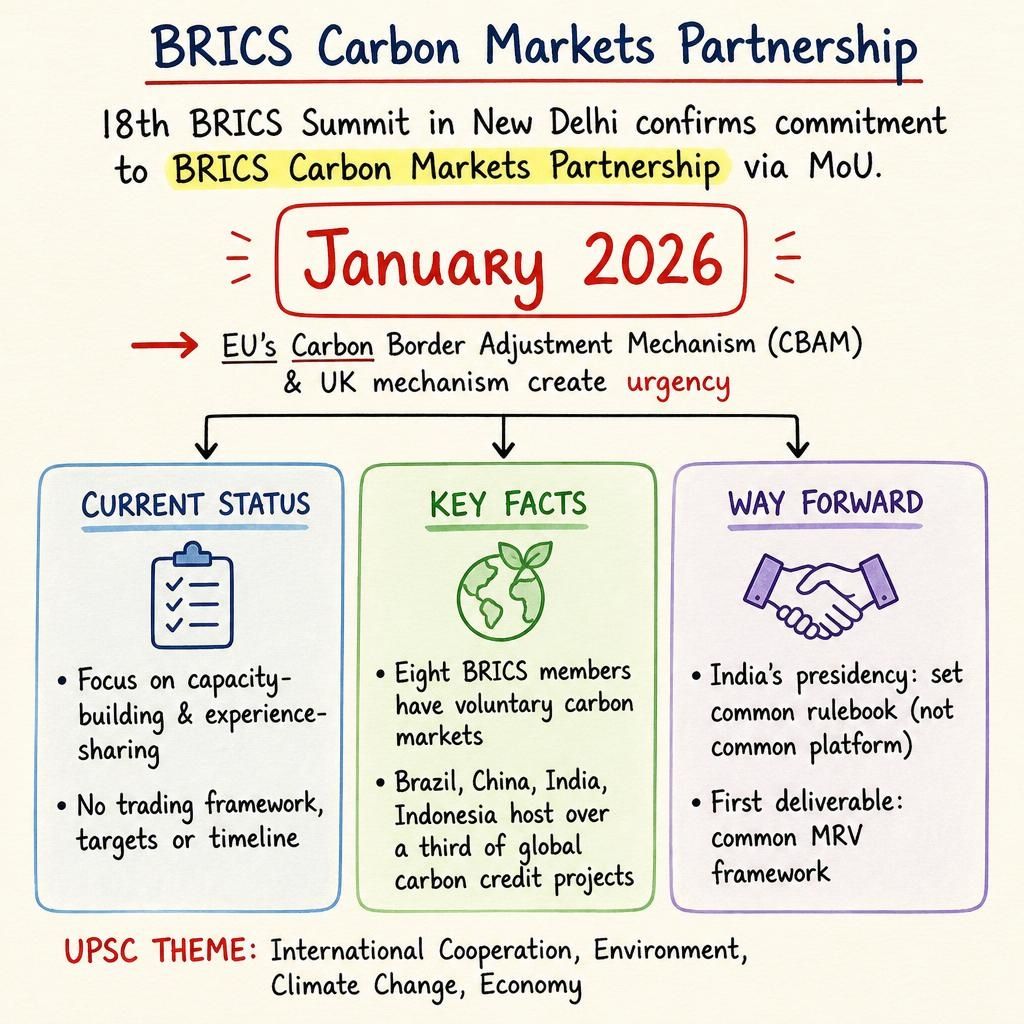
- The 18th BRICS Summit in New Delhi confirmed commitment to the BRICS Carbon Markets Partnership through a Memorandum of Understanding.
- The partnership currently focuses on capacity-building and experience-sharing, lacking a trading framework, targets, or timeline.
- India's BRICS presidency aims to operationalize the partnership by establishing a common rulebook rather than a common trading platform.
- Eight BRICS members operate voluntary carbon markets, with Brazil, China, India, and Indonesia hosting over a third of global carbon credit projects.
- The European Union’s Carbon Border Adjustment Mechanism (CBAM), effective January 2026, and a similar UK mechanism, create urgency for a common BRICS framework.
BRICS Carbon Market.jpg
Detailed Insights:
- National carbon markets within BRICS, like China's Emissions Trading System (ETS) and India's Carbon Credit Trading Scheme (CCTS), are maturing but remain unlinked.
- Divergences exist in allocation methods, with China and India using output-based intensity benchmarks, while Brazil establishes an absolute emissions cap.
- Offset-credit rules are inward-looking, with each country typically accepting only its own certified credits or specific project types.
- The legal status of carbon units varies significantly across BRICS nations, impacting cross-border recognition and trade.
- A common framework for Measurement, Reporting and Verification (MRV) is identified as the partnership's crucial first deliverable.
- The New Delhi Declaration did not explicitly carry forward the 2025 Principles for Fair, Inclusive and Transparent Carbon Accounting.
- A BRICS rulebook would establish common monitoring rules, mutually recognize verifiers, and harmonize registry data fields.
- A pilot exchange project, leveraging Article 6.2 of the Paris Agreement, could facilitate bilateral transfers of mitigation outcomes.
- Such a pilot would expose operational frictions related to corresponding adjustments, capital account regulations, and legal classification of carbon units.
- The New Development Bank could potentially host a shared registry data facility or a purchasing facility for pilot units.
- Full linkage of compliance markets is deemed unlikely and undesirable currently due to diverging interests and complexities.
Key Concepts Involved:
- BRICS Carbon Markets Partnership: An initiative among BRICS nations to collaborate on carbon market development, initially focusing on capacity building.
- Emissions Trading System (ETS): A market-based approach to control pollution by providing economic incentives for achieving reductions in emissions.
- Carbon Border Adjustment Mechanism (CBAM): An EU policy imposing a carbon price on imports of certain goods to prevent carbon leakage and encourage cleaner production globally.
- Measurement, Reporting and Verification (MRV): A system for tracking, documenting, and independently checking greenhouse gas emissions or reductions.

SuperKalam is your personal mentor for UPSC preparation, guiding you at every step of the exam journey.
Download the App


STUDY RESOURCES
CONTACT US
ⓒ Snapstack Technologies Private Limited