Letting the wind flow freely is the secret to cooling our cities, PgII
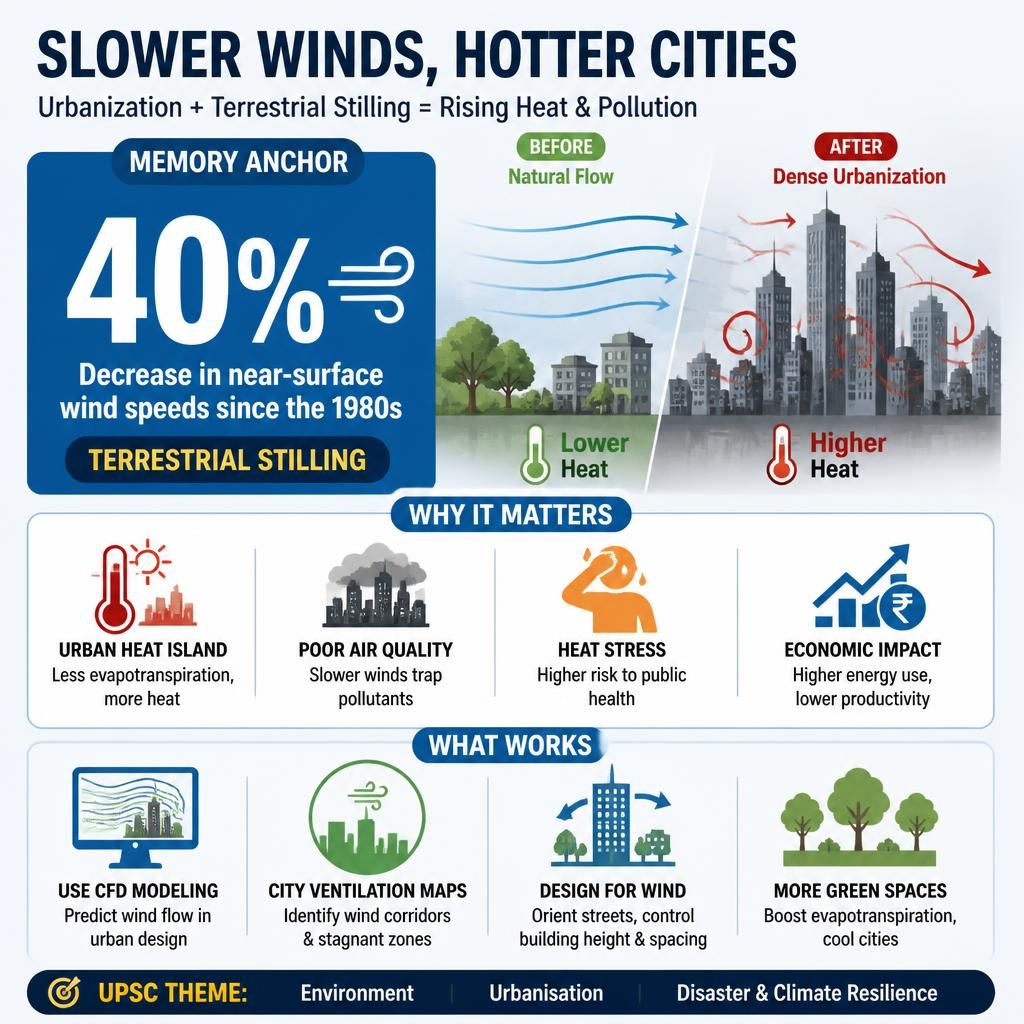
Dense urbanisation and high-rise buildings disrupt wind flow, exacerbating urban heat island effect and pollution, demanding integrated urban planning for city ventilation.
Practice MCQs
826 Students attempted
Key Highlights:
- Indian cities are experiencing reduced wind flow due to dense urbanization, contributing to increased heat stress and slower dispersion of air pollution.
- The global phenomenon of terrestrial stilling, a decrease in near-surface wind speeds since the 1980s, is exacerbating urban heat issues.
- Tall buildings and dense infrastructure disrupt natural wind patterns, leading to phenomena like the Venturi effect and downdraught effect.
- Experts advocate for integrating wind analysis and Computational Fluid Dynamics (CFD) modeling into urban planning and design.
- The development of city ventilation maps and a homogenised wind record are proposed to inform better urban development strategies.
Urban Heat Island.jpg
Detailed Insights:
- Urbanization increases surface friction and turbulence, significantly slowing wind speeds at pedestrian levels in cities.
- The replacement of vegetation with asphalt and concrete reduces evapotranspiration, intensifying the urban heat island effect.
- The Venturi effect causes wind to accelerate through narrow urban spaces, while the downdraught effect forces wind downwards along tall structures.
- Slower wind speeds impede the natural dispersal of air pollutants, worsening air quality in densely populated areas.
- Implementing Computational Fluid Dynamics (CFD) in urban design can help predict and mitigate adverse wind flow patterns.
- Cities like Stuttgart, Seoul, and Hong Kong have successfully used city-wide ventilation assessments to improve urban environments.
- Challenges include the high computational cost and specialized expertise required for advanced wind flow simulations.
Scientific/Technical Concepts Involved:
- Terrestrial Stilling: A global phenomenon characterized by a decrease in near-surface wind speeds observed since the 1980s.
- Urban Heat Island Effect: A metropolitan area that is significantly warmer than its surrounding rural areas due to human activities.
- Venturi Effect: The reduction in fluid pressure that results when a fluid flows through a constricted section of a pipe or channel.
- Downdraught Effect: The downward deflection of wind along the face of a tall building, creating strong gusts at ground level.
- Computational Fluid Dynamics (CFD): A branch of fluid mechanics that uses numerical analysis and data structures to solve and analyze problems that involve fluid flows.
- Anemometer: A device used for measuring wind speed and direction.
- Reynolds Number: A dimensionless quantity used in fluid mechanics to indicate whether fluid flow is laminar or turbulent.

SuperKalam is your personal mentor for UPSC preparation, guiding you at every step of the exam journey.
Download the App


STUDY RESOURCES
CONTACT US
ⓒ Snapstack Technologies Private Limited