GS 3: Environment & EcologyGS 1: Physical GeographyPrelimsGS1: Salient Features of World's Physical GeographyGS1: Changes in Critical Geographical Features, Water Bodies, Ice Caps, Flora and Fauna
Tuvalu: Barely Above Water, PgII
Climate change devastates Tuvalu, wiping out 99.9% of coral and threatening the island nation with rising sea levels, making it unliveable.
Practice MCQs
826 Students attempted
Key Highlights:
- Leaders are visiting the Pacific nation of Tuvalu on October 5, 2026, for a pre-COP gathering, highlighting the severe impacts of climate change.
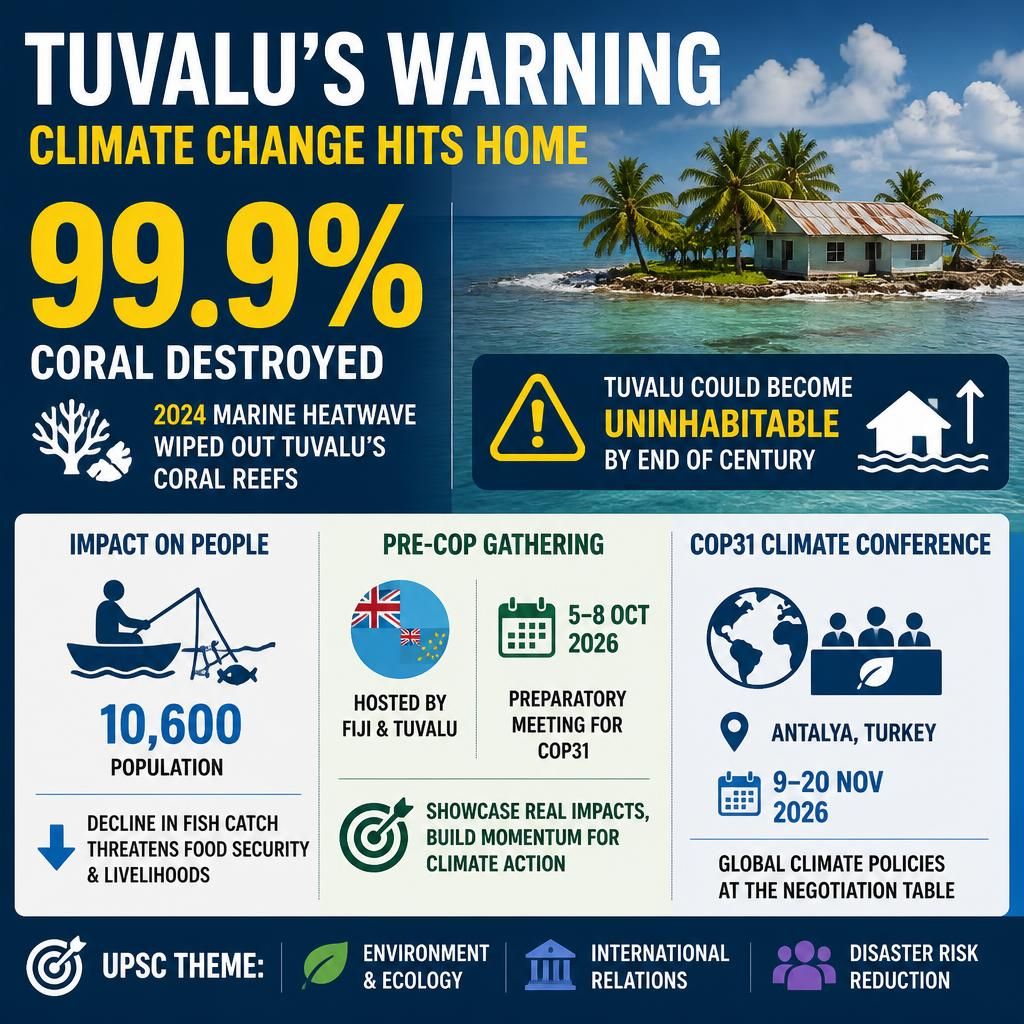
- A marine heatwave in 2024 destroyed an estimated 99.9% of the coral that forms the Tuvalu islands.
- The pre-COP meeting, hosted by Fiji, aims to showcase the direct damage of climate change in the Pacific region ahead of the annual UN Climate Conference (COP31) in Antalya, Turkey.
- Scientists warn that Tuvalu, a low-lying coral atoll nation, could become uninhabitable by the end of the century due to rising sea levels.
- The destruction of marine ecosystems has significantly impacted local livelihoods, including traditional fishing practices for Tuvalu's population of 10,600.
Tuvalu's Warning.jpg
Detailed Insights:
- The pre-COP gathering, held from October 5-8, 2026, in Fiji and Tuvalu, serves as a preparatory meeting for COP31 to build momentum for climate negotiations.
- Tuvalu is an archipelago of low-lying coral atolls, making it exceptionally vulnerable to rising sea levels and extreme weather events.
- The 2024 marine heatwave caused widespread coral mortality, directly impacting the foundational ecosystem that built the islands, rather than pollution or overfishing.
- This ecological devastation threatens the food security and traditional fishing practices of Tuvalu's inhabitants, as fish populations and sizes have declined.
- The UN Climate Conference (COP31) is scheduled to take place in Antalya, Turkey, from November 9-20, 2026, where global climate policies will be discussed.
- The Pacific region, including Tuvalu, is advocating for stronger climate action, increased climate finance, and the protection of the 1.5°C global warming limit.
Scientific/Technical Concepts Involved:
- Coral Atoll: A ring-shaped coral reef, island, or chain of islands enclosing a central lagoon, typically formed as a volcanic island subsides.
- Marine Heatwave: A prolonged period of unusually high ocean temperatures that exceed a location-specific climatological threshold for at least five consecutive days.
- Coral Bleaching: The process where corals expel algae (zooxanthellae) living in their tissues, causing them to turn white, often due to increased water temperatures.

SuperKalam is your personal mentor for UPSC preparation, guiding you at every step of the exam journey.
Download the App


STUDY RESOURCES
CONTACT US
ⓒ Snapstack Technologies Private Limited