GS 2: International RelationsGS 2: PolityPrelimsGS2: Bilateral, Regional and Global Groupings and AgreementsGS2: Effect of Policies and Politics of Developed and Developing Countries on India's Interests
Going ‘beyond advocacy’: India talking to both Kyiv, Moscow, says Jaishankar, Pg1
EAM Jaishankar reveals India's active role in mediating Russia-Ukraine conflict, discussing Black Sea safety, grain, and energy exports, while defending historical ties.
Practice MCQs
826 Students attempted
Key Highlights:
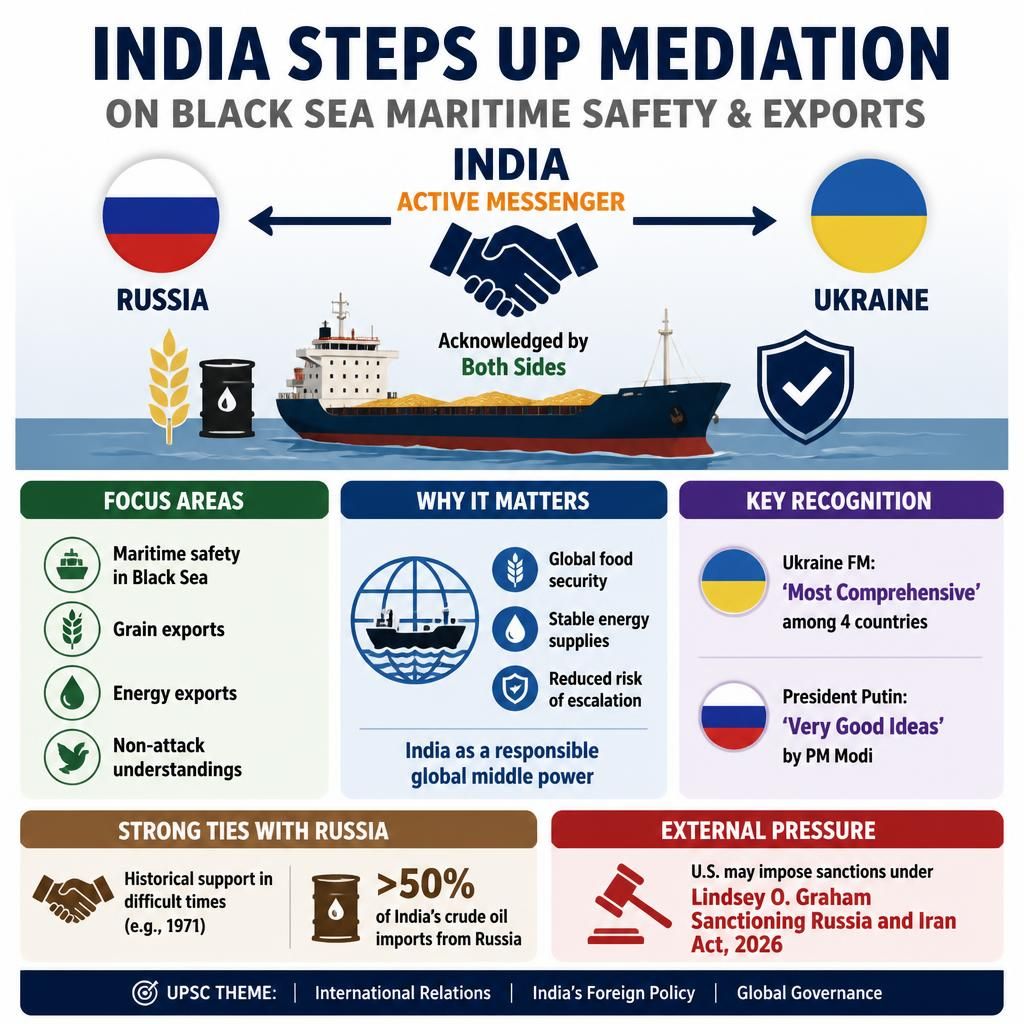
- External Affairs Minister S. Jaishankar announced that India is actively engaged in conveying messages between Russia and Ukraine regarding maritime safety in the Black Sea and grain/energy exports.
- This marks a shift from India's previous "advocacy" role to a more direct involvement in mediation efforts.
- Jaishankar made these remarks at the Munich Leaders Meeting in New Delhi on October 4, 2026.
- India's initiative has been acknowledged by both sides, with Ukraine's Foreign Minister calling India's proposal the "most comprehensive" among four countries, and Russian President Vladimir Putin recognizing Prime Minister Narendra Modi's "very good ideas."
- India continues to defend its strong ties with Russia, citing historical support during challenging times, such as the 1971 India-Pakistan war.
- India's continued purchase of Russian oil, accounting for over 50% of its imports, comes amidst potential U.S. sanctions under the recently enacted Lindsey O. Graham Sanctioning Russia and Iran Act of 2026.
India's Mediation.jpg
Detailed Insights:
- India's engagement focuses on immediate concerns such as the safety of shipping in the Black Sea, grain exports, energy exports, and possibilities for non-attack agreements.
- The Black Sea Grain Initiative, previously brokered by the UN and Turkey, allowed safe passage for Ukrainian grain exports from July 2022 to July 2023 before Russia withdrew.
- Jaishankar's comments were part of a session at the Munich Security Forum focusing on opportunities for emerging and middle power cooperation.
- The Lindsey O. Graham Sanctioning Russia and Iran Act of 2026, signed on September 18, 2026, allows the U.S. to impose tariffs of up to 100% on goods from major importers of Russian oil and gas, directly impacting countries like India.
- India's foreign policy stance emphasizes dialogue and diplomacy to resolve the conflict, with Prime Minister Modi having met Ukrainian President Volodymyr Zelenskyy in France and Russian President Vladimir Putin in Bishkek and Delhi.
- Jaishankar also critiqued the "changing global landscape," describing the U.S. as a "lonelier power" and China as a "unique country," advocating for coalitions among other nations.
- The Valdai Forum, where President Putin acknowledged Modi's ideas, is a Moscow-based think tank and discussion forum for global issues.
Key Concepts Involved:
- Strategic Autonomy: India's foreign policy approach of maintaining independent relations with various global powers based on national interest, rather than aligning with any single bloc.
- Multipolar World Order: A global power structure where multiple major powers exist, contrasting with unipolar (one dominant power) or bipolar (two dominant powers) systems.
- Middle Power Diplomacy: The role played by states that are not superpowers but possess significant influence and often act as mediators or bridge-builders in international relations.

SuperKalam is your personal mentor for UPSC preparation, guiding you at every step of the exam journey.
Download the App


STUDY RESOURCES
CONTACT US
ⓒ Snapstack Technologies Private Limited