GS 2: GovernanceGS 2: International RelationsPrelimsGS 2: Bilateral, Regional and Global Groupings and AgreementsGS 2: Effect of Policies and Politics of Developed and Developing Countries on India's Interests
In Tehran, A Search For The Future Of West Asian Security, Pg6
Amid escalating West Asian tensions, the 'Mecca Agreement' alliance visits Tehran, seeking a new regional security architecture and de-escalation of conflicts.
Practice MCQs
826 Students attempted
Key Highlights:
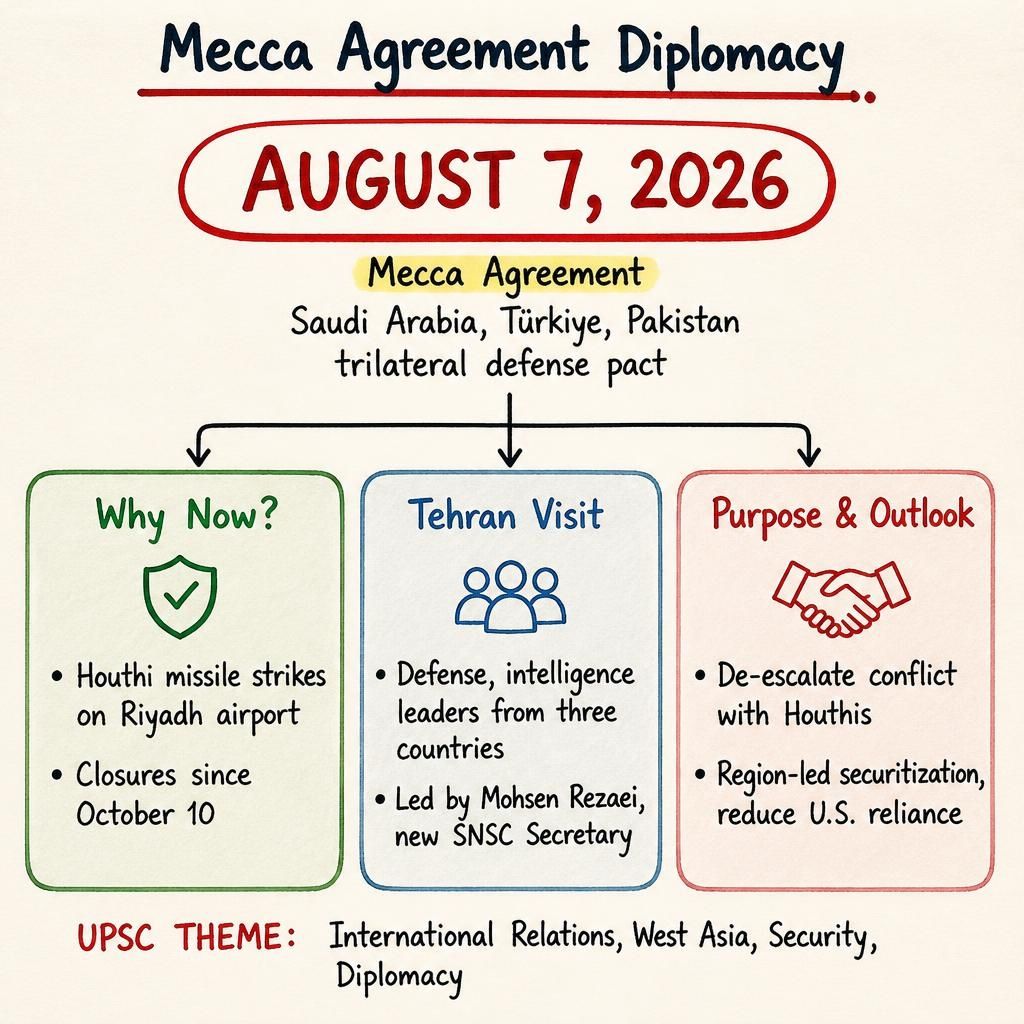
- A delegation comprising defense and intelligence leaders from Saudi Arabia, Türkiye, and Pakistan visited Tehran in October to discuss regional security, following the signing of the Mecca Agreement in August 2026.
- This diplomatic move occurred amidst heightened tensions in West Asia, eight months after the United States and Israel launched strikes on Iran in February 2026.
- The visit was primarily driven by Saudi Arabia's urgent need to de-escalate the conflict with the Houthis, who had launched missile strikes on Riyadh's King Khalid International Airport, causing closures since October 10.
- The Iranian delegation was led by Mohsen Rezaei, the new Secretary of the Supreme National Security Council (SNSC), highlighting the increasing influence of the Islamic Revolutionary Guard Corps (IRGC) in Iran's power structure.
- The Mecca Agreement is a trilateral defense pact that includes a mutual defense clause, considering an attack on one member as an attack on all.
Mecca Agreement.jpg
Detailed Insights:
- The Mecca Agreement, signed on August 7, 2026, by Saudi Arabia, Türkiye, and Pakistan, aims to prevent a security vacuum in the Gulf region.
- Iran's response to the US and Israeli strikes, which included the assassination of Supreme Leader Ayatollah Ali Khamenei on February 28, 2026, involved targeting American interests through asymmetric warfare.
- Saudi Arabia's air campaigns against the Houthis since 2015 have yielded limited results, leading to a search for alternative de-escalation strategies.
- Pakistan's Army chief, Asim Munir, part of the visiting delegation, has previously played a mediating role between Washington D.C. and Tehran.
- Mohsen Rezaei, a former commander-in-chief of the IRGC, assumed the role of SNSC Secretary in August 2026, consolidating the IRGC's influence in Iran's security and foreign policy.
- Iran views the Mecca Agreement and its engagement with regional powers as a step towards region-led securitization, aiming to reduce reliance on American auspices.
- Tehran seeks to leverage its influence over the Houthis to facilitate dialogue with Riyadh for de-escalation, with Pakistan and Türkiye playing supporting roles.
- The ongoing tensions suggest a potential recalibration of the long-standing security order in West Asia, where the US may have to share influence.
Key Concepts Involved:
- Mecca Agreement: A trilateral intergovernmental military alliance signed by Saudi Arabia, Türkiye, and Pakistan in August 2026, featuring a mutual defense clause.
- Supreme National Security Council (SNSC): Iran's top national security body responsible for formulating and overseeing strategic national security policies.
- Islamic Revolutionary Guard Corps (IRGC): A major military, political, and economic force in Iran, responsible for national security and directly reporting to the Supreme Leader.
- Asymmetric Warfare: A conflict between belligerents whose military power, strategies, or tactics differ significantly.

SuperKalam is your personal mentor for UPSC preparation, guiding you at every step of the exam journey.
Download the App


STUDY RESOURCES
CONTACT US
ⓒ Snapstack Technologies Private Limited