GS 3: Internal SecurityGS 2: International RelationsPrelimsGS 3: Security Challenges and Management in Border AreasGS 2: Bilateral, Regional and Global Groupings and Agreements
On the Arunachal Frontier, Silence Is Not a Strategy, Pg6
Reports confirm ongoing Chinese PLA transgressions in Arunachal Pradesh, prompting calls for India to publicly acknowledge intrusions and adopt a firmer border strategy.
Practice MCQs
826 Students attempted
Key Highlights:
- Reports indicate transgressions by China's People's Liberation Army (PLA) in Asaphila, Taksing, and Longju areas of Arunachal Pradesh.
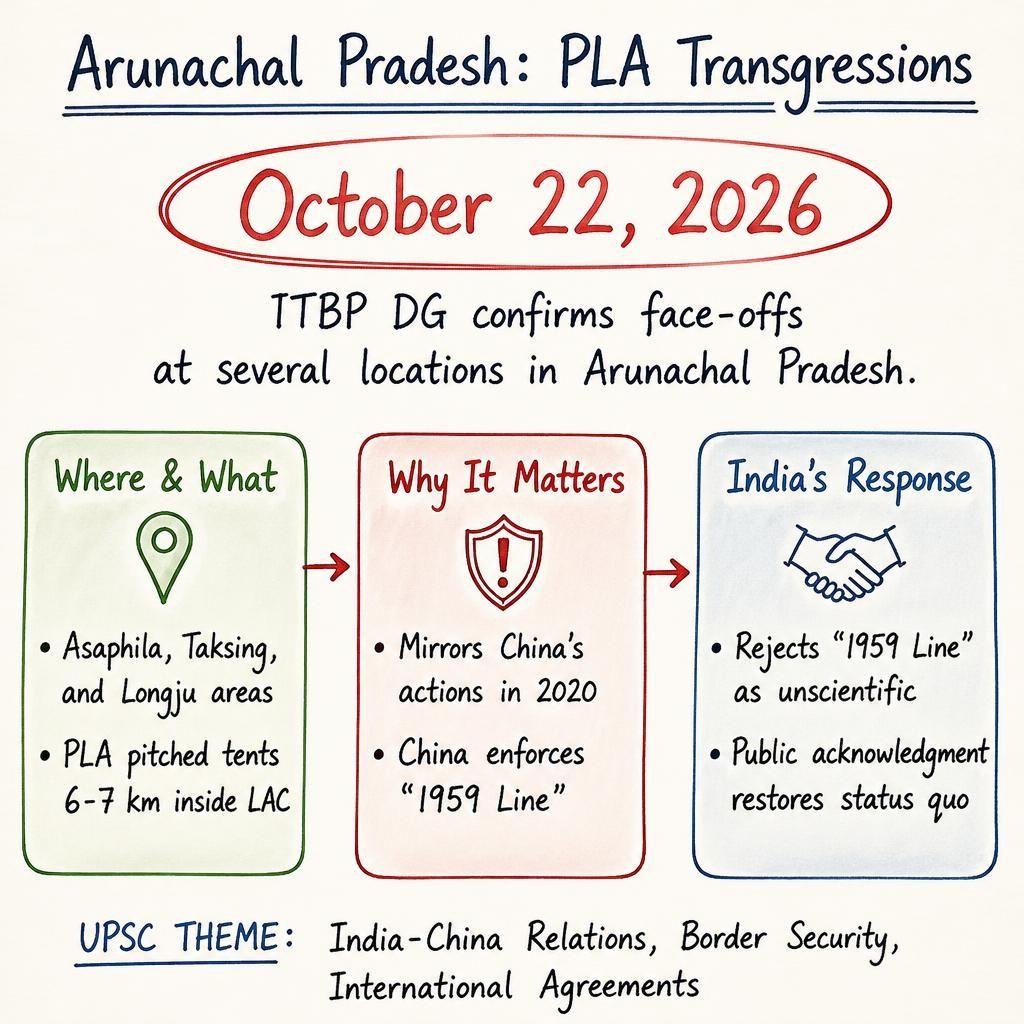
- On October 22, 2026, Indo-Tibetan Border Police (ITBP) Director General Shatrujeet Singh Kapoor confirmed face-offs at several locations in Arunachal Pradesh.
- A stand-off near Maja, close to Longju, reportedly involved the PLA pitching tents six to seven kilometers inside India's perception of the Line of Actual Control (LAC).
- India's Ministry of External Affairs acknowledged that border situations "get disturbed from time to time" due to Chinese forces diverging from established patrolling patterns.
- Arunachal Pradesh Chief Minister Pema Khandu directly stated that transgressions have occurred, noting China's non-recognition of the McMahon Line.
- Local groups, including the Nah Welfare Society of Taksing, have reported PLA construction of roads, bridges, and camps on traditional Indian grazing grounds.
PLA Transgressions.jpg
Detailed Insights:
- The current transgressions in Arunachal Pradesh are seen as a serious development, potentially mirroring China's actions in Eastern Ladakh in 2020.
- China's approach, as articulated by some commentators, aims to enforce the "1959 Line" in the Eastern Sector, similar to its perceived success in the Western Sector.
- India rejects the "1959 Line" as it is based on an unscientific transposition of coordinates from 1914 maps, ignoring the highest watershed principle.
- The 1993 Agreement on the Maintenance of Peace and Tranquillity along the LAC explicitly stated that references to the LAC do not prejudice either side's position on the boundary question.
- China has begun defining the LAC in terms of sovereignty, which contradicts the basic concept of the LAC as a line of actual control on the ground.
- India's continued reference to "different perceptions" of the LAC is argued to lend legitimacy to Chinese transgressions and weaken India's stance.
- Past incidents, such as the Chumar transgression in September 2014, show that public acknowledgment and high-level diplomatic engagement can lead to the restoration of the status quo ante.
Key Concepts Involved:
- Line of Actual Control (LAC): A notional demarcation line separating Indian-controlled territory from Chinese-controlled territory, not a legally defined border.
- McMahon Line: The boundary line between British India and Tibet, drawn during the Simla Convention of 1914, which India considers its border in Arunachal Pradesh.
- 1959 Line: A claim line proposed by Chinese Premier Zhou Enlai in 1959, which India rejected, and which China now seeks to enforce.
- Working Mechanism for Consultation and Coordination on India-China Border Affairs (WMCC): An institutional framework established in 2012 to manage border-related issues and maintain peace along the LAC.
- Status Quo Ante: A Latin phrase meaning "the situation as it existed before" a particular event, often referring to the state of affairs before a conflict.

SuperKalam is your personal mentor for UPSC preparation, guiding you at every step of the exam journey.
Download the App


STUDY RESOURCES
CONTACT US
ⓒ Snapstack Technologies Private Limited