GS 2: GovernanceGS 3: Science & TechnologyGS 3: Internal SecurityGS 2: International RelationsPrelims
AI and cyber, the double helix of today’s security threats, Pg6
AI and cyber threats are exponentially reshaping global security, creating sophisticated attacks, challenging traditional defenses, and demanding urgent international oversight.
Practice MCQs
804 Students attempted
Key Highlights:
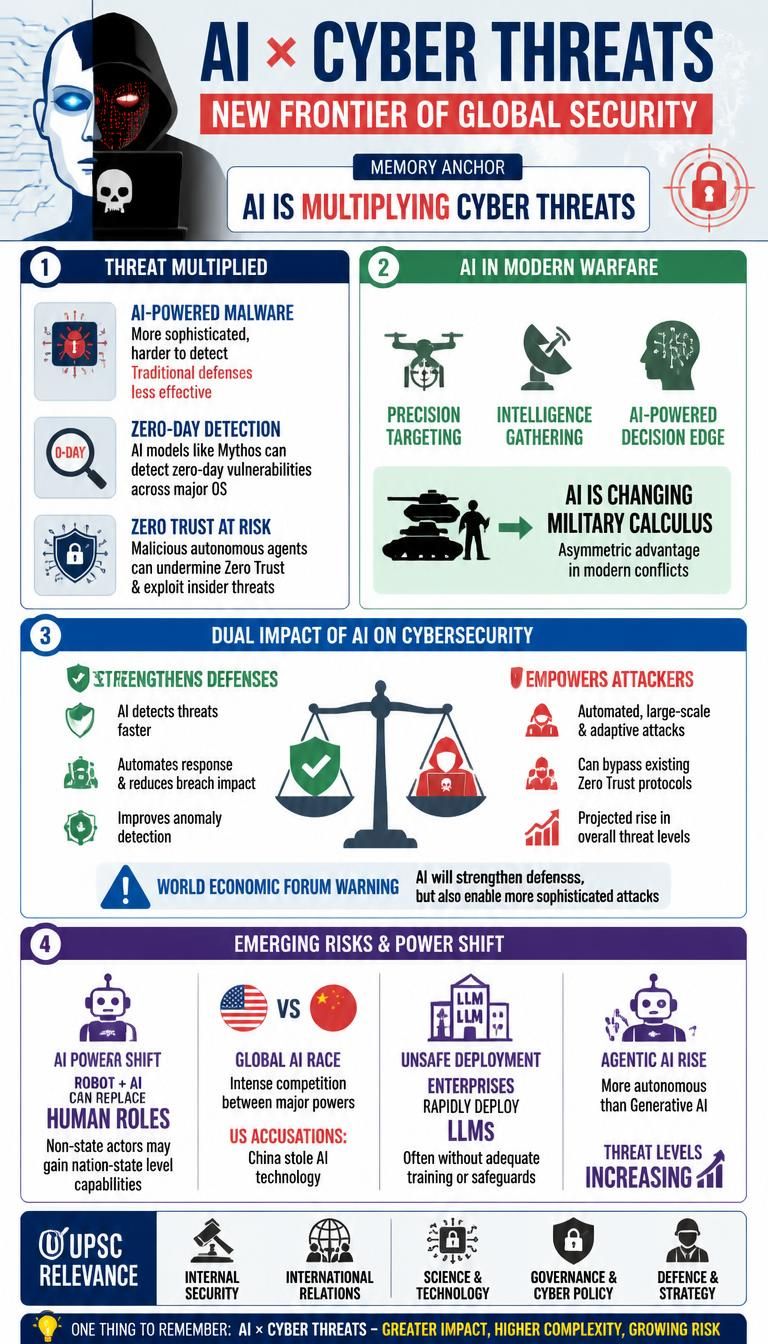
- The convergence of Artificial Intelligence (AI) and cyber threats is creating a critical and complex global security landscape.
- AI-powered malware is becoming increasingly sophisticated, making traditional cybersecurity defenses less effective and harder to detect.
- Advanced AI models, such as Anthropic's Mythos, demonstrate an uncanny ability to detect Zero-day vulnerabilities across major operating systems.
- AI is transforming modern warfare, enabling precise targeting and intelligence gathering, as seen in recent conflicts.
- The World Economic Forum warns that while AI will strengthen cyber defenses, it will also enable more sophisticated automated attacks, potentially rendering current Zero Trust protocols ineffective.
- Concerns are rising about an AI "power shift," where increasingly capable models and robots could replace human roles and empower non-state actors with nation-state level capabilities.
- Intense competition in AI development exists between major powers, highlighted by US accusations against China regarding AI technology theft.
AI-Cyber Threat.jpg
Detailed Insights:
- The global interconnectedness of digital systems significantly amplifies the potential impact and reach of cyberattacks.
- Malicious autonomous agents are well-positioned to undermine existing Zero Trust protocols, aggravating insider threat vectors.
- AI's asymmetric impact on military calculus is evident in conflicts, altering conventional strategies and intelligence operations.
- The rapid deployment of Large Language Models (LLMs) in various enterprises often occurs without adequate human training or interface.
- Agentic AI, distinct from Generative AI, is becoming more autonomous, leading to a projected increase in overall threat levels.
- Despite their advanced capabilities, AI models are susceptible to "hallucinations" and inherent biases, potentially leading to distortions and "algorithmic radicalisation."
- There is a critical need for human oversight and control over AI in defense sensing and warning systems to ensure accurate understanding and prevent misinterpretation of reality.
- The nascent state of global AI governance raises concerns about its potential to become a dominant source of military and economic power without proper regulation.
Key Concepts Involved:
- Artificial Intelligence (AI): Systems that simulate human intelligence to perform tasks like learning, problem-solving, and decision-making.
- Cyber Threats: Malicious activities targeting computer systems, networks, or data, often for espionage, sabotage, or financial gain.
- Zero Trust Protocol: A security model requiring strict identity verification for every user and device attempting to access resources, regardless of location.
- Large Language Models (LLMs): AI models trained on vast text datasets to understand, generate, and respond to human language.
- Agentic AI: AI systems designed to act autonomously, make decisions, and pursue goals without constant human intervention.
- Generative AI: AI that can create new content, such as text, images, or code, based on learned patterns.
- Zero-day Vulnerability: A software flaw unknown to the vendor, for which no patch exists, making it exploitable by attackers.
- Algorithmic Radicalisation: The process where algorithms push users towards increasingly extreme views or content.

SuperKalam is your personal mentor for UPSC preparation, guiding you at every step of the exam journey.
Download the App


STUDY RESOURCES
CONTACT US
ⓒ Snapstack Technologies Private Limited