GS 2: GovernanceGS 2: International RelationsGS 3: EconomyPrelimsGS 3: Changes in Industrial Policy and Effects on Industrial Growth
The Problem With India’s Free Trade Agreement Strategy, Pg7
India's FTA strategy underperforms, widening trade deficits and weakening export competitiveness with Asian partners, necessitating stronger domestic industrial capabilities and policy.
Practice MCQs
804 Students attempted
Key Highlights:
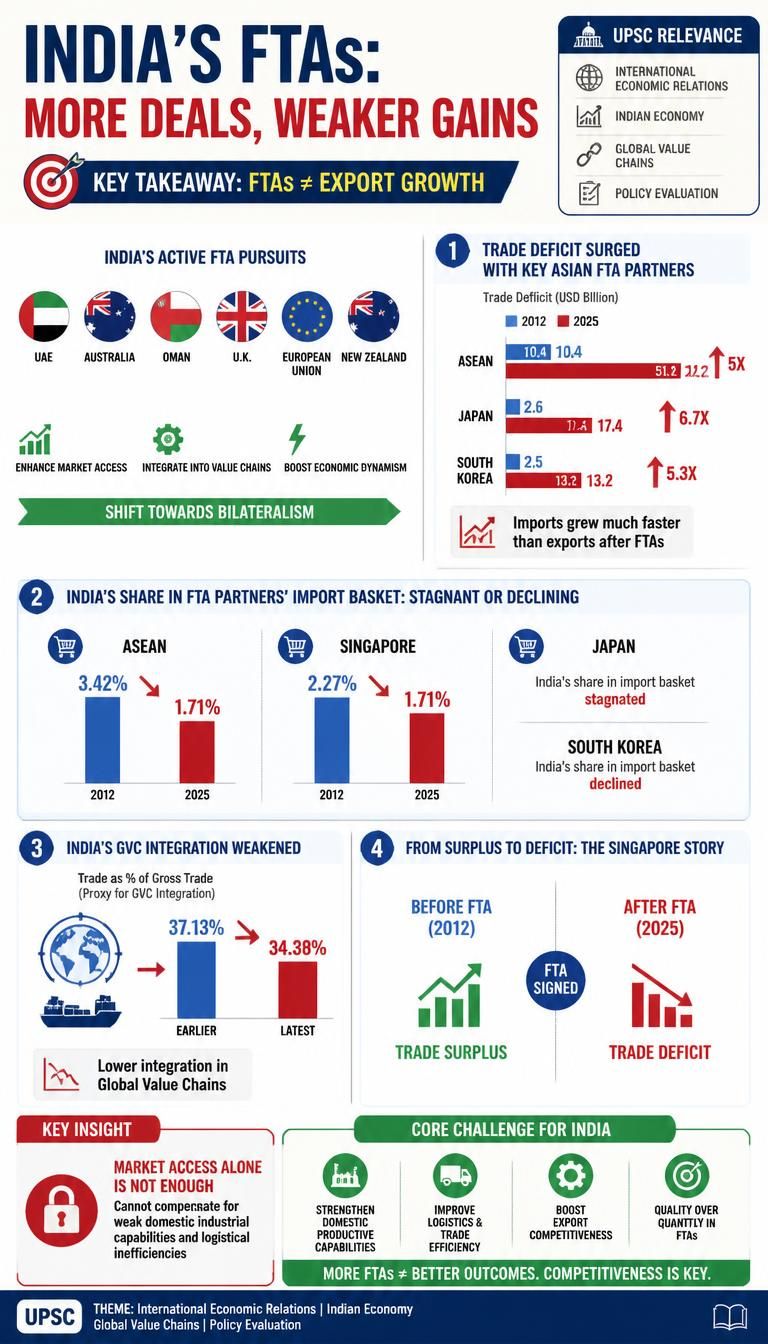
- India has actively pursued Free Trade Agreements (FTAs) with several nations, including the UAE, Australia, Oman, the U.K., the European Union, and New Zealand.
- This strategy aims to enhance market access, integrate into value chains, and boost economic dynamism, marking a shift towards bilateralism.
- India's trade deficit with key Asian FTA partners like ASEAN, South Korea, and Japan has widened significantly post-agreements.
- India's share of the import basket among its FTA partners has stagnated or declined, indicating weakening export competitiveness.
- India's integration into Global Value Chains (GVCs), measured as trade percentage of gross trade, has weakened from 37.13% to 34.38%.
FTAs.jpg
Detailed Insights:
- The article highlights that the assumption that FTAs automatically stimulate export growth and GVC integration requires a more nuanced perspective.
- India's trade deficit with ASEAN surged from $10.4 billion in 2012 to $51.2 billion in 2025, primarily due to rising imports.
- For Japan and South Korea, imports grew at a much faster rate than exports after signing FTAs.
- India's trade surplus with Singapore transformed into a deficit following their trade agreement.
- India's share in ASEAN's import basket decreased from 3.42% to 1.71%, and in Singapore's from 2.27% to 1.71%.
- The inability to leverage tariff preferences under FTAs suggests that market access alone cannot compensate for weak domestic industrial capabilities and logistical inefficiencies.
- The core challenge for India is to strengthen domestic productive capabilities and address associated impediments, rather than solely focusing on more FTAs.
- Without adequate industrial transformation, FTAs risk increasing import penetration faster than export competitiveness, leading to asymmetrical trade outcomes.
- India's FTA strategy needs to be integrated with a broader industrial policy focusing on technological upgrading, strategic investment, and domestic value addition.
Key Concepts Involved:
- Free Trade Agreement (FTA): A pact between two or more countries to reduce or eliminate certain barriers to trade, such as tariffs and quotas.
- Trade Deficit: An economic measure where a country's imports exceed its exports, resulting in a negative balance of trade.
- Global Value Chain (GVC): The full range of activities that firms and workers perform to bring a product from its conception to its end use.
- Bilateralism: The conduct of political, economic, or cultural relations between two sovereign states.

SuperKalam is your personal mentor for UPSC preparation, guiding you at every step of the exam journey.
Download the App


STUDY RESOURCES
CONTACT US
ⓒ Snapstack Technologies Private Limited