GS 3: Science & TechnologyGS 2: International RelationsGS 3: Environment & EcologyGS 3: EconomyPrelims
Critical minerals, the foundation of strategic power, Pg6
India prioritizes critical minerals for strategic autonomy, addressing supply chain vulnerabilities through domestic exploration and global partnerships for clean energy.
Practice MCQs
804 Students attempted
Key Highlights:
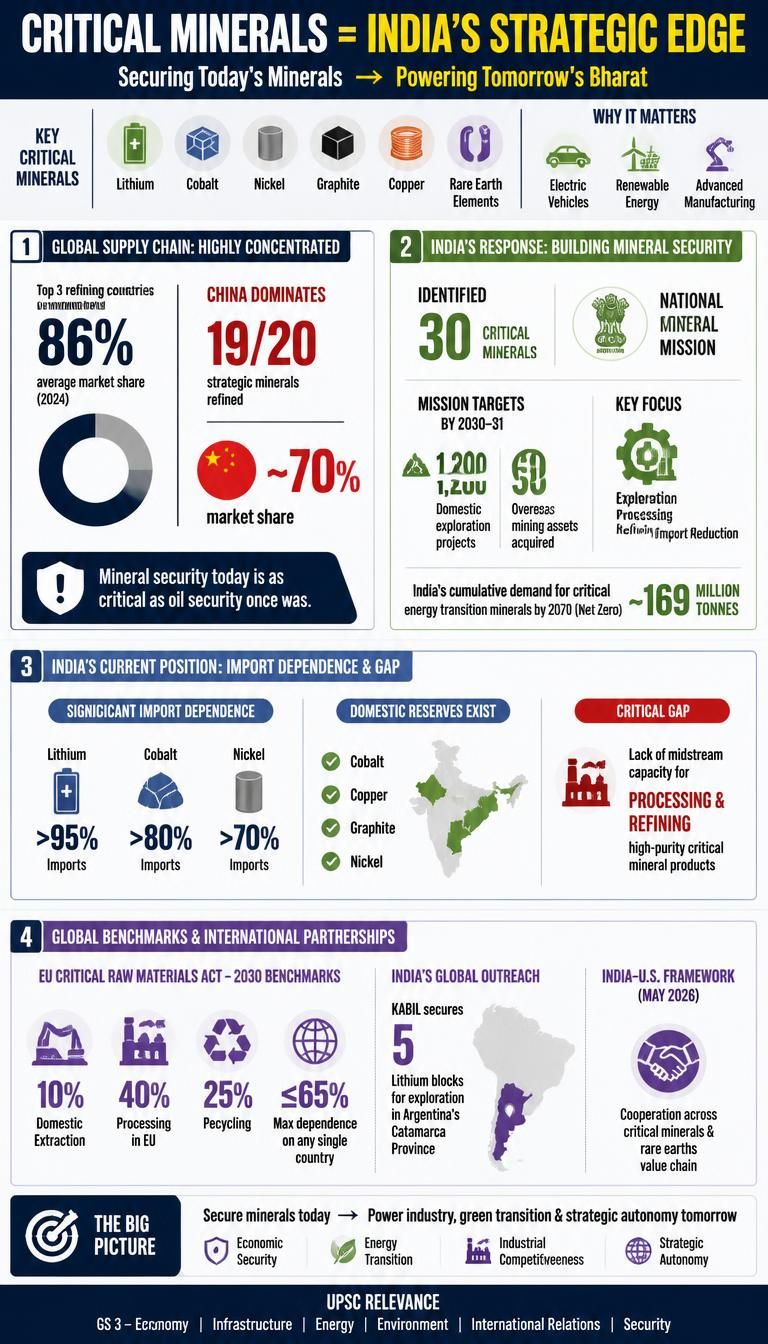
- Critical minerals like lithium, cobalt, nickel, graphite, copper, and rare earth elements are now central to industrial strategy and security, vital for electric vehicles, renewable energy, and advanced manufacturing.
- The global supply chain for these minerals is highly concentrated, with the top three refining countries holding an average market share of 86% in 2024.
- China dominates the refining of 19 out of 20 strategic minerals, possessing approximately 70% of the market share.
- India has identified 30 critical minerals and launched the National Critical Mineral Mission to enhance domestic exploration, processing, and reduce import dependence.
- Khanij Bidesh India Limited (KABIL) has secured five lithium blocks for exploration in Argentina's Catamarca province.
- The India-U.S. critical minerals and rare earths framework was signed in May 2026 to deepen cooperation across the supply chain.
Critical Minerals.jpg
Detailed Insights:
- Decarbonization and digitalization are making mineral security as strategically important as oil security once was.
- The European Union Critical Raw Materials Act sets 2030 benchmarks for domestic extraction (10%), processing (40%), and recycling (25%), limiting single-country dependence to 65%.
- India's cumulative demand for critical energy transition minerals could reach approximately 169 million tonnes by 2070 under a net-zero scenario.
- Despite having domestic reserves of cobalt, copper, graphite, and nickel, India remains significantly import-dependent for lithium, cobalt, and nickel.
- The critical gap for India lies in developing midstream capacity for processing and refining high-purity critical mineral products.
- The National Critical Mineral Mission aims to complete 1,200 domestic exploration projects and acquire 50 overseas mining assets by Indian companies by 2030-31.
- The 2026-27 Budget proposed establishing dedicated rare earth corridors in Odisha, Kerala, Andhra Pradesh, and Tamil Nadu to integrate mining, processing, and manufacturing.
- India needs to operationalize strategic stockpiles, accelerate applied research and development, and diversify overseas supply through trusted partners.
Key Concepts Involved:
- Critical Minerals: Minerals essential for modern technologies and economies, facing supply risks due to geological scarcity, geopolitical issues, or processing concentration.
- Decarbonization: The process of reducing or eliminating carbon dioxide emissions, especially from energy production, to mitigate climate change.
- Net Zero Scenario: A state where greenhouse gas emissions are balanced by their removal from the atmosphere, achieving no net increase in emissions.
- Supply Chain Realignment: The strategic restructuring of global supply networks to reduce dependencies and enhance resilience, often due to geopolitical or economic factors.

SuperKalam is your personal mentor for UPSC preparation, guiding you at every step of the exam journey.
Download the App


STUDY RESOURCES
CONTACT US
ⓒ Snapstack Technologies Private Limited