GS 2: GovernanceGS 3: Environment & EcologyPrelimsGS 3: Conservation, Pollution and DegradationGS 2: Government policies and interventions for development in various sectors
For the first time, captive-bred Great Indian Bustard will set foot in the wild, Pg1
India launches critical rewilding efforts for critically endangered Great Indian Bustard in Jaisalmer and reintroduces tigers to Buxa Reserve.
Practice MCQs
811 Students attempted
Key Highlights:
- The first pilot wild release of captive-bred Great Indian Bustard (GIB) chicks is set to occur in Desert National Park, Jaisalmer.
- This marks the official commencement of the 'rewilding phase' of Project GIB, which has been under implementation since 2013.
- Two male GIB chicks, aged four to six months, will be radio-tagged to monitor their movement and behavior.
- The GIB is a critically endangered species with a wild population of approximately 140 individuals, predominantly in Rajasthan.
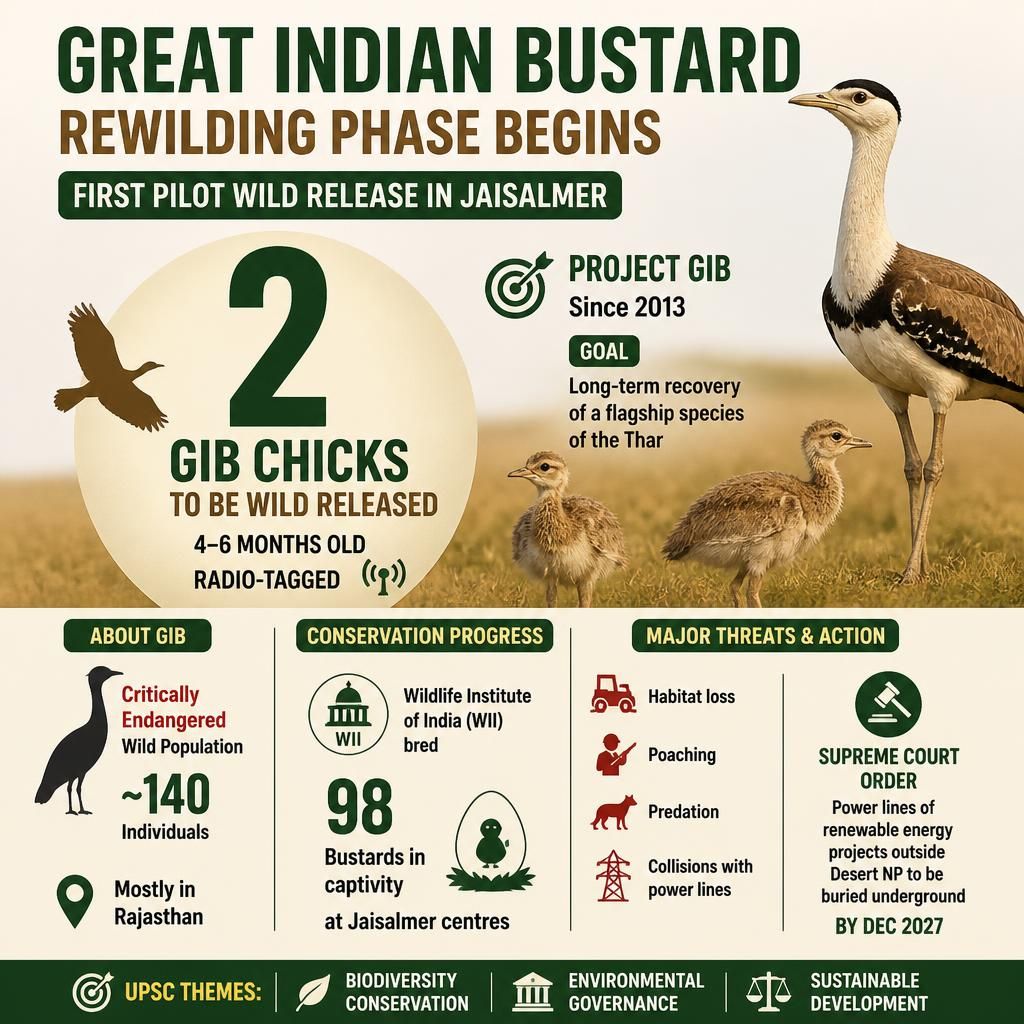
Great Indian Bustard.jpg
Detailed Insights:
- The release of GIB chicks is a critical step for the long-term recovery of this flagship species of the Thar landscape.
- The Wildlife Institute of India (WII) has successfully bred 98 bustards in captivity at its conservation breeding centres in Jaisalmer.
- Major threats to GIB include habitat loss, poaching, predation, and collisions with power lines from renewable energy projects.
- The Supreme Court has mandated that renewable energy project power lines situated outside Desert National Park be buried underground by December 2027.
Key Concepts Involved:
- Great Indian Bustard (GIB): A critically endangered large bird, recognized as a keystone species of arid and semi-arid grasslands.
- Project GIB: A dedicated conservation initiative launched in 2013 for the long-term recovery and protection of the GIB.
- Conservation Breeding: A technique involving rearing endangered species in controlled environments to increase their numbers for eventual reintroduction into the wild.
- Rewilding: The process of reintroducing animal species, often those bred in captivity, back into their natural habitats to restore ecological processes.
- Desert National Park: A large protected area in Rajasthan, India, crucial for the conservation of desert fauna, including the GIB.
- Buxa Tiger Reserve: A protected area in West Bengal, India, part of Project Tiger, now undergoing a significant tiger reintroduction program.
- National Tiger Conservation Authority (NTCA): A statutory body under the Ministry of Environment, Forest and Climate Change, responsible for strengthening tiger conservation in India.
- Wildlife Institute of India (WII): An autonomous institution under the Ministry of Environment, Forest and Climate Change, engaged in wildlife research, management, and training.
- Critically Endangered: The highest risk category assigned by the IUCN Red List for species facing an extremely high risk of extinction in the wild.
- Keystone Species: A species that has a disproportionately large effect on its natural environment relative to its abundance, often crucial for maintaining ecosystem structure.

SuperKalam is your personal mentor for UPSC preparation, guiding you at every step of the exam journey.
Download the App


STUDY RESOURCES
CONTACT US
ⓒ Snapstack Technologies Private Limited