GS 2: GovernanceGS 2: International RelationsGS 3: EconomyPrelimsGS 3: Changes in Industrial Policy and Effects on Industrial Growth
Trade deal with India not imminent, sticking points identified: USTR, Pg1
India-US trade deal faces delays due to unresolved 'sticking points' and US demands, including potential tariffs and economic security alignment concerns.
Practice MCQs
811 Students attempted
Key Highlights:
- The United States Trade Representative (USTR), Jamieson Greer, stated that a trade deal with India is not "imminent" due to identified "sticking points" despite talks being in their final phase.
- This announcement came after Greer met with India's Commerce and Industry Minister, Piyush Goyal, during the G20 Trade Ministers’ Meeting.
- The US is expected to release findings from its second Section 301 trade investigation concerning "overcapacity," which could lead to new tariffs on Indian goods.
- The recently enacted Lindsey O. Graham Sanctioning Russia and Iran Act of 2026 allows for tariffs of up to 100% on key buyers of Russian energy, including India.
- India has committed to purchasing US products worth $500 billion over five years, including energy and technology, under a framework agreement.
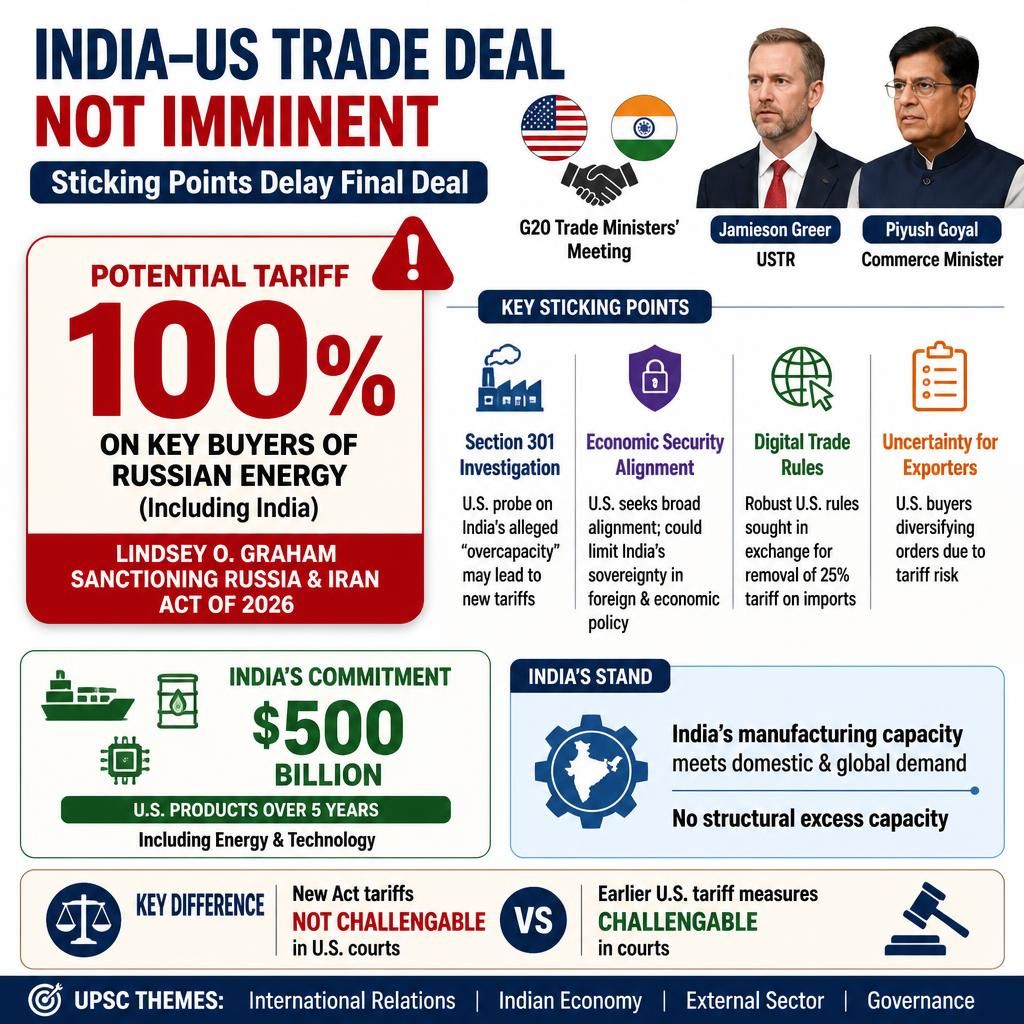
India-US Trade Deal.jpg
Detailed Insights:
- The USTR's statement contradicted earlier optimism from Indian officials who believed a deal was close to being finalized.
- The Lindsey O. Graham Sanctioning Russia and Iran Act of 2026 introduces tariffs that cannot be challenged in court, unlike previous US tariff mechanisms.
- India had previously agreed to negotiate robust bilateral digital trade rules in exchange for the removal of a 25% tariff on imports.
- The ongoing Section 301 investigation into India's alleged excess industrial capacity is causing uncertainty for Indian exporters, leading to diversified orders from US buyers.
- India's Commerce Minister, Piyush Goyal, asserted that India's manufacturing capacity meets both domestic and global demands and does not suffer from structural excess capacity.
- Concerns have been raised that provisions on economic security alignment, if similar to those in other US trade agreements, could significantly limit India's sovereignty in foreign policy and economic matters.
- A US State Department report highlighted that India's Foreign Exchange Management Act (FEMA) restricts concurrent foreign direct and portfolio investment, creating burdensome regulations.
- The report also noted a higher effective tax rate for foreign banks in India (35.22%), which could impact their attractiveness to the market.
Key Concepts Involved:
- United States Trade Representative (USTR): A US government agency responsible for developing and promoting US foreign trade policies, headed by a Cabinet-level official.
- Section 301 of the Trade Act of 1974: A US trade law authorizing the USTR to investigate and take action against foreign trade practices deemed unfair or discriminatory to US commerce.
- Lindsey O. Graham Sanctioning Russia and Iran Act of 2026: A US law imposing tariffs and sanctions on Russia and countries that purchase significant amounts of Russian energy.
- Foreign Exchange Management Act (FEMA): An Indian law enacted in 1999 to regulate foreign exchange transactions, cross-border trade, payments, and foreign investments.
- Foreign Direct Investment (FDI): An investment made by a company or individual in one country into business interests in another country, establishing lasting interest and managerial influence.
- Foreign Portfolio Investment (FPI): Investment in financial assets like stocks and bonds in a foreign country, typically without gaining managerial control and often with a shorter-term focus.

SuperKalam is your personal mentor for UPSC preparation, guiding you at every step of the exam journey.
Download the App


STUDY RESOURCES
CONTACT US
ⓒ Snapstack Technologies Private Limited