UPSC CSAT Logical Reasoning: Syllogism PYQs & Concepts
Feb, 2026
•8 min read
The Syllogism topic is one of the most important areas in the UPSC CSAT syllabus. Every year, questions based on syllogism UPSC concepts appear in the Prelims, testing aspirants’ analytical ability and accuracy under time pressure.
Here, we simplify the core concepts, decode common traps, and solve previous year questions to help you master logical reasoning for UPSC CSAT and improve your qualifying score with confidence.
What is a Syllogism?
A syllogism is a form of logical reasoning where a conclusion is drawn from two or more given statements (premises). It tests your ability to:
- Understand relationships between groups
- Analyse statements logically
- Identify whether conclusions follow
In UPSC CSAT, syllogism questions usually provide:
- 2–3 statements
- 2–4 conclusions
You must decide which conclusions logically follow
Also see: UPSC CSAT Comprehension PYQs: Prelims 2026 Practice
Basic Structure of a Syllogism
A standard syllogism in UPSC CSAT is built on a simple logical framework. If you understand this structure clearly, half the battle is already won.
1. Premises (Given Statements)
Premises are the starting facts provided in the question. They define relationships between groups (sets). You must:
- Treat them as completely true
- Not question their realism
- Not modify their meaning
Example:
- All dogs are animals.
- All animals are mammals.
Here:
- “Dogs” is one group
- “Animals” is a broader group
- “Mammals” is an even broader group
The premises create a chain of inclusion.
2. Logical Link Between Premises
This is where real reasoning begins.
- From the first statement:
Dogs ⊂ Animals - From the second statement:
Animals ⊂ Mammals - When you combine them:
Dogs ⊂ Mammals
This logical connection allows us to test conclusions.
3. Conclusion (What You Must Evaluate)
A conclusion is a claim derived from the premises. Your task is to check whether it necessarily follows from the given statements.
Example conclusion:
- All dogs are mammals.
Since the logical chain guarantees this relationship, the conclusion is valid.
Important: A conclusion must follow in every possible case, not just in one diagram you imagine.
Here is the Venn diagram representation of the syllogism:
- All Dogs are Animals
- All Animals are Mammals
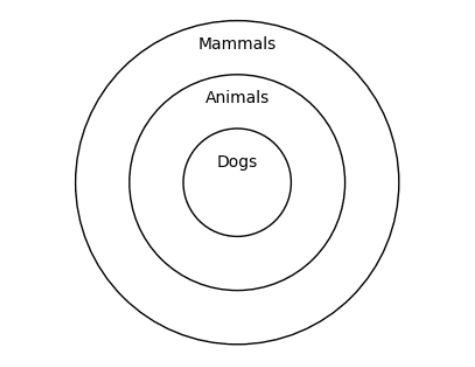
As you can see:
- The smallest circle (Dogs) lies completely inside Animals.
- The Animals circle lies completely inside Mammals.
- Therefore, Dogs are fully contained within Mammals — proving the conclusion logically.
This nested structure visually explains why “All dogs are mammals” necessarily follows in every possible case.
3 Golden Rules of Syllogism in CSAT
These rules protect you from common traps in logical reasoning for UPSC CSAT.
Rule 1: Ignore Real-World Knowledge
Syllogism operates in a logical world, not the real world. If the question says:
- “All birds are green.”
You must accept it, even if it contradicts reality. Bringing outside knowledge leads to wrong answers.
Rule 2: Treat Every Statement as Absolutely True
Do not doubt, reinterpret, or weaken the premises. If it says:
- “Some engineers are artists.”
You cannot assume:
- Only a few
- Most
- Exactly two
“Some” simply means at least one. Accept the statement exactly as written.
Rule 3: Judge Conclusions Only from Given Information
Your decision must be based strictly on:
- The relationships provided
- Logical necessity
- Not a possibility unless specifically asked
If the connection is not clearly established in the premises, the conclusion does not follow.
Understanding “Some” in SyllogismIn Syllogism :
This is a common trap in CSAT PYQs. Example: Some apples are fruits. This does NOT mean:
Unless explicitly stated, you cannot assume the negative. |
Also read: Top CSAT Books for UPSC Prelims Exam
Types of Statements in Syllogism
In UPSC CSAT logical reasoning, syllogism questions are built using four standard types of categorical statements. Understanding their form, meaning, and valid inferences is crucial to solving syllogism questions accurately.
Let’s understand each type properly.
1. Universal Affirmative (A-Type Statement)
A statement that asserts that every member of one group belongs to another group.
All A are B
- Meaning: The entire set A is fully contained within set B.
- Symbolically: A ⊂ B
- Valid Inference: Some B are A (conversion is valid in a limited form)
- Example: All cats are animals.
- Meaning: Every cat is an animal. There is no cat outside the animal group.
Important: You cannot conclude that all B are A. (Animals are not necessarily all cats.)
2. Universal Negative (E-Type Statement)
A statement that completely separates two groups.
No A are B
- Meaning: There is zero overlap between A and B.
- Symbolically: A ∩ B = Ø
- Valid Inferences:
✔ Some A are not B
✔ Some B are not A
- Example: No doctors are engineers.
- Meaning: Not a single doctor is an engineer.
Why? If the groups do not overlap at all, at least one element of A must be outside B, and vice versa.
3. Particular Affirmative (I-Type Statement)
A statement that indicates partial overlap between two groups.
Some A are B
- Meaning: At least one member of A belongs to B.
- Symbolically: A ∩ B ≠ Ø
- Example: Some students are athletes.
- Meaning: There is at least one student who is an athlete. There may be many. Possibly even all.
In syllogism, “Some” means at least one, possibly all. It does NOT mean:
- Few
- Only some
- Majority
Invalid Conclusions
❌ All students are athletes
❌ Some students are not athletes
Why? Because the statement does not give information about the entire group.
4. Particular Negative (O-Type Statement)
A statement that indicates that at least one member of a group is excluded from another group.
Some A are not B
- Meaning: There exists at least one A that lies outside B.
- Symbolically: At least one part of A is outside B.
- Example: Some cars are not electric.
- Meaning: At least one car is non-electric. But other cars may still be electric.
From this statement, you cannot conclude:
❌ No A are B
❌ All A are not B
❌ Some B are not A (not definite)
It only gives limited negative information.
Quick Concept Table for Revision
| Type | Form | Nature | Strength |
|---|---|---|---|
| Universal Affirmative | All A are B | Full inclusion | Strong |
| Universal Negative | No A are B | Complete separation | Very Strong |
| Particular Affirmative | Some A are B | Partial overlap | Moderate |
| Particular Negative | Some A are not B | Partial exclusion | Weak |
Venn Diagram Method for Syllogism UPSC
When it comes to Syllogism UPSC questions, the Venn Diagram approach is the safest and most accurate method. Instead of guessing relationships mentally, you see the logic visually. Let's learn making venn diagram with the help of an example.
Q1. Statements:
- All Pens are Blue.
- Some Blue are Plastic.
Conclusions:
- Some Pens are Plastic.
- Some Plastic are Blue.
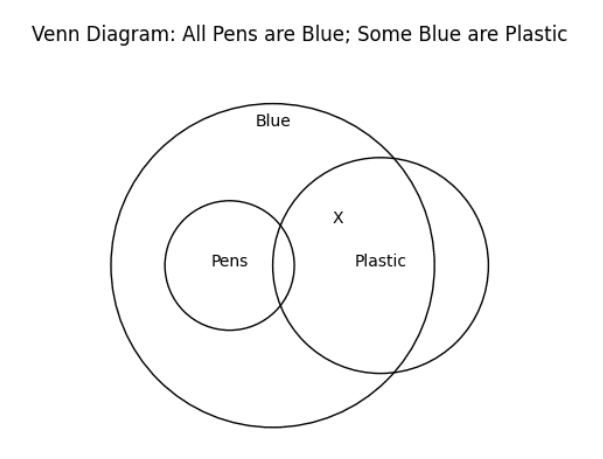
Step 1: Draw the Venn Diagram
From Statement 1: All Pens are Blue → The "Pens" circle lies completely inside the "Blue" circle.
From Statement 2: Some Blue are Plastic → There is partial overlap between "Blue" and "Plastic". We mark at least one element (X) in the overlapping region.
Step 2: Test Each Conclusion
Conclusion 1: Some Pens are Plastic
- Does it necessarily follow?
- Not definite ❌
Why? The overlapping part between Blue and Plastic may or may not include the Pens region. The diagram does not guarantee that Pens lie in that overlapping portion.
So, this conclusion does NOT follow.
Conclusion 2: Some Plastic are Blue
- Does it follow?
- Yes ✅
Why? Statement 2 directly tells us that some Blue are Plastic. This automatically means some Plastic are Blue (valid conversion of "Some").
So, this conclusion follows.
Key Insights
In syllogism:
- Universal statements control placement (All, No)
- Particular statements create overlap (Some)
- The diagram must remain flexible
- Never draw an unnecessarily fixed diagram.
- Always allow room for logical possibilities unless restricted by the statement.
Must see: All Important UPSC CSAT Formulas for Prelims 2026 – Quick Revision for Prelims
Common Logical Rules in Syllogism
These rules frequently help in logical reasoning for UPSC CSAT:
Rule 1: All + All → All (sometimes)
Example:
All A are B
All B are C
→ All A are C ✅
Rule 2: All + Some → Some
All A are B
Some B are C
→ Some A are C (may or may not follow — check carefully)
Depends on placement in diagram.
Rule 3: No + All
No A are B
All B are C
→ No A are C (follows)
Rule 4: Two Particular Statements → No Conclusion
Some A are B
Some B are C
→ No definite conclusion
UPSC often tests this confusion.
Possibility-Based ConclusionsUPSC sometimes asks:
Possibility conclusions usually follow if:
Example: All A are B
|
Also see: Coding Decoding Questions and Answers: A Guide for UPSC CSAT
Step-by-Step Method to Solve Syllogism Questions
Follow this clear, exam-focused framework to solve Syllogism UPSC questions accurately, even under time pressure.
Step 1: Read the Statements Slowly and Precisely
- Identify the type of each statement (All/No/Some/Some not).
- Note the relationship between sets.
- Avoid interpreting beyond what is written.
Step 2: Draw a Minimal and Flexible Venn Diagram
Keep the diagram simple.
- For “All” → place one circle completely inside another.
- For “No” → keep circles separate.
- For “Some” → show overlap with an X mark.
Do not over-restrict the diagram unless forced by the statement.
Step 3: Evaluate Each Conclusion Independently
Never combine conclusions. For each conclusion:
- Ask: Does it follow in every possible case?
- If it works in only one situation but fails in another → Reject it.
In CSAT PYQs, options often include traps where one conclusion seems logical but is not guaranteed.
Step 4: Eliminate Extreme Conclusions First (All/No)
Universal conclusions (All/No) are strong claims. Ask yourself:
- Is there 100% certainty?
- Does the diagram force this relationship?
If there is even a little possibility of exception, the universal conclusion is invalid. This technique quickly removes 1–2 options in most questions.
Step 5: Look for Direct or Definite Relationships
Check for:
- Direct statement-based conclusions
- Valid conversions (e.g., Some A are B → Some B are A)
- Clear inclusion chains (All A are B, All B are C → All A are C)
Direct relationships are usually safer than indirect assumptions.
UPSC CSAT PYQs on Syllogism
QUESTION 1
CSAT
Medium
Reasoning
Prelims 2020
Two Statements are given followed by two Conclusions:
Statements: All cats are dogs. All cats are black.
Conclusion-I: All dogs are black. Conclusion-II: Some dogs are not black.
Which of the above Conclusions logically follows/follow from the two given Statements, disregarding commonly known facts?
Select an option to attempt
QUESTION 2
CSAT
Easy
Reasoning
Prelims 2019
Consider the following Statements and Conclusions:
Statements-1: Some rats are cats. Statements-2: Some cats are dogs. Statements-3: No dog is a cow.
Conclusions-I: No cow is a cat. Conclusions-II: No dog is a rat. Conclusions-III: Some cats are rats.
Which of the above conclusions is/are drawn from the statements?
Select an option to attempt
QUESTION 3
CSAT
Easy
Reasoning
Prelims 2021
A Statement followed by Conclusion-I and Conclusion-II is given below. You have to take the Statement to be true even if it seems to be at variance from the commonly known facts. Read all Conclusions and then decide which of the given Conclusion(s) logically follows/follow from the Statement, disregarding the commonly known facts.
Statement: Some radios are mobiles. All mobiles are computers. Some computers are watches.
Conclusion-I: Certainly some radios are watches. Conclusion-II: Certainly some mobiles are watches.
Which one of the following is correct?
Select an option to attempt
QUESTION 4
CSAT
Easy
Reasoning
Prelims 2021
Consider two Statements and four Conclusions given below. You have to take the Statements to be true even if they seem to be at variance from the commonly known facts. Read all Conclusions and then decide which of the given Conclusion(s) logically follows/follow from the Statements, disregarding the commonly known facts.
Statement-1: Some greens are blues. Statement-2: Some blues are blacks.
Conclusion-1: Some greens are blacks. Conclusion-2: No green is black. Conclusion-3: All greens are blacks. Conclusion-4: All blacks are greens.
Which one of the following is correct?
Select an option to attempt
QUESTION 5
CSAT
Hard
Reasoning
Prelims 2022
Two statements followed by four conclusions are given below. You have to take the statements to be true even if they seem to be at variance from the commonly known facts. Read all the conclusions and then decide which of the given conclusions logically follow from the statements, disregarding the commonly known facts : Statement-1 : All pen are books. Statement-2 : No chair is a pen.
Conclusion-I : All chair are books. Conclusion-II : Some chair are pens. Conclusion-III : All book are chair. Conclusion-IV : No chair is a book.
Which one of the following is correct?
Select an option to attempt
QUESTION 6
CSAT
Hard
Reasoning
Prelims 2022
Three Statements followed by three Conclusions are given below. You have to take the Statements to be true even if they seem to be at variance from the commonly known facts. Read all the Conclusions and then decide which of the given Conclusions logically follows/ follow from the Statements, disregarding the commonly known facts: Statement-1 : Some doctors are teachers. Statement-2 : All teachers are engineers. Statement-3 : All engineers are scientists.
Conclusion-I : Some scientists are doctors. Conclusion-II : All engineers are doctors. Conclusion-III: Some engineers are doctors.
Which one of the following is correct?
Select an option to attempt
Practice CSAT PYQs for UPSC Prelims with SuperKalam
Practise UPSC CSAT PYQs year-wise, covering Comprehension, Reasoning, and Quantitative Aptitude, with detailed explanations and exam-like practice.
Start nowFinal Words
Syllogism is about understanding relationships between sets clearly and thinking logically without assumptions. Once you:
- Understand the four statement types
- Learn the Venn diagram application
- Avoid common traps
You can confidently handle Syllogism UPSC questions and strengthen your overall logical reasoning for UPSC CSAT.
Practice consistently, revise concepts regularly, and solve multiple CSAT PYQs to build exam-level confidence.
Start your UPSC Preparation 2026/2027 with SuperKalam
SuperKalam is your personal mentor for UPSC preparation, guiding you at every step of the exam journey. Practice, revise, and evaluate– all in one place.
Download Now