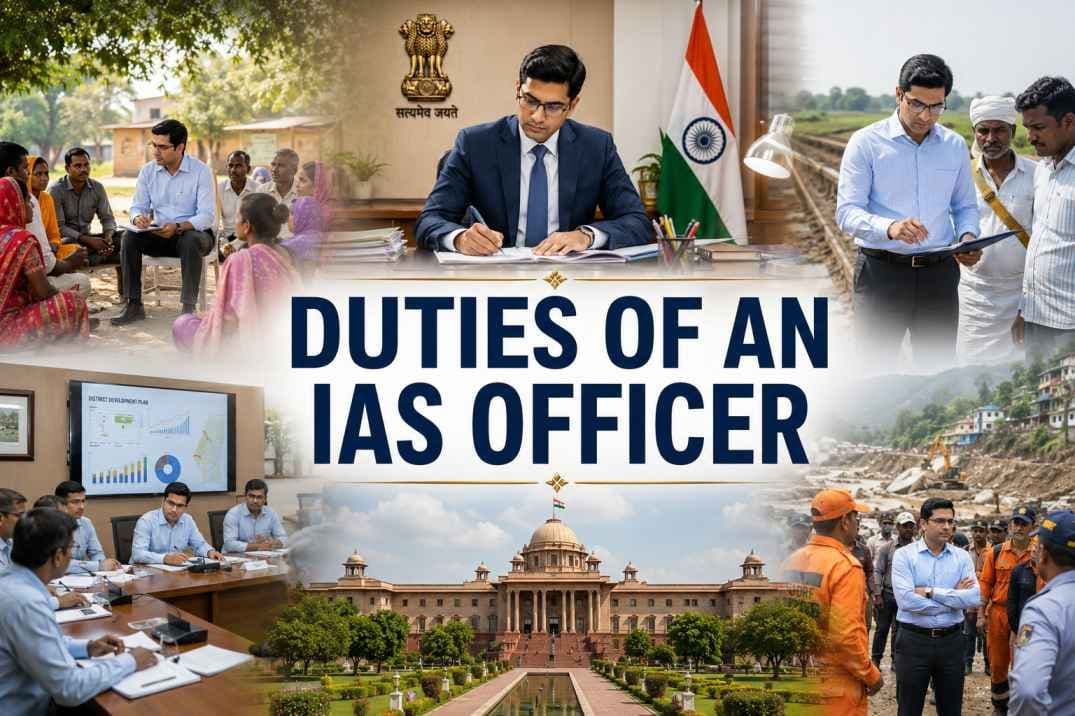
What is LBSNAA? IAS Training, Duration and Course Details
LBSNAA is India’s premier IAS training academy in Mussoorie, Uttarakhand. This is your complete guide to IAS training duration, phases, daily routine, campus life, and courses.
Apr, 2026
•7 min read
"Ma'am, I have a question?”
“Go ahead,” the IAS officer said with a smile.
“I understand the preparation part for the UPSC Civil Services Examination… but what happens after we clear it? I have heard about the LBSNAA. What is it really?”
“That’s a good question, and honestly, one most aspirants don’t ask early enough.”
“So… is it like a training college?” the aspirant asked.
“Yes, but not the usual kind,” he replied. “Lal Bahadur Shastri National Academy of Administration—LBSNAA—is where you begin to understand what being an IAS officer means.”
“Till UPSC preparation, you study to clear an exam. At LBSNAA, you learn how to handle real responsibilities of administration, decision-making, and public dealing.”
“What do you do there daily? Just classes?”
“Classes are there, of course. But your day starts early, with physical training, lectures, group discussions, and field visits. You meet officers from different services, learn teamwork, and slowly adapt to a disciplined life.”
“Sounds completely different from preparation life…”
“It is,” she said. “And the environment helps. The academy is in Mussoorie—quiet, focused, and perfect for learning.”
“And how long does all this IAS training go on?”
“It’s not one single phase,” the officer explained. “There’s a Foundation Course, then Phase I, then Bharat Darshan, where you travel across India, and finally Phase II. Each stage prepares you for the next level of responsibility.”
“So clearing UPSC isn’t the final step…”
“Not at all,” she said. “It’s just your entry. LBSNAA is where you become an officer.”
Let's understand in detail what LBSNAA is, how IAS training works, what the course structure is, and how long the training lasts.
What is LBSNAA?
The Lal Bahadur Shastri National Academy of Administration (LBSNAA) in Mussoorie, Uttarakhand, is a premier training institution for the civil services in India. It is headed by a Director (an officer at the level of Secretary to the Government of India). It is an attached office of the Department of Personnel & Training, Government of India.
It conducts a common Foundation Course for entrants to the All India Services:
- Indian Foreign Service
- Group ‘A’ services of the Union and the Royal Bhutan Service,
- Indian Administrative Service (IAS)
The Academy also conducts in-service and Mid-Career Training Programmes (MCTPs) for members of the IAS and Induction Training Programmes for officers promoted to the IAS from State Civil Services. In addition, workshops and seminars on policy and governance-related issues are held from time to time.
Must see: Top 10 Toughest Exams in India 2026
IAS Officer Training at LBSNAA
Training at Lal Bahadur Shastri National Academy of Administration is structured, multi-phase, and designed to prepare officers for real administrative responsibilities. It combines academic learning, field exposure, and personality development.
Key Phases of IAS Training
1. Foundation Course (FC) – Common Training
- Duration: ~3–4 months
- Conducted for all civil services together after clearing the UPSC Civil Services Examination
- Focus on basic subjects like polity, economics, history, and public administration
- Emphasis on inter-service coordination, teamwork, and discipline
2. Phase I Training (IAS Professional Course)
- Focus on core administrative subjects such as law, governance, public administration, and rural development
- Includes case studies and practical problem-solving approaches
- Prepares officers for field-level responsibilities
3. Bharat Darshan (Study Tour)
- All-India tour to understand the country’s diversity
- Exposure to different states, cultures, institutions, and administrative systems
- Visits to government bodies, military establishments, and important regions
4. District Training (Field Training)
- Conducted in the allotted cadre/state
- Officers work under senior officials like the District Magistrate
- Real exposure to administration, public dealing, and policy implementation at the ground level
5. Phase II Training
- Conducted after district training back at Lal Bahadur Shastri National Academy of Administration
- Sharing of field experiences and advanced learning
- Focus on refining administrative skills and decision-making ability
Other Important Components of Training
Physical Training
- Regular exercise, trekking, and outdoor activities in Mussoorie
- Builds stamina, discipline, and mental strength
Village Visit Programme
- Direct interaction with rural communities
- Understanding grassroots challenges and development issues
Classroom + Practical Learning Approach
- Mix of lectures, group discussions, presentations, and fieldwork
- Focus on real-life administrative situations rather than only theory
Overall, IAS training at LBSNAA is designed to gradually transform a candidate into a capable administrator by combining knowledge, field exposure, and practical experience.
Duration of IAS Training at LBSNAA
The training of an IAS officer is spread over different phases and usually takes around 2 years to complete. It is a combination of academy-based learning and field-level exposure, ensuring that officers are fully prepared for administrative roles.
- Foundation Course (FC): Duration: 3–4 months
- Phase I: Duration: 15–20 weeks (approx. 4–5 months)
- Bharat Darshan (All India Study Tour): Duration: 6–8 weeks
- District Training (On-field Training): Duration: 10–12 months
- Phase II (Final Training at LBSNAA): Duration: 6–8 weeks
Total IAS training duration: Approximately 2 years. It includes both institutional training at LBSNAA and practical field training
You might also like: Success Stories of IAS Toppers Cleared with Self-Study
Campus and Infrastructure of LBSNAA
Lal Bahadur Shastri National Academy of Administration is located in Mussoorie, a hill station at an altitude of around 6,580 feet. It is about 35 km from Dehradun (nearest railhead) and nearly 270 km from Delhi. The location provides a calm and focused environment suitable for intensive training.
Over time, the academy has expanded into a large and well-developed campus spread across 189 acres, with multiple complexes supporting training, accommodation, and administrative activities.
Major Campus Complexes
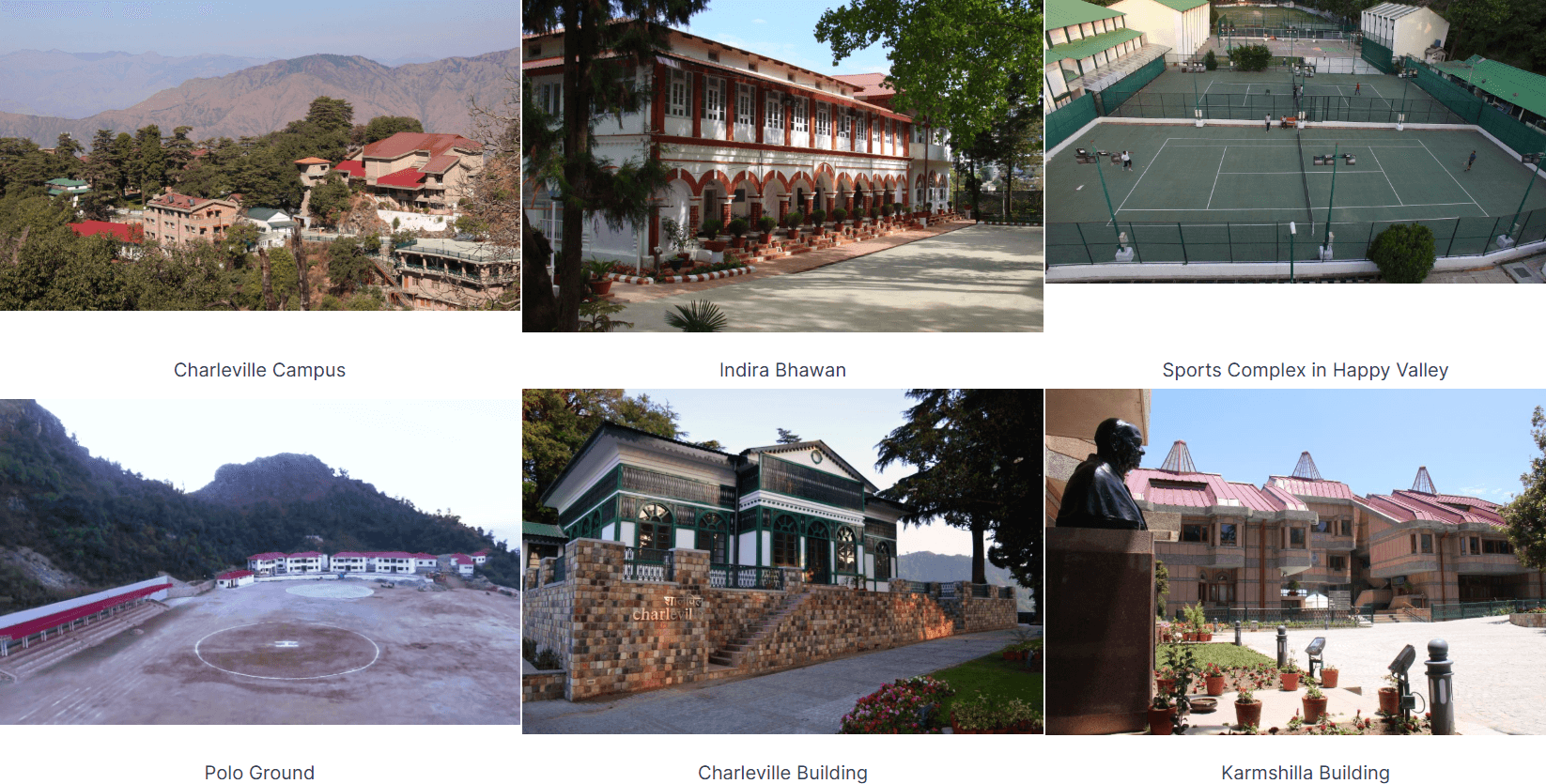
1. Main Academy Complex (Charleville Estate)
- Spread over 69 acres
- Primary centre for training fresh entrants (Officer Trainees)
- Houses classrooms, administrative offices, and key academic facilities
2. Indira Bhawan Campus
- Dedicated to in-service training programs
- Used for specialised courses, workshops, seminars, and mid-career training of officers
3. Glenmire Estate
- Earlier housed the National Institute of Administrative Research (NIAR)
- Now accommodates the National Centre for Good Governance (NCGG) and residential facilities
4. Happy Valley Complex
- Focused on sports and physical training infrastructure
- Includes gym, courts, and grounds for various sports
5. Polo Ground
- Central area for physical training and horse riding activities
- Regularly used for morning exercises and drills
6. Monastery Estate
- Additional campus area supporting academy functions and accommodation
7. Residential Facilities
- The academy also has 17 additional residential properties
- These provide accommodation for officer trainees, faculty, and staff
A Day in the Life of an Officer Trainee at LBSNAA
The daily routine at LBSNAA is structured and intensive, designed to ensure all-around development. A typical day combines physical activity, academic learning, and extracurricular engagement, with trainees spending 8–10 hours daily in structured activities.
Daily Schedule of an Officer Trainee
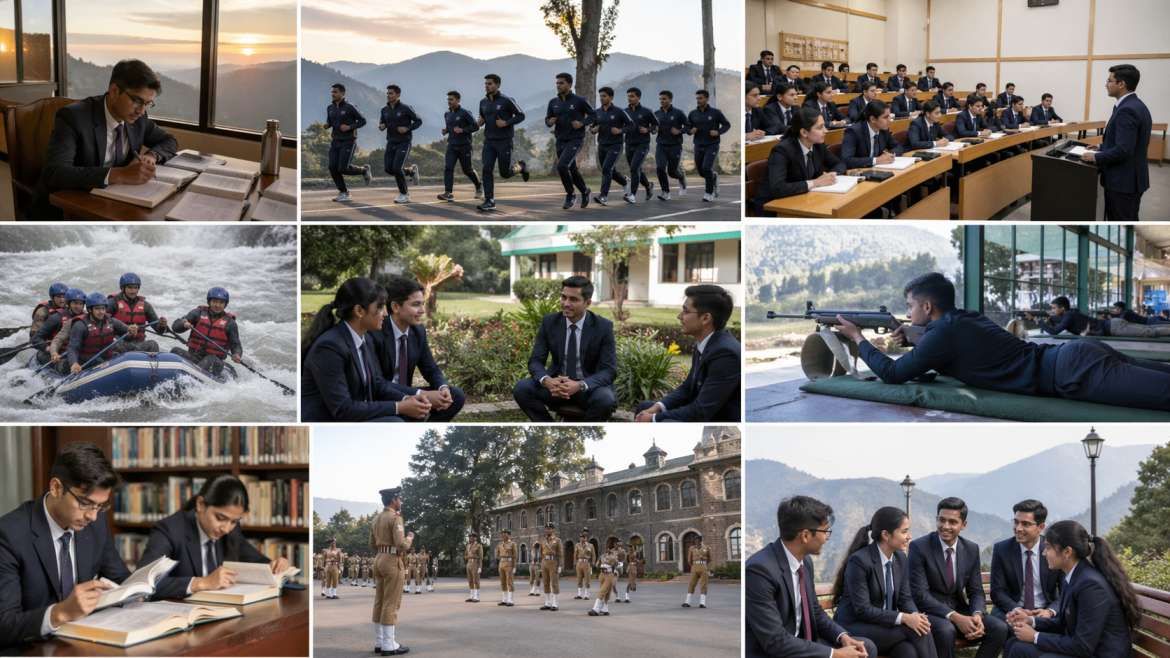
1. Early Morning Physical Training (6:00 AM onwards)
- The day begins early with 60 minutes of physical exercise at the Polo Ground
- Activities include running, drills, yoga, and fitness training
- Horse riding sessions are also conducted during this time and at other slots, depending on the batch size
2. Morning Preparation Time
- Around 1–1.5 hours after PT for getting ready, breakfast, and preparation
- Trainees report for classes by 9:30 AM
3. Academic Sessions (9:30 AM onwards)
- 5–6 classroom sessions daily, each of about 55 minutes
- Subjects include History, Political Science, Economics, Law, ICT, Public Administration, Management, and Behavioural Science
- Focus on building administrative understanding and analytical ability
4. Afternoon and Evening Engagements
Sessions or activities may continue after lunch, depending on the schedule. Evening hours are allocated for:
- Sports and fitness activities
- Horse riding practice
- Extra-curricular modules and skill-building sessions
5. Cultural and Social Activities
- Cultural programmes, performances, and events are organised on selected evenings
- Encourages participation, expression, and peer interaction
6. Self-Study and Peer Interaction
Pre- and post-dinner time is used for:
- Revising the day’s learning
- Preparing for upcoming sessions
- Informal discussions with fellow trainees
Learning Beyond the Classroom
Weekend and Holiday Activities
- Treks in and around Mussoorie and the Greater Himalayas
- Adventure activities like rock climbing, river rafting, and paragliding
- Community service and village visits to understand grassroots realities
Outdoor and Sports Facilities
- Access to the Happy Valley Sports Complex with facilities for gym, badminton, squash, lawn tennis, football, and hockey
- Dedicated infrastructure for horse riding with trained instructors
Clubs and Societies Participation
Trainees are encouraged to pursue hobbies and interests through various clubs and societies, such as:
- Society for Social Service
- House Journal Society
- Officers’ Mess activities
- House-based participation (like Nanda Devi, Kangchenjunga, etc.)
Facilities at the Academy
To support its training mission, the Academy has a wide range of facilities, including spacious and well-equipped lecture rooms, conference halls, an auditorium, a library, a mess, hostels, a sports complex, a dispensary, a reprographic unit, a bank, a post office, an EPABX, a computer lab, and a Wi-Fi campus.
- Teaching Facilities
- IT Services
- Library
- Officers Mess
- Accommodation
- Medical Centre
- Sports Complex
Also see: PRATIBHA Setu: UPSC Aspirants’ Bridge to Alternative Career Pathways
Final Words
The day you start preparing for the UPSC Civil Services Examination, you are not only studying for an exam; you are preparing for responsibility, pressure, and real decisions that affect people’s lives.
Lal Bahadur Shastri National Academy of Administration (LBSNAA) will train you after selection, but it will not build your intent, your discipline, or your honesty. That part is in your hands, starting today.
Study with purpose. Stay consistent even when results are slow. Focus on understanding, not shortcuts. The system does not need perfect people; it needs dependable officers. And always remember the motto:
शीलम् परम भूषणम्
(Character is the highest virtue)
Start your UPSC Preparation 2026/2027 with SuperKalam
SuperKalam is your personal mentor for UPSC preparation, guiding you at every step of the exam journey. Practice, revise, and evaluate– all in one place.
Install Now