Discuss, with suitable examples, how the contradiction between 'rapid infrastructure development' and 'disaster-risk reduction' in ecologically-sensitive areas of India can be managed.
Discuss, with suitable examples, how the contradiction between 'rapid infrastructure development' and 'disaster-risk reduction' in ecologically-sensitive areas of India can be managed.
India’s infrastructure expansion in fragile terrains creates systemic vulnerabilities highlighted by ISRO’s Landslide Atlas of India. Balancing growth requires integrating the Disaster Management Act 2005 with standards from the Coalition for Disaster Resilient Infrastructure to ensure stability.
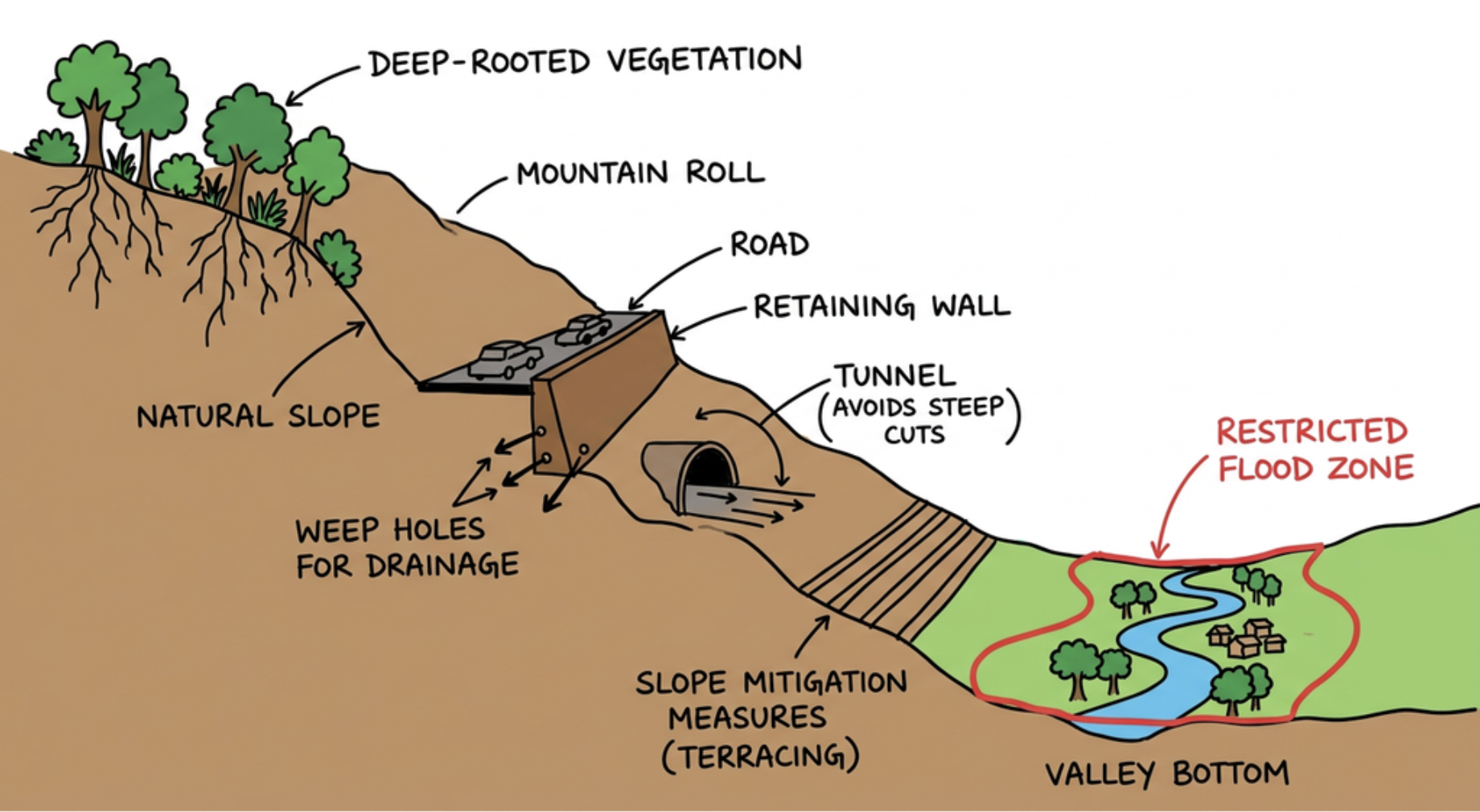
Sustainable Mountain Infrastructure through Slope Stabilisation, Drainage and Flood-Zone Protection
Strategies for Harmonizing Development and Risk Reduction
-
Carrying Capacity Assessment: evaluate thresholds for activity.
- Eg: NITI Aayog Hill City Regions Planning Initiative 2026; Himalayan urban limits.
-
Disaster Risk Audits: review infrastructure safety.
- Eg: Disaster Management Act 2025; annual project updates.
-
Eco-Sensitive Zoning: prohibit commercial activity in fragile zones.
- Eg: July 2026 Union Environment Ministry draft; 56,825 sq km Western Ghats Ecologically Sensitive Areas.
-
Nature-Based Solutions: utilize bio-engineering for slopes.
- Eg: Him-CONNECT initiative 2026; Himachal Pradesh road construction.
-
Early Warning Systems: deploy sensors for mitigation.
- Eg: NDMA 2026 directive; 60 high-risk glacial lakes.
Governance and Financial Mechanisms for Resilience
-
Dedicated Mitigation Funding: allocate reserves for prevention.
- Eg: 15th Finance Commission; 2.28 lakh crore with 90 percent funding for Himalayan states.
-
Climate-Resilient Urban Planning: adopt weather-based frameworks.
- Eg: 2025 NMHS project; Himachal Pradesh village planning.
-
Decentralized Disaster Management: empower community response.
- Eg: Wayanad Landslide 2024; community-led housing.
-
Technological Infrastructure Monitoring: track subsidence via satellite.
- Eg: ISRO’s Landslide Atlas; Char Dham Pariyojana alignment.
-
Standardization of Materials: enforce terrain-specific materials.
- Eg: Coalition for Disaster Resilient Infrastructure (CDRI); global mountain transport standards.
Implementing the Sendai Framework for Disaster Risk Reduction alongside the National Mission on Himalayan Studies is crucial. Leveraging the Coalition for Disaster Resilient Infrastructure ensures that developmental goals remain ecologically viable.
Answer Length
Model answers may exceed the word limit for better clarity and depth. Use them as a guide, but always frame your final answer within the exam’s prescribed limit.
Evaluate this PYQ now
Write your answer & evaluate in just 60 seconds




500+ students evaluated
Model Answers by Subject


Crack UPSC with your
Personal AI Mentor
An AI-powered ecosystem to learn, practice, and evaluate with discipline



