"China's Belt and Road Initiative (BRI) has transformed South Asia from a regional space into a theatre of great power competition." Analyse the strategic implications of the BRI for India's security and regional influence in South Asia.
"China's Belt and Road Initiative (BRI) has transformed South Asia from a regional space into a theatre of great power competition." Analyse the strategic implications of the BRI for India's security and regional influence in South Asia.
China’s Maritime Silk Road and the China-Pakistan Economic Corridor (CPEC) have effectively bypassed traditional regional boundaries, forcing India to recalibrate its Security and Growth for All in the Region (SAGAR) framework against burgeoning extra-regional naval presence.
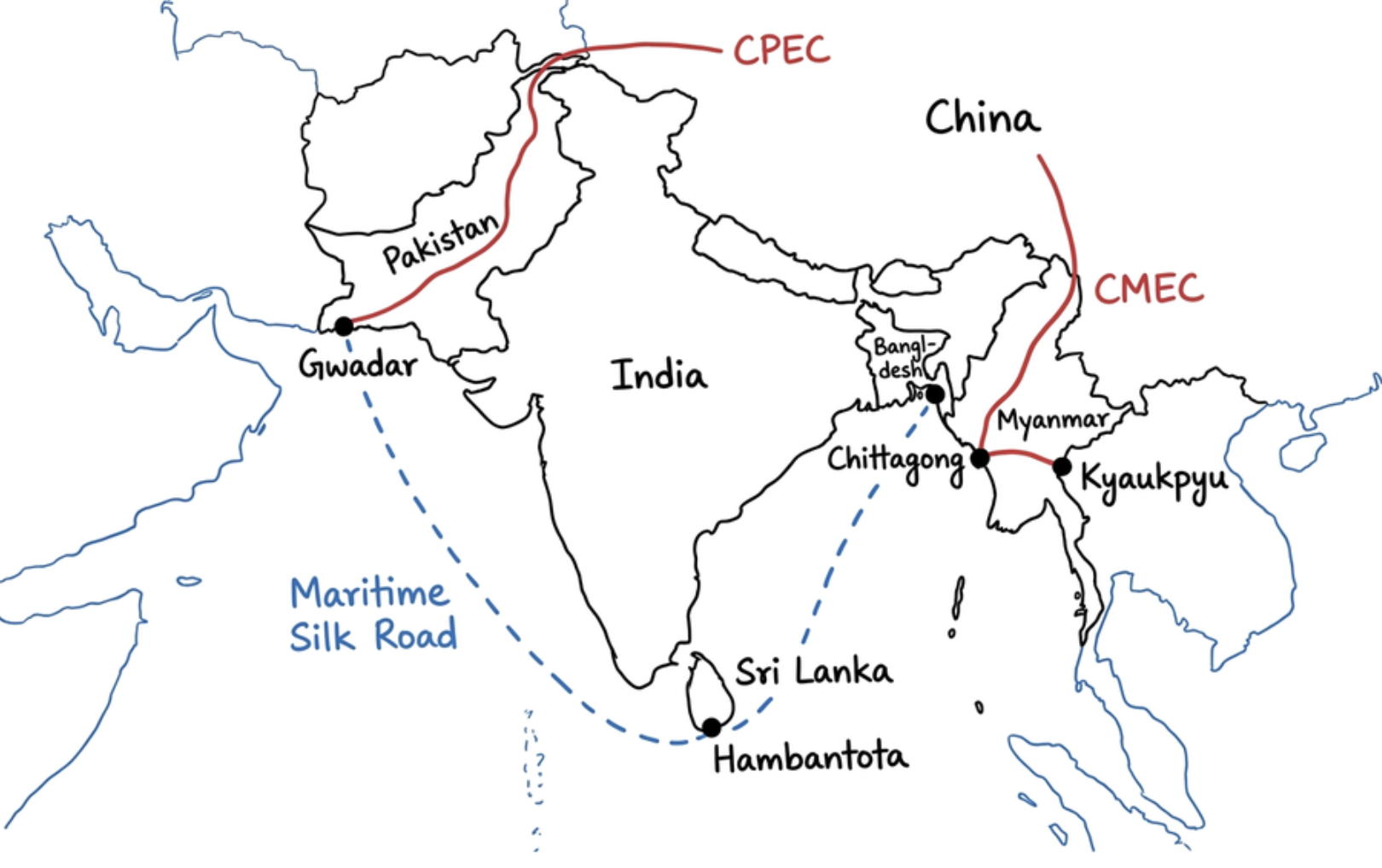
China’s BRI Connectivity Corridors and Maritime Network in South Asia
Strategic Implications for India’s Security
-
China-Pakistan Economic Corridor (CPEC) violates territorial integrity by traversing Indian-claimed lands.
- Eg: The MEA’s January 2026 assessment: CPEC in Pakistan-Occupied Kashmir violates norms.
-
The "String of Pearls" uses dual-use infrastructure to monitor Indian naval movements.
- Eg: The December 2025 Pentagon report: logistics center at Cambodia’s Ream Naval Base.
-
BRI-linked ports facilitate a persistent People’s Liberation Army Navy (PLAN) presence.
- Eg: The 2025 commissioning of the Fujian signals a nine-carrier navy by 2035.
-
Research vessel deployments map the Indian Ocean Region (IOR) for submarine warfare.
- Eg: 2025 reports: 40% increase in Chinese military-linked survey missions in the IOR.
-
Himalayan infrastructure improves China’s logistical agility for rapid troop mobilization.
-
Digital corridors enable electronic surveillance and cyber-espionage against Indian interests.
-
Instability in Af-Pak region corridors risks spillover effects destabilizing India’s periphery.
Strategic Implications for India’s Regional Influence
-
Chinese lending creates dependencies limiting the strategic autonomy of neighbors.
- Eg: A 77% drop in 2025 CPEC engagement, yet debt constrains Pakistan.
-
Trilateral dialogues with neighbors dilute India's "Net Security Provider" status.
- Eg: The MEA noted in July 2025 these dialogues diminish Indian regional leadership.
-
India must match Chinese funding despite a recent slowdown in BRI.
- Eg: Nepal saw a 100% decrease in BRI engagement in 2025, favoring India.
-
India must accelerate trans-regional projects to avoid being geographically bypassed.
- Eg: India-Middle East-Europe Economic Corridor (IMEC) construction began April 2025 to cut transit 40%.
-
Neighbors seek trilateral grids, necessitating a flexible sub-regional approach.
- Eg: An October 2024 agreement: Nepal’s electricity reaches Bangladesh via India.
-
BRI promotes Chinese technical standards, potentially locking out Indian systems.
-
India leverages minilateral groupings to counter China’s bilateral influence.
- Eg: The April 2025 MoU between India, Sri Lanka, and the UAE develops Trincomalee.
-
BRI necessitates a Neighborhood First Policy focused on community-centric projects.
- Eg: The August 2026 Lowy Institute report recommended a renewed SARIC strategy for India.
India must synergize the Neighborhood First Policy and Security and Growth for All in the Region with UNCLOS principles to foster a transparent, multi-polar, and rules-based regional security architecture.
Answer Length
Model answers may exceed the word limit for better clarity and depth. Use them as a guide, but always frame your final answer within the exam’s prescribed limit.
Evaluate this PYQ now
Write your answer & evaluate in just 60 seconds




500+ students evaluated
Model Answers from
- 2026International Relations15 MarksView Answer
"India's global diaspora acts as a living bridge, as a critical economic factor and knowledge network in transforming cultural heritage into geopolitical influence and strategic leverage worldwide." Critically examine this statement.
- 2026International Relations10 MarksView Answer
"BRICS acts as a powerful counterweight in global governance, actively amplifying the voice and influence of the Global South." Explain the role of BRICS in projecting itself as an alternative to other groupings.
- 2026International Relations10 MarksView Answer
"IPMDA (Indo-Pacific Partnership for Maritime Domain Awareness) bridges the gap between India's SAGAR (Security and Growth for All in the Region) vision and the Quad's collective Indo-Pacific strategy." Make a critical assessment of the statement focusing on IPMDA.
Model Answers by Subject


Crack UPSC with your
Personal AI Mentor
An AI-powered ecosystem to learn, practice, and evaluate with discipline



