Can the constitutional mandate of rights-based welfare be effectively realised in the context of non-integrated governance and minimal public investment? Examine.
Can the constitutional mandate of rights-based welfare be effectively realised in the context of non-integrated governance and minimal public investment? Examine.
India’s constitutional mandate for a rights-based welfare state requires fulfilling social justice obligations through legislative frameworks and fiscal commitments to ensure dignity, equality, and essential basic services for every citizen under the law.
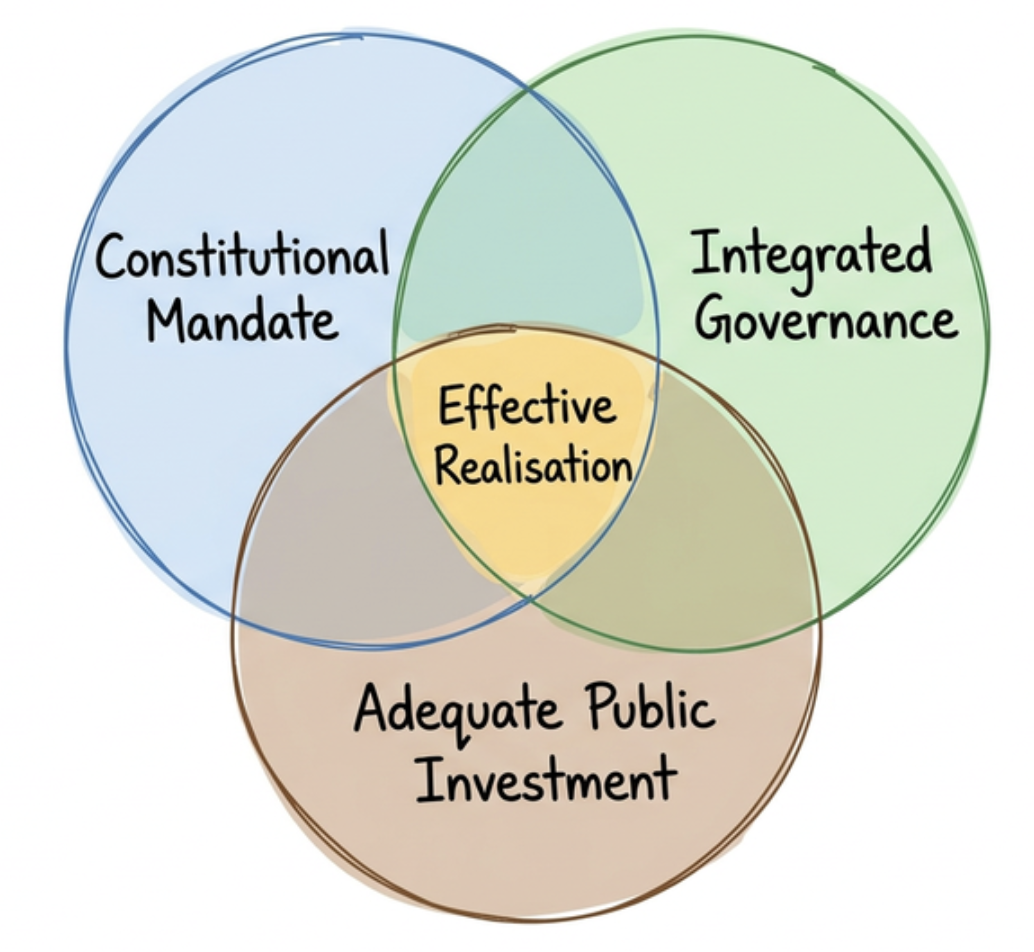
Effective Realisation through Constitutional Mandate, Governance and Public Investment
Constitutional and Statutory Mandate of Rights-based Welfare
-
Fundamental Rights Framework: Article 21 encompasses the right to live with dignity.
-
Directive Principles Foundation: Articles 38 and 39 direct the State to minimize inequalities.
-
Economic Security Statutes: The MGNREGA 2005 guarantees a legal right to work.
- Eg: Article 41 and 47 emphasize the duty to provide public assistance.
-
Education and Food Security: The Right to Education Act 2009 and NFSA 2013 institutionalize social claims.
- Eg: The National Food Security Act 2013 covers two thirds of the population.
-
Decentralized Governance Mandate: The 73rd and 74th Amendments empower local bodies.
Obstructions of Non-integrated Governance and Low Investment
-
Fragmented Scheme Implementation: Overlapping programs across ministries create administrative silos.
- Eg: In January 2026 ministries were directed to merge or discontinue 54 centrally sponsored schemes.
-
Fiscal Space Constraints: Public expenditure on social services remains insufficient.
- Eg: The Economic Survey 2025 reported social sector spending at 1.7 percent of GDP.
-
Inter-departmental Coordination Gaps: Lack of data sharing results in beneficiary exclusion.
-
Weak Institutional Capacity: Inefficient service delivery mechanisms hinder the last mile reach.
- Eg: The India Justice Report notes vacancies in institutions responsible for protecting statutory rights.
-
Inequality Adjustment Losses: Systemic inequality reduces the impact of human development.
- Eg: The Human Development Report 2025 shows a 30.7 percent loss in HDI value.
Requirements for Possible Realisation of Rights
-
Strategic Scheme Rationalization: Restructuring spending through the consolidation of schemes enhances outcomes.
- Eg: The Union Budget 2026-27 reflects a shift towards the saturation of welfare schemes.
-
Enhanced Public Investment: Increasing the social sector budget is critical for human development.
- Eg: The social sector received 2.5 percent of GDP in the Budget Estimates for 2026-27.
-
Judicial and Administrative Reforms: Streamlining legal processes ensures rights do not remain paper promises.
- Eg: The Tribunals Reforms Bill 2026 aims to enhance efficiency in administrative adjudication.
-
Data Driven Governance: Utilizing digital technology facilitates targeted service delivery.
-
Empowering Local Institutions: Strengthening the capacity of Panchayats ensures welfare planning aligns with needs.
- Eg: NITI Aayog emphasizes the role of cooperative federalism in achieving social outcomes.
Effective governance integration and robust public investment are indispensable for translating constitutional promises into tangible improvements in the quality of life for India’s marginalized and vulnerable populations.
Answer Length
Model answers may exceed the word limit for better clarity and depth. Use them as a guide, but always frame your final answer within the exam’s prescribed limit.
Evaluate this PYQ now
Write your answer & evaluate in just 60 seconds




500+ students evaluated
Model Answers from
- 2026Governance15 MarksView Answer
"Transparency and accountability in governance are not about controlling corruption but about creating the trust of stakeholders in the policy process by following the Rule of Law and Participatory Governance." Comment.
- 2026Governance10 MarksView Answer
Analyse the advantages and limitations of the generalist structure of the Indian Civil Services in contemporary governance.
Model Answers by Subject


Crack UPSC with your
Personal AI Mentor
An AI-powered ecosystem to learn, practice, and evaluate with discipline



