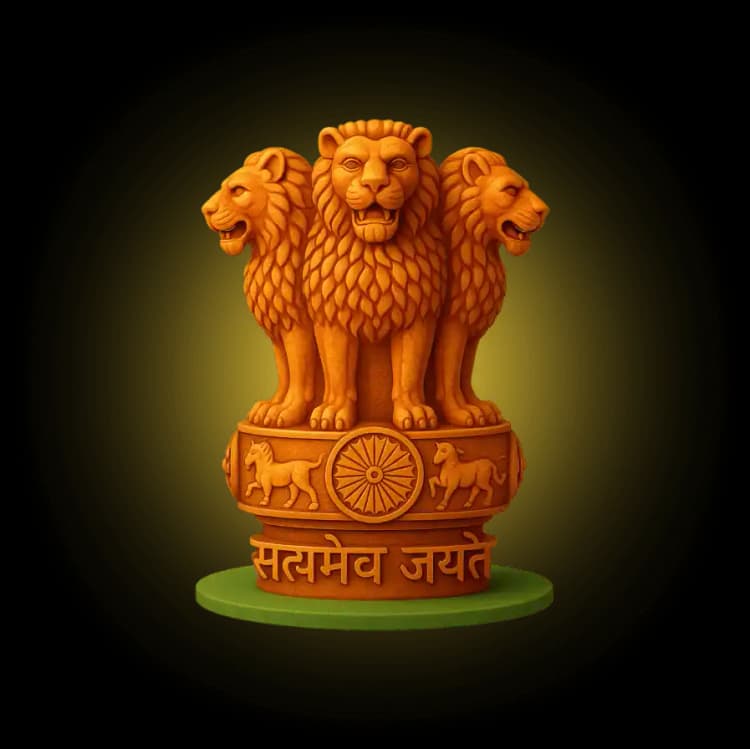
A well-educated mind will always have more questions than answers.
A well-educated mind will always have more questions than answers.
The oldest surviving piece of Indian philosophical writing about the origin of the universe does not end in a doctrine. The Nasadiya Sukta of the Rigveda, having described the state before existence, closes with an astonishing shrug: who really knows? Whence this creation arose, perhaps it formed itself, perhaps it did not, even the one who surveys it from the highest heaven, perhaps he does not know. Three thousand years ago, at the very beginning of the tradition, the most educated minds available chose to end with a question mark.
That instinct is what education is for. Helen Keller's line, that a well-educated mind will always have more questions than answers is not a paradox but an arithmetic fact about knowledge: every answer opens a wider perimeter of ignorance. The uneducated mind has few questions because it has not yet discovered how much there is to ask.
Why knowing more produces more questions
Socrates built an entire method on this. He claimed to know only that he did not know, and then took Athens' most confident men to the state he called aporia, the productive confusion in which learning actually begins. It cost him his life, which tells us something about how societies feel about questioners.
Indian pedagogy independently arrived at the same architecture. The Upanishads are structured as dialogue, and their most famous student, Nachiketa, earns his teaching by refusing to be satisfied with Yama's offers of wealth and long life; he wants to know what happens after death and will not be diverted. The Buddha's invitation was ehipassiko come and see, verify it yourself, and he explicitly discouraged acceptance of authority. Nalanda and Takshashila examined entrants through shastrartha, structured debate; Adi Shankara established his philosophy not by decree but by travelling the subcontinent to argue. Charvaka's materialism was preserved within the tradition it attacked, because the tradition needed its objections.
Science formalised the same humility. Popper made falsifiability the boundary of the scientific: a claim that cannot be questioned is not a scientific claim. Kuhn showed that progress comes in ruptures when accumulated anomalies, questions that would not go away, break a paradigm. Gödel proved that even arithmetic contains truths it cannot prove about itself. Heisenberg established a limit on what can be simultaneously known. Newton, at the end of his life, described himself as a boy on a beach while the great ocean of truth lay undiscovered before him. Feynman said he would far rather have questions that cannot be answered than answers that cannot be questioned. Each advance in physics has enlarged the list of things we know we do not understand, dark matter, dark energy, consciousness. The frontier grows faster than the settled territory.
What this says about how we actually educate
Measured against this standard, much of our schooling is doing the opposite of education. It rewards recall, punishes deviation, and treats the question as an interruption of the syllabus. A student who asks why in the wrong week is a scheduling problem. Coaching factories perfect the model: an industry built on the premise that the purpose of a mind is to produce the expected answer within a time limit. The ASER surveys keep reporting children who can decode letters but not meaning, the exact signature of a system optimising for output rather than understanding.
Paulo Freire called this the "banking" model of education: the teacher deposits, the student stores, and nobody is transformed. His alternative was problem-posing education, in which learners interrogate their own condition. Krishnamurti, teaching in India, argued that an education which produces efficient functionaries and not questioning human beings has failed at its only real task. Tagore's Santiniketan and Gandhi's Nai Talim were both revolts against the clerk-producing colonial curriculum: one through art and nature, the other through work and craft, but both towards a mind that inquires.
The National Education Policy, 2020 accepts the diagnosis in its own language, critical thinking, competency-based assessment, reduction of rote content, flexibility of subject choice, mother-tongue instruction so that comprehension precedes performance. Atal Tinkering Labs put screwdrivers in the hands of school children; the Anusandhan National Research Foundation is meant to fund curiosity rather than only deliverables. Whether any of this survives contact with the board examination is the real test, because assessment is the true curriculum. A system that examines for answers will produce students who collect them, whatever the policy document says.
The necessary counter-argument
Our present information environment is proof. "I'm just asking questions" is now the standard preface to conspiracy theory. Vaccine hesitancy, flat-earth revivals, denial of climate science and communal rumour all dress themselves as scepticism. But the skeptic's question is disciplined by a willingness to accept the answer; the crank's question is a device for refusing every answer. Doubt without method is not inquiry, it is corrosion. Whataboutery in public debate performs the same function: it uses the form of a question to avoid a conclusion.
Second, action requires provisional answers. A surgeon in theatre cannot suspend judgement; a district magistrate ordering an evacuation before a cyclone cannot wait for certainty; a pilot cannot be endlessly open-minded about the fuel gauge. Analysis paralysis is a real vice, and expertise is precisely the ability to close questions responsibly and act. The Constitution's framers debated for three years, and then signed.
The resolution is that the educated mind holds two capacities together: it questions its beliefs and still acts on the best of them. Aristotle's formulation remains the cleanest, the mark of an educated mind is the ability to entertain a thought without accepting it. Fitzgerald's version is the ability to hold two opposed ideas at once and retain the capacity to function. Certainty in action, humility in belief.
Why a republic needs questioners
This is not merely an academic virtue. A democracy is a machine for asking questions of power. Question Hour in Parliament, parliamentary committees, the RTI Act, which converted curiosity into an enforceable right, public interest litigation, an independent press, an audited executive: each is institutionalised interrogation. The Constitution even makes it a fundamental duty of every citizen to develop the scientific temper and the spirit of inquiry.
Where questioning collapses, catastrophe follows on a schedule. Engineers who warned about the Challenger's O-rings were overruled. Warnings about Bhopal, about the design compromises of the 737 MAX, about the loans that were being evergreen rather than recognised, all existed, and all were institutionally inconvenient. Every large failure has a paper trail of unwelcome questions. Organisations do not usually lack information; they lack permission to ask.
Conclusion
Education, properly understood, does not fill a mind; it opens one. Its product is not a stock of answers but a permanent, disciplined restlessness, the habit of asking better questions than one asked last year, and the courage to ask them where they are least welcome.
The measure of a school, an institution or a civilisation is therefore not the confidence of its answers but the quality of the questions it permits. India has both the oldest recorded tradition of ending in a question and one of the world's largest examination systems built on the opposite premise. Reconciling the two is the central educational task of our time: to produce a generation whose first response to the world is not the memorised reply, but the honest, rigorous, unafraid why.
Answer Length
Model answers may exceed the word limit for better clarity and depth. Use them as a guide, but always frame your final answer within the exam’s prescribed limit.
Evaluate this PYQ now
Write your answer & evaluate in just 60 seconds



500+ students evaluated
Model Answers from
- 2026Essay125 MarksView Answer
A good leader is one who follows the followers.
- 2026Essay125 MarksView Answer
Shelving hard decisions is the least ethical course.
- 2026Essay125 MarksView Answer
Nature is the symbol of the spirit.
- 2026Essay125 MarksView Answer
When two elephants fight, it is the grass that gets trampled.
- 2026Essay125 MarksView Answer
A thorn is a changed bud.
- 2026Essay125 MarksView Answer
A grateful mind is very beautiful.
Model Answers by Subject


Year-Wise Model Answer
Crack UPSC with your
Personal AI Mentor
An AI-powered ecosystem to learn, practice, and evaluate with discipline