Discuss the work of ‘Bose-Einstein Statistics’ done by Prof. Satyendra Nath Bose and show how it revolutionised the field of Physics.
Discuss the work of ‘Bose-Einstein Statistics’ done by Prof. Satyendra Nath Bose and show how it revolutionised the field of Physics.
Satyendra Nath Bose's groundbreaking work on quantum statistics fundamentally transformed modern physics by introducing a revolutionary statistical framework that governs particle behavior at quantum scales.
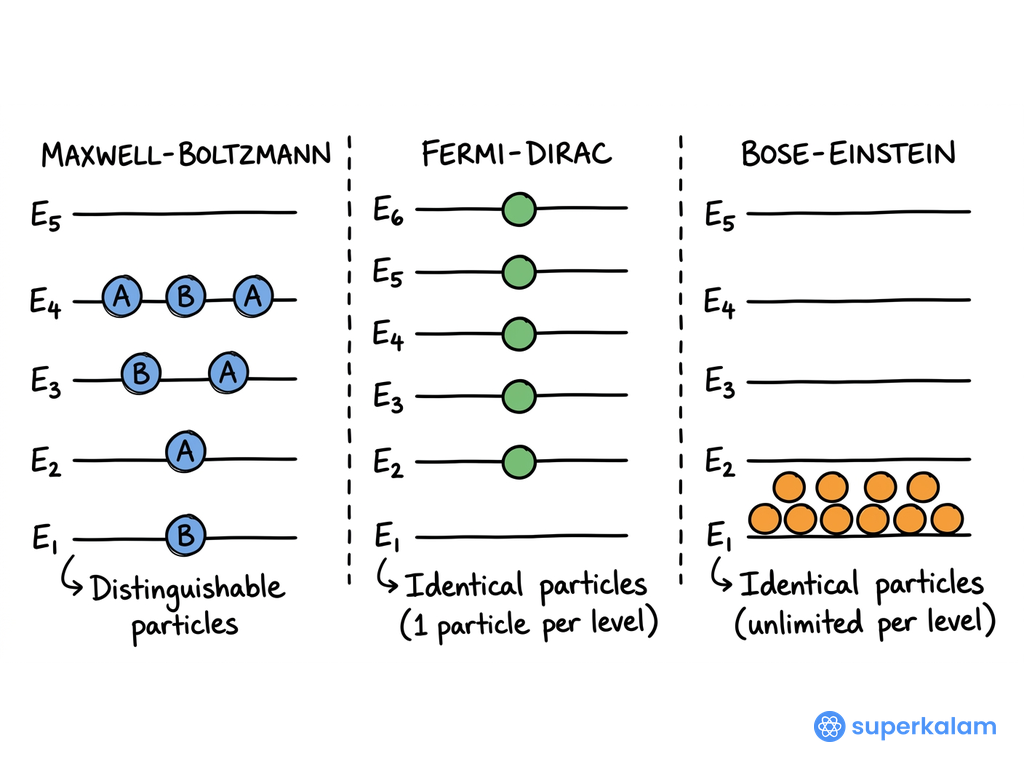
Statistical mechanics models energy level comparison
Bose's Quantum Statistical Method
- Novel Approach (1924): Bose developed a new method to derive Planck's radiation law by treating photons as indistinguishable particles, rejecting classical statistical mechanics
- Quantum Counting: Introduced the concept of counting photon states rather than individual photons, fundamentally changing statistical calculations
- Indistinguishability Principle: Established that identical quantum particles cannot be distinguished, leading to new statistical behavior
- Mathematical Framework: Created equations governing particles with integer spin values (later called bosons)
- Einstein's Extension: Einstein extended Bose's method to material particles, predicting Bose-Einstein Condensation
Revolutionary Impact on Theoretical Physics
- Particle Classification: Led to fundamental division of particles into bosons (integer spin) and fermions (half-integer spin)
- Quantum Field Theory: Provided foundation for understanding particle interactions and field quantization
- Statistical Mechanics: Revolutionized statistical mechanics by introducing quantum statistics alongside classical Maxwell-Boltzmann statistics
- Wave-Particle Duality: Strengthened understanding of light's dual nature through quantum statistical treatment
- Quantum Many-Body Systems: Enabled analysis of collective quantum phenomena in multi-particle systems
Modern Applications and Technologies
| Application Area | Technology | Impact |
|---|---|---|
| Quantum Computing | Quantum bits (qubits) | Information processing |
| Precision Instruments | Atomic clocks, interferometers | Ultra-precise measurements |
| Medical Technology | MRI machines, laser surgery | Healthcare advancement |
| Communication | Quantum cryptography | Secure information transfer |
Contemporary Scientific Breakthroughs
- Bose-Einstein Condensate (1995): First created by Cornell, Wieman, and Ketterle, earning 2001 Nobel Prize
- Higgs Boson Discovery (2012): CERN's discovery validated boson theory, leading to 2013 Nobel Prize
- Quantum Supremacy (2019): Google's quantum computer demonstrated computational advantages using bosonic systems
- Quantum Sensors: Development of ultra-sensitive gravitational wave detectors like LIGO
- Superconductivity Research: Understanding Cooper pairs as composite bosons advancing quantum technologies
Bose's work established India's prominence in theoretical physics and continues driving innovations in quantum computing, precision metrology, and fundamental research. His statistical framework remains crucial for advancing quantum technologies and exploring exotic states of matter in modern physics.
Answer Length
Model answers may exceed the word limit for better clarity and depth. Use them as a guide, but always frame your final answer within the exam’s prescribed limit.
Evaluate this PYQ now
Write your answer & evaluate in just 60 seconds




500+ students evaluated
Model Answers by Subject


Crack UPSC with your
Personal AI Mentor
An AI-powered ecosystem to learn, practice, and evaluate with discipline