Launched on 25th December, 2021, James Webb Space Telescope has been much in the news since then. What are its unique features which make it superior to its predecessor Space Telescopes ? What are the key goals of this mission ? What potential benefits does it hold for the human race?
Launched on 25th December, 2021, James Webb Space Telescope has been much in the news since then. What are its unique features which make it superior to its predecessor Space Telescopes ? What are the key goals of this mission ? What potential benefits does it hold for the human race?
Launched on 25th December 2021 by an Ariane-5 rocket from French Guiana, JWST is a joint project of NASA, ESA, and CSA. Positioned at Lagrange Point 2 (L2), about 1.5 million km from Earth, it is the most advanced space observatory ever built, regarded as the successor to the Hubble Space Telescope (1990) and Spitzer Space Telescope (2003).
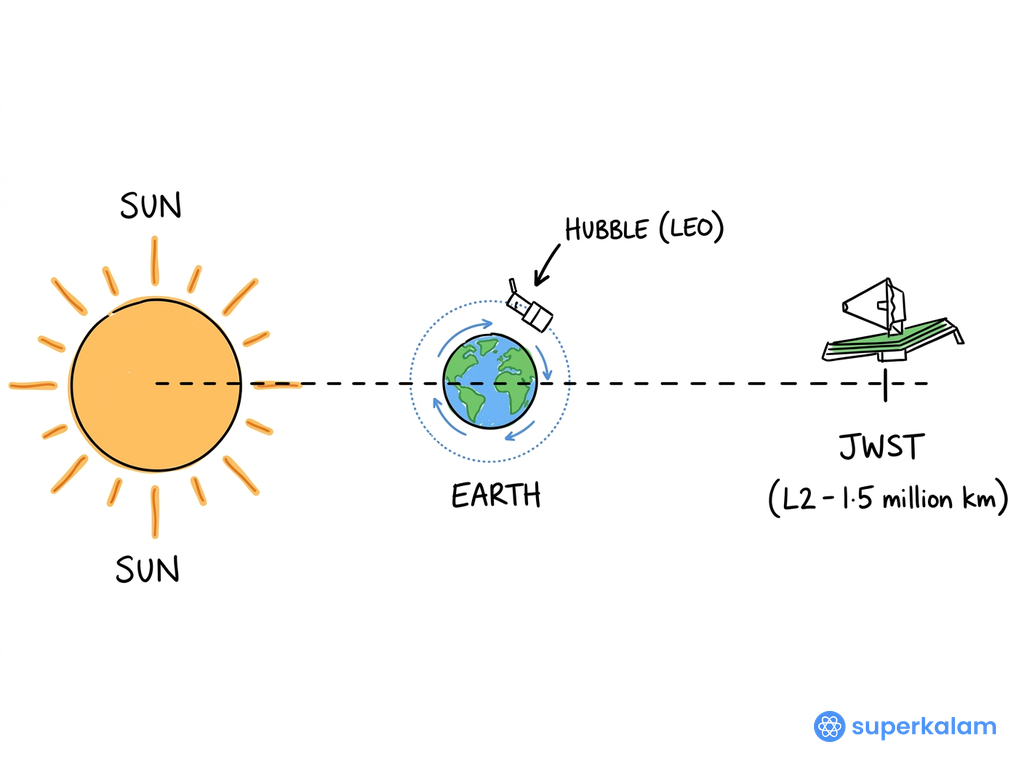
Sun Earth L2 Lagrange Point Alignment
Unique Features of JWST (vs Hubble & others)
-
Infrared Capability – Works primarily in the near and mid-infrared spectrum (0.6–28 microns), unlike Hubble which mostly observes in visible & ultraviolet light. This allows it to peer through dust clouds and study early galaxies.
-
Mirror Size – 6.5 m segmented beryllium mirror (vs Hubble’s 2.4 m), offering ~7 times more light-gathering power and sharper resolution.
-
Sunshield – A 5-layer, tennis-court-sized sunshield keeps instruments at –223°C, preventing infrared interference.
-
Positioning at L2 – 4 times farther than the Moon, providing a stable, cold environment and continuous view of space.
-
High Sensitivity Instruments – Includes NIRCam, NIRSpec, MIRI, and FGS/NIRISS enabling spectroscopy, imaging, and exoplanet atmosphere analysis.
-
Longer Mission Life – Originally 10 years, now extended to ~20 years due to precise fuel usage during launch.
Key Goals of JWST Mission
-
Origin of Galaxies & Stars – Study light from the first stars and galaxies formed after the Big Bang (~13.5 billion years ago).
-
Exoplanet Research – Analyse atmospheres of exoplanets for biosignatures like water, methane, and CO₂.
-
Stellar & Planetary Formation – Observe protoplanetary disks to understand how stars, planets, and solar systems evolve.
-
Cosmic Structure Mapping – Provide insights into dark matter, dark energy, and cosmic expansion.
-
Solar System Studies – Observe planets, moons, asteroids, and comets within our Solar System in unprecedented detail.
Potential Benefits for Humanity
-
Scientific Knowledge – Revolutionises understanding of cosmology, astrophysics, and planetary science.
-
Search for Extraterrestrial Life – Identifying habitable planets could answer one of humanity’s greatest questions.
-
Technological Advancement – Development of cryogenics, optics, and space engineering drives innovation in materials science, AI, and robotics.
-
Earth Applications – Improved infrared imaging has spinoffs in medicine, agriculture, and disaster management.
-
Inspiration & Global Cooperation – Joint effort by NASA–ESA–CSA showcases international collaboration in science and technology.
The James Webb Space Telescope represents a quantum leap in space exploration, extending humanity’s vision deeper into the cosmos than ever before. Its findings may not only reshape our understanding of the universe’s origin but also hold the promise of discovering new Earth-like worlds—bridging the gap between science, philosophy, and the human quest for existence.
Answer Length
Model answers may exceed the word limit for better clarity and depth. Use them as a guide, but always frame your final answer within the exam’s prescribed limit.
Evaluate this PYQ now
Write your answer & evaluate in just 60 seconds




500+ students evaluated
Model Answers from
- 2022Science & Technology15 MarksView Answer
What is the basic principle behind vaccine development? How do vaccines work? What approaches were adopted by the Indian vaccine manufacturers to produce COVID-19 vaccines ?
- 2022Science & Technology10 MarksView Answer
Each year a large amount of plant material, cellulose, is deposited on the surface of Planet Earth. What are the natural processes this cellulose undergoes before yielding carbon dioxide, water and other end products ?
Model Answers by Subject


Crack UPSC with your
Personal AI Mentor
An AI-powered ecosystem to learn, practice, and evaluate with discipline