GS 3: Environment & EcologyGS 2: GovernancePrelims
Why shift matters, Pg4
Delhi's new EV policy targets vehicular emissions, the largest PM2.5 source, prioritizing two-wheelers and commercial vehicles for rapid electrification to combat air pollution.
Practice MCQs
796 Students attempted
Key Highlights:
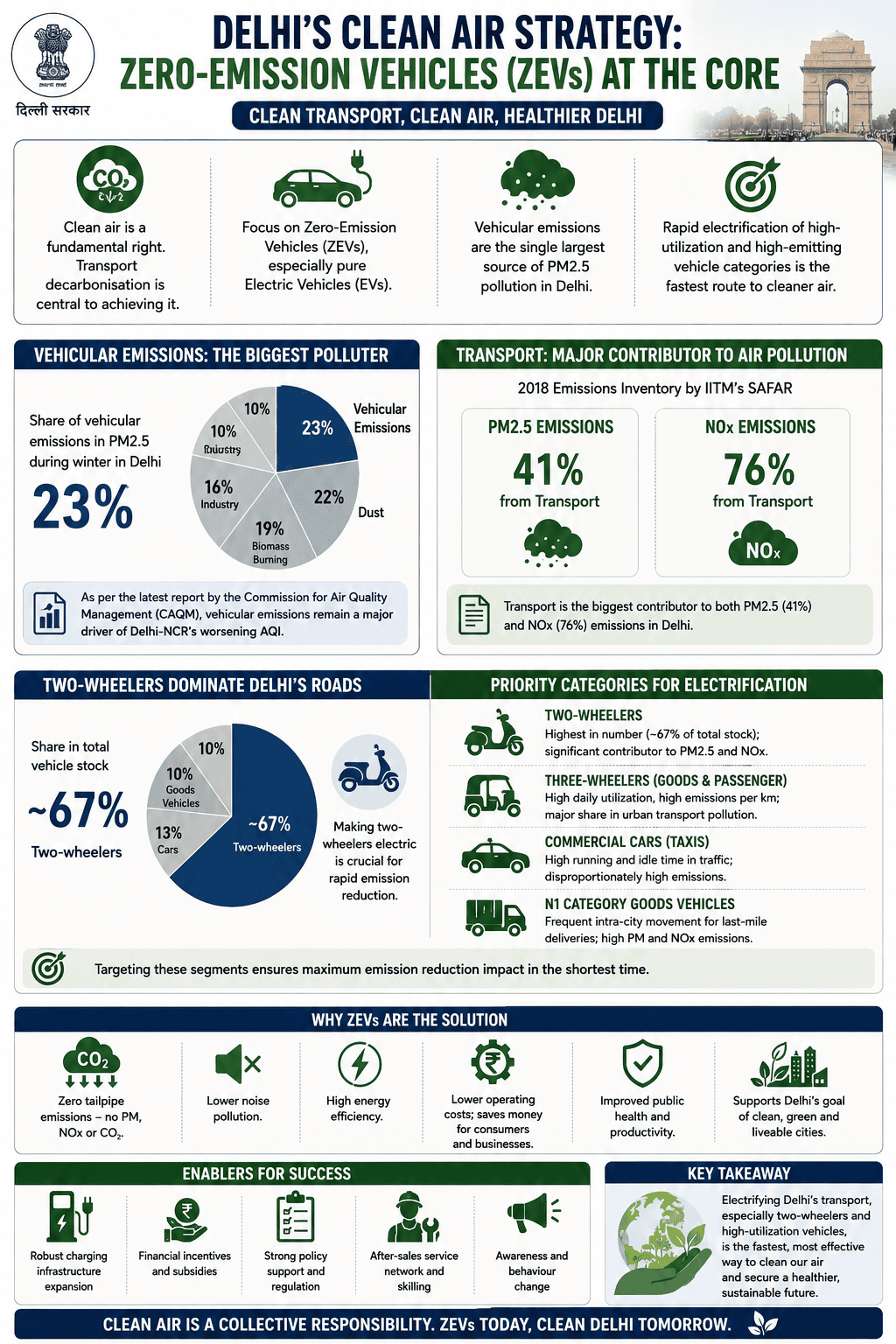
- The Delhi government's clean air strategy focuses on zero-emission vehicles (ZEVs), particularly pure Electric Vehicles (EVs), to improve air quality.
- Vehicular emissions are identified as the single largest source of PM2.5 pollution in Delhi, contributing around 23% during winter.
- Two-wheelers constitute nearly 67% of Delhi’s vehicle stock, making their rapid electrification crucial for reducing emissions.
- Three-wheelers, commercial cars, and N1 category goods vehicles are prioritized for electrification due to their high utilization and disproportionately high emissions.
Delhi ev policy.png
Detailed Insights:
- The policy references the latest report from the Commission for Air Quality Management (CAQM), which highlights vehicular emissions as a major contributor to Delhi-NCR's worsening AQI.
- A 2018 emissions inventory by the Indian Institute of Tropical Meteorology’s System of Air Quality and Weather Forecasting and Research (SAFAR) identified transport as the biggest contributor to PM2.5 (41%) and NOx (76%) emissions.
- Older vehicles, especially those certified under pre-BS-VI norms, emit significantly higher levels of pollutants due to engine deterioration and less effective emission-control systems.
- Traffic congestion further exacerbates emissions by causing inefficient combustion and increasing vehicle-kilometres travelled.
- A 2025 study by Delhi Technological University recommended that India's vehicle scrappage policy should incorporate mileage, in addition to age, to identify highly polluting vehicles.
- A 2021 draft report by The Energy and Resources Institute (TERI) found two-wheelers to be the largest contributors to PM2.5, PM10, sulphur dioxide, and carbon monoxide emissions within the transport sector.
- An earlier source apportionment study by IIT Kanpur estimated that two-wheelers contributed about a third of vehicular PM2.5 and PM10 emissions in Delhi.
- The CAQM also noted that Nitrogen Oxides (NOx) and Volatile Organic Compounds (VOCs) from vehicles react in the atmosphere to form secondary particulate matter, which accounts for about 27% of winter PM2.5 in Delhi.
Key Concepts Involved:
- Zero-emission vehicles (ZEVs): Vehicles that do not emit exhaust gases or other pollutants from their onboard power source.
- PM2.5: Fine particulate matter with a diameter of 2.5 micrometers or less, capable of penetrating deep into the lungs and bloodstream.
- Commission for Air Quality Management (CAQM): A statutory body established to coordinate efforts and implement measures for air quality improvement in the National Capital Region.
- Bharat Stage (BS) Emission Standards: India's vehicular emission standards, aligned with European norms, that regulate pollutant output from internal combustion engines.
- Vehicle Scrappage Policy: A government policy aimed at phasing out older, polluting vehicles by offering incentives for their replacement with newer, cleaner ones.
- N1 category goods vehicles: Light trucks designed for the transport of goods with a gross vehicle weight not exceeding 3.5 tonnes.
- Secondary Particulate Matter: Particles formed in the atmosphere from gaseous precursors (like NOx and VOCs) through chemical reactions, rather than being directly emitted.

SuperKalam is your personal mentor for UPSC preparation, guiding you at every step of the exam journey.
Download the App


STUDY RESOURCES
CONTACT US
ⓒ Snapstack Technologies Private Limited