GS 2: International RelationsGS 3: EconomyGS 2: PolityPrelims
On the delay in India-U.S. trade deal, Pg10
U.S. tariffs, Supreme Court rulings, and new Section 301 investigations stall India-U.S. trade deal, raising bilateral economic uncertainty.
Practice MCQs
796 Students attempted
Key Highlights:
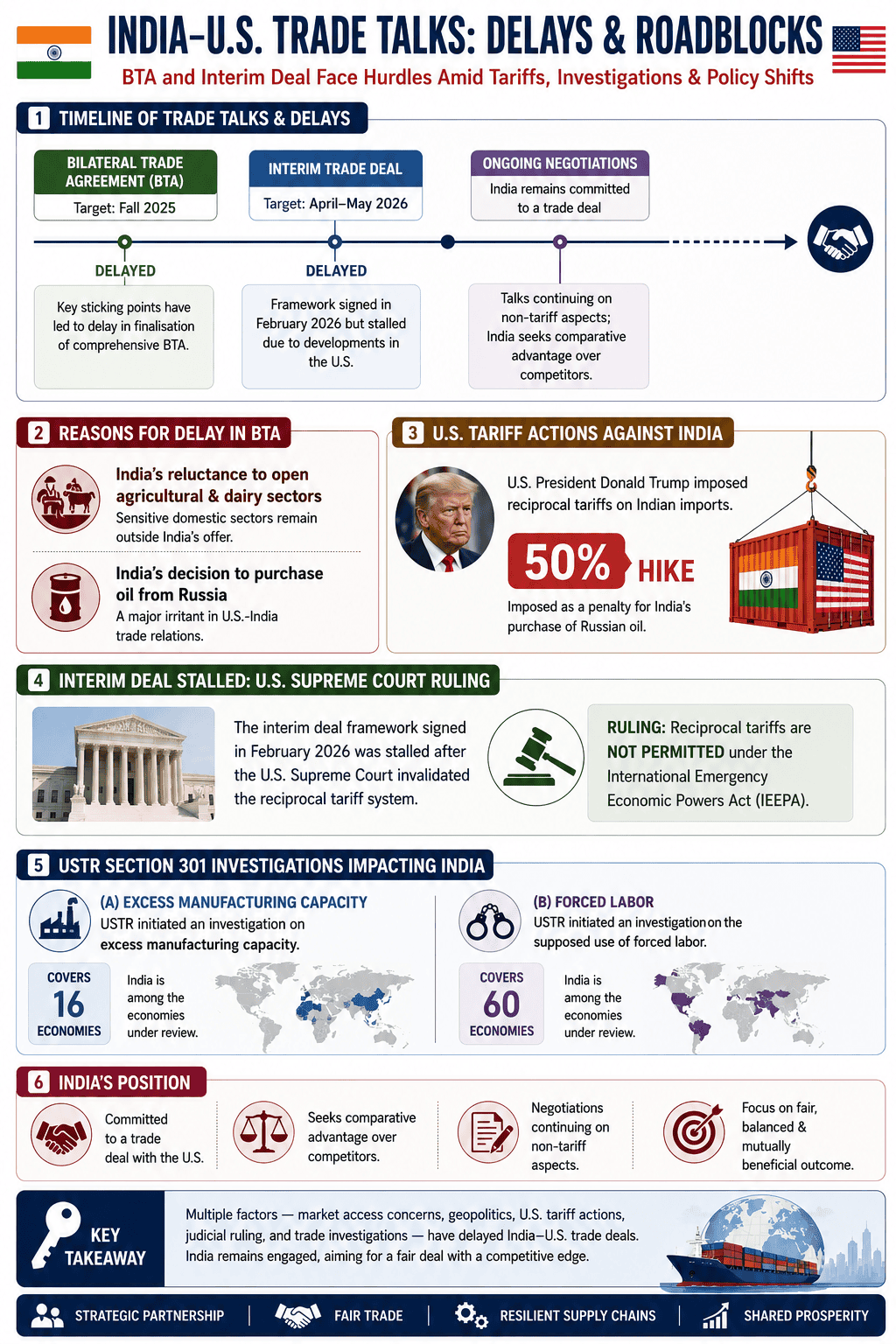
- India and the U.S. have experienced delays in finalizing both a comprehensive Bilateral Trade Agreement (BTA) and an interim trade deal, initially targeted for Fall 2025 and April-May 2026, respectively.
- The BTA faced delays due to India's reluctance to open its agricultural and dairy sectors and its decision to purchase oil from Russia.
- U.S. President Donald Trump imposed reciprocal tariffs, including a 50% hike on Indian imports, as a penalty for India's Russian oil imports.
- The interim deal framework, signed in February 2026, was stalled after the U.S. Supreme Court invalidated the reciprocal tariff system, stating it was not permitted under the International Emergency Economic Powers Act (IEEPA).
- The U.S. Trade Representative (USTR) initiated two Section 301 investigations, one concerning excess manufacturing capacity and another on forced labor, impacting 16 and 60 economies, including India, respectively.
- India remains committed to a trade deal but insists on receiving a comparative advantage over competitors, continuing negotiations on non-tariff aspects.
Ind-US Trade.png
Detailed Insights:
- The Bilateral Trade Agreement (BTA) was first announced in February 2025 by Prime Minister Narendra Modi and U.S. President Donald Trump.
- Talks for the BTA intensified after April 2025 when Mr. Trump paused reciprocal tariffs for 90 days to negotiate with trade partners.
- The interim agreement framework aimed for the U.S. to reduce total tariffs on Indian imports to 18%, providing a competitive advantage.
- The U.S. Supreme Court ruled that the International Emergency Economic Powers Act (IEEPA) does not authorize the President to impose broad import duties.
- Following this, President Trump announced a temporary 10% flat tariff on all imports under the Trade Act of 1974, which was later challenged in court.
- The U.S. Court of International Trade deemed these flat tariffs illegal, though an appeals court stayed that order.
- The USTR's forced labor investigation proposed a 12.5% tariff on imports from 54 countries, including India, for failing to enforce prohibitions on goods produced with forced labor.
- India is actively negotiating non-tariff aspects such as enhanced market access, digital trade, and supply chain resilience.
- India seeks assurance that any tariff benefits will be durable and not disappear with policy changes, ensuring long-term predictability for businesses.
Key Concepts Involved:
- Bilateral Trade Agreement (BTA): A formal agreement between two countries to reduce trade barriers and promote commerce.
- International Emergency Economic Powers Act (IEEPA): A U.S. federal law granting the President authority to regulate economic transactions during a declared national emergency.
- Section 301 Investigations: Trade investigations conducted by the U.S. Trade Representative (USTR) into unfair foreign trade practices that burden U.S. commerce.
- Trade Act of 1974: A U.S. law that grants the President authority to negotiate trade agreements and take action against unfair trade practices.

SuperKalam is your personal mentor for UPSC preparation, guiding you at every step of the exam journey.
Download the App


STUDY RESOURCES
CONTACT US
ⓒ Snapstack Technologies Private Limited