GS 2: PolityGS 2: GovernancePrelims
ONOE and Anti-Defection law, Pg16
Joint Parliamentary Committee debates One Nation, One Election, addressing constitutional hurdles, delimitation, and anti-defection law reforms for synchronized polls by 2034.
Practice MCQs
789 Students attempted
Key Highlights:
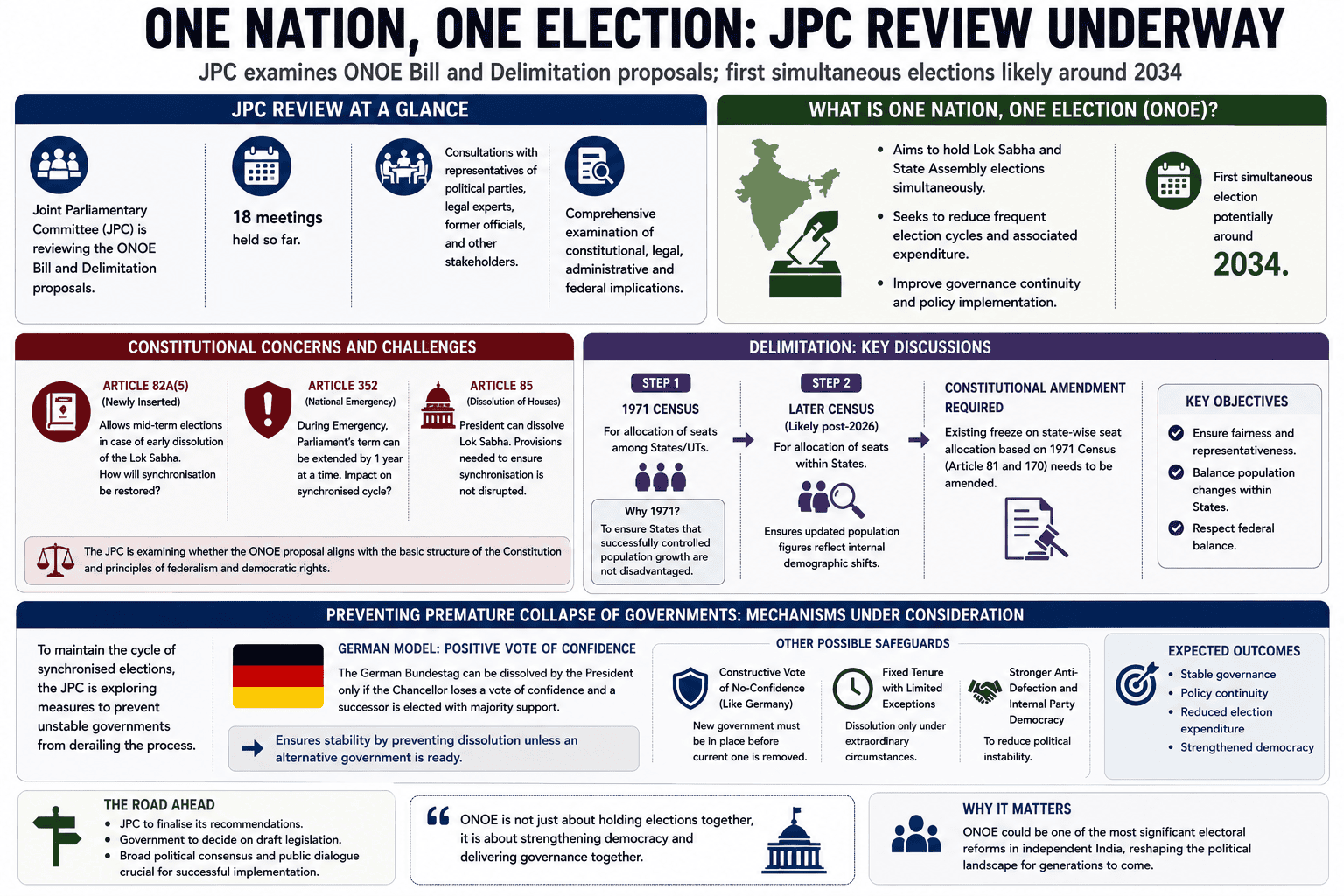
- The Joint Parliamentary Committee (JPC) is reviewing the One Nation, One Election (ONOE) Bill and Delimitation proposals, having held 18 meetings and consulted various stakeholders.
- The ONOE Bill aims to synchronize Lok Sabha and State Assembly elections, with the first simultaneous election potentially occurring around 2034.
- Key concerns include constitutional inconsistencies related to Article 82A(5), Article 352 (Emergency), and Article 85 (dissolution of Houses).
- Delimitation discussions involve using the 1971 Census for state-wise seat allocation and a later Census for allocation within states, requiring a constitutional amendment.
- The committee is exploring mechanisms like the German model of positive vote of confidence to prevent premature government collapses and maintain election synchronisation.
ONOE.png
Detailed Insights:
- The JPC is empowered to propose changes to the ONOE Bill and recommend constitutional amendments to address inconsistencies.
- A major challenge is maintaining election synchronisation over decades, especially if state assemblies or Lok Sabha are dissolved prematurely.
- The ONOE Bill is silent on the basis for the Election Commission's opinion to postpone state elections and the duration of such postponements.
- The German model of positive vote of confidence requires an alternative government to be identified before a no-confidence motion can succeed, preventing political instability.
- A phased introduction of One Nation, One Election is envisioned, where assemblies elected after an "appointed date" may serve shorter terms to align with the national calendar.
- The 1971 Census is proposed as the basis for state-wise seat allocation to protect states that successfully implemented population control measures.
- The debate over using the 2011 Census versus the 2026 Census for delimitation within states is a political decision to expedite the process and potentially women's reservation.
- The anti-defection law is under deliberation for potential relaxation in specific scenarios to balance party discipline with individual legislator's voice.
- Proponents argue that simultaneous elections reduce governance disruption, election costs, voter fatigue, and allow for focused development.
Key Concepts Involved:
- One Nation, One Election (ONOE): A proposal to hold elections for the Lok Sabha and all State Legislative Assemblies simultaneously.
- Delimitation: The process of redrawing boundaries of Lok Sabha and state assembly constituencies to represent changes in population.
- Anti-defection law: The Tenth Schedule of the Indian Constitution, which penalizes individual Members of Parliament or State Legislatures for defecting from their political party.
- Positive Vote of Confidence: A parliamentary procedure where a no-confidence motion against a government can only succeed if a new government is simultaneously elected by the same vote.
- Article 368: Grants the Parliament the power to amend the Constitution and specifies the procedure for doing so.
- Article 82: Mandates the readjustment of Lok Sabha constituencies after every Census.
- Article 85: Empowers the President to summon, prorogue, and dissolve the Lok Sabha.
- Article 352: Deals with the proclamation of a National Emergency in India.

SuperKalam is your personal mentor for UPSC preparation, guiding you at every step of the exam journey.
Download the App


STUDY RESOURCES
CONTACT US
ⓒ Snapstack Technologies Private Limited