GS 3: Science & TechnologyPrelims
How bat viruses become threats, Pg17
UC scientists uncover how a single genetic change in bat viruses, specifically Orf8B protein, can enable immune evasion and human spillover.
Practice MCQs
789 Students attempted
Key Highlights:
- Researchers at the University of California discovered that a single genetic change can profoundly alter how a coronavirus behaves across different species.
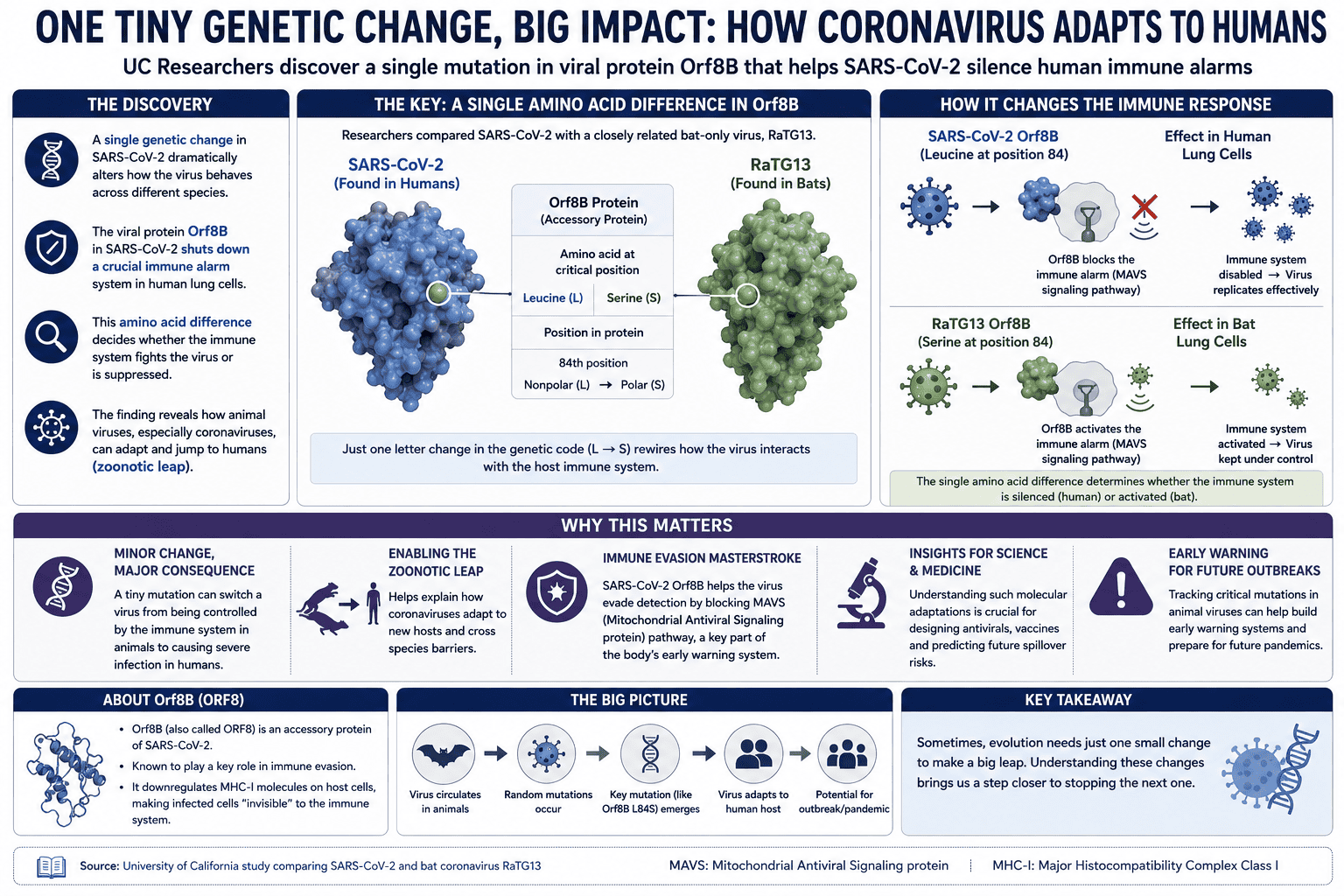
- The viral protein, Orf8B, in SARS-CoV-2 was found to shut down a crucial immune alarm system in human lung cells.
- This specific amino acid difference in Orf8B dictates whether the immune system fights or is suppressed, enabling the virus to replicate effectively in humans.
- The findings offer significant insights into the mechanisms by which animal viruses, particularly coronaviruses, can adapt and make the zoonotic leap to humans.
Corona Virus.png
Detailed Insights:
- The study compared SARS-CoV-2 with a closely related bat-only virus, RaTG13, to understand their differing interactions with host immune systems.
- A single amino acid difference in the Orf8B protein was identified as the critical factor influencing viral behavior in different species.
- In human lung cells, the SARS-CoV-2 version of Orf8B disables the immune system's ability to detect and fight the virus, promoting its multiplication.
- Conversely, the equivalent protein in the bat virus activates an immune response in bat lung cells, helping to keep the virus under control.
- This research underscores how even minor genetic mutations can enable a virus to cross species barriers and cause severe disease in new hosts.
- Understanding these molecular adaptations is vital for developing early warning systems and strategies to mitigate future zoonotic spillover events.
- Orf8B (also referred to as ORF8) is an accessory protein of SARS-CoV-2 known for its role in immune evasion, including downregulating MHC-I molecules.
Scientific/Technical Concepts Involved:
- SARS-CoV-2: The severe acute respiratory syndrome coronavirus 2, responsible for the COVID-19 pandemic.
- Orf8B Protein: An accessory protein of SARS-CoV-2 that modulates host immune responses, influencing viral replication and pathogenesis.
- Amino Acid: The basic organic molecules that serve as the fundamental building blocks for proteins.
- Zoonotic Spillover: The process by which a pathogen transmits from an animal host to a human population, leading to a new infection.

SuperKalam is your personal mentor for UPSC preparation, guiding you at every step of the exam journey.
Download the App


STUDY RESOURCES
CONTACT US
ⓒ Snapstack Technologies Private Limited