GS 3: EconomyGS 2: GovernancePrelims
‘Investment is casualty when industry concentration rises’, Pg7
Expert reveals India's private investment flatlines for 15 years due to rising industry concentration, skill gaps, and poor connectivity.
Practice MCQs
789 Students attempted
Key Highlights:
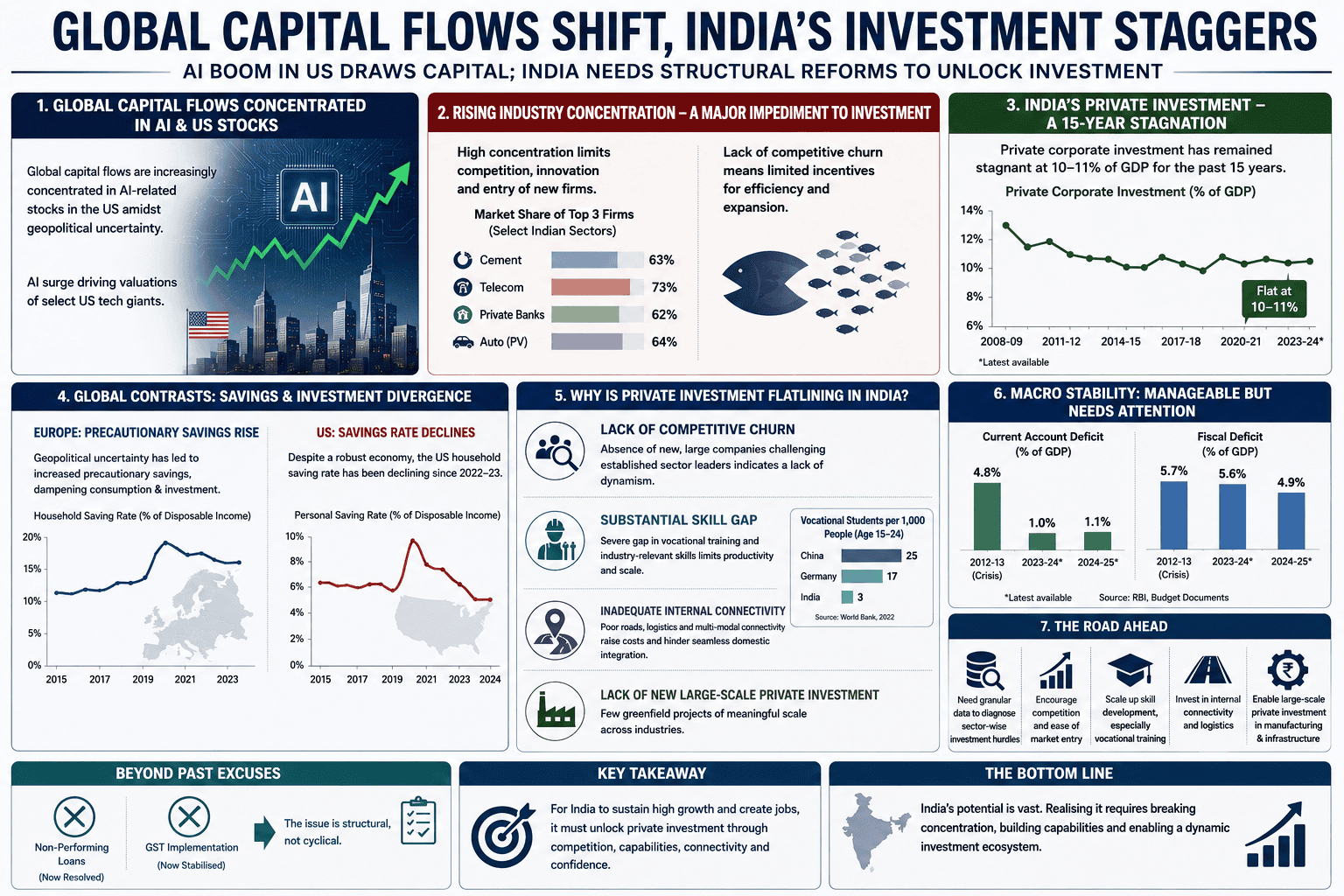
- Global capital flows are increasingly concentrated in AI-related stocks in the US amidst geopolitical uncertainty.
- Rising industry concentration is identified as a significant impediment to investment, particularly in India.
- India's private corporate investment has remained stagnant at 10-11% of GDP for the past 15 years.
- The country faces challenges including a substantial skill gap, especially in vocational training, and inadequate internal connectivity.
- The article highlights a lack of competitive churn and new large-scale private investment in India's industrial sectors.
Global Investment.png
Detailed Insights:
- Geopolitical uncertainty has led to increased precautionary savings in Europe, dampening consumption and investment.
- In contrast, the US has seen declining household saving rates since 2022-23, despite a robust economy.
- India's flatlining private investment is attributed to structural issues like industry concentration, moving beyond past excuses such as Non-Performing Loans or GST implementation.
- The absence of new, large companies challenging established sector leaders indicates a lack of dynamism in the Indian economy.
- India's skill development infrastructure, particularly vocational schools, lags significantly compared to countries like China.
- Poor internal connectivity within India hinders the seamless integration and efficiency of its domestic economy.
- India's Current Account Deficit and Fiscal Deficit are manageable compared to historical crisis levels, but still require attention.
- The article suggests a need for granular data to understand the persistent stagnation in private investment.
Key Concepts Involved:
- Industry Concentration: A market condition where a few large firms dominate a significant portion of the market share.
- Private Corporate Investment: Capital expenditure by private sector companies to expand, modernize, or create new productive assets.
- Non-Performing Loans (NPLs): Loans where the borrower has failed to make scheduled payments for a specified period, typically 90 days.
- Current Account Deficit: When a country's total imports of goods, services, and transfers exceed its total exports.
- Fiscal Deficit: The shortfall in a government's income compared to its spending over a financial year.

SuperKalam is your personal mentor for UPSC preparation, guiding you at every step of the exam journey.
Download the App


STUDY RESOURCES
CONTACT US
ⓒ Snapstack Technologies Private Limited