GS 3: Environment & EcologyGS 2: GovernancePrelims
Govt flags priority intervention in 25 of 58 tiger reserves which are low on big cats or have none, Pg9
Government flags 25 tiger reserves with critically low or zero big cats for priority intervention, urging science-backed reintroductions and community participation.
Practice MCQs
789 Students attempted
Key Highlights:
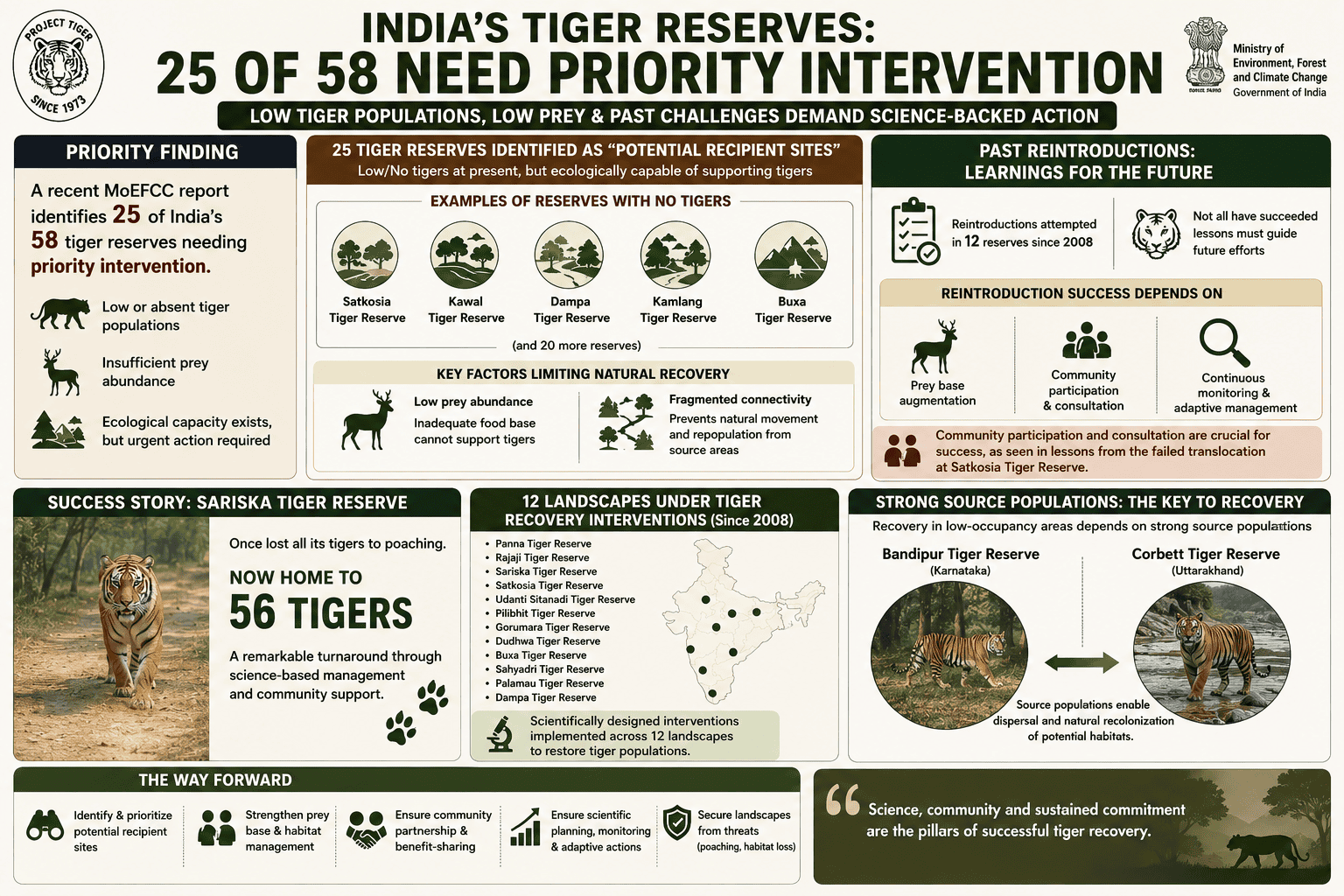
- A recent Ministry of Environment, Forest and Climate Change report identified 25 of India's 58 tiger reserves needing priority intervention.
- These reserves are characterized by low or absent tiger populations and insufficient prey abundance.
- The report highlighted that past tiger reintroductions in 12 reserves have not consistently succeeded, necessitating rigorous, science-backed approaches.
- Union Minister Bhupender Yadav released two reports on active tiger management and reintroduction learnings at an event in Alwar.
- Sariska Tiger Reserve, which previously lost all its tigers to poaching, now hosts 56 tigers, marking a successful reintroduction effort.
Tiger Reserves.png
Detailed Insights:
- The 25 identified reserves are designated as "potential recipient sites" due to their ecological capacity to support tigers despite current low or absent populations.
- Specific reserves like Satkosia Tiger Reserve, Kawal Tiger Reserve, Dampa Tiger Reserve, Kamlang Tiger Reserve, and Buxa Tiger Reserve currently have no tigers.
- Recurring challenges include low prey abundance and fragmented connectivity, which prevent natural repopulation from source areas.
- Project Tiger officials and the Environment Minister emphasized that community participation and consultation are crucial for successful reintroductions, citing lessons from the failed translocation at Satkosia Tiger Reserve.
- Successful reintroduction strategies require a combination of prey base augmentation, active community involvement, and continuous monitoring.
- Since 2008, scientifically designed tiger recovery interventions have been implemented across 12 landscapes, including Panna Tiger Reserve and Rajaji Tiger Reserve.
- The recovery of tiger populations in low-occupancy areas is dependent on the presence of strong source populations, such as those found in Bandipur Tiger Reserve and Corbett Tiger Reserve.
Key Concepts Involved:
- Tiger Reserve: A protected area specifically designated for the conservation of tigers and their habitats.
- Translocation: The process of capturing, transporting, and releasing wild animals from one location to another for conservation purposes.
- Prey Base Augmentation: Measures taken to increase the population of prey animals to support predator populations like tigers.
- Community Participation: The active involvement of local communities in conservation initiatives, vital for the long-term success of such projects.

SuperKalam is your personal mentor for UPSC preparation, guiding you at every step of the exam journey.
Download the App


STUDY RESOURCES
CONTACT US
ⓒ Snapstack Technologies Private Limited