GS 3: Environment & EcologyPrelims
How saving elephants helps forests breathe easier, Pg8
India's elephant reserves boost forest carbon storage by 38%, aiding climate goals; study emphasizes habitat quality over mere declarations.
Practice MCQs
782 Students attempted
Key Highlights:
- A recent study highlights that protecting the endangered Asiatic elephant (Elephas maximus indicus) indirectly aids in safeguarding India's forests as significant carbon stores.
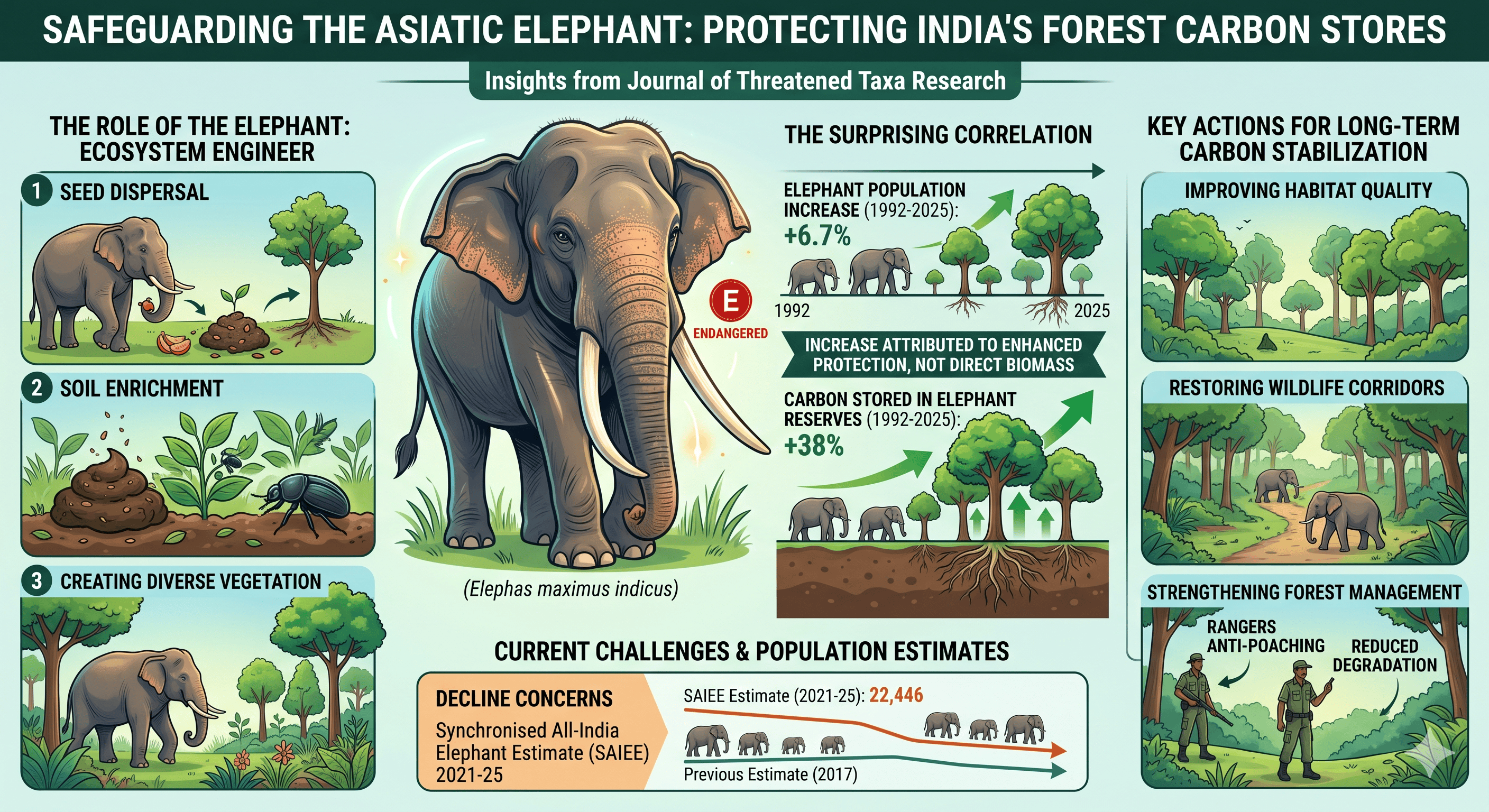
- The research, published in the Journal of Threatened Taxa, found that the carbon stored within elephant reserves increased by 38% between 1992 and 2025, despite only a marginal 6.7% rise in the elephant population.
- This increase in carbon storage is primarily attributed to enhanced protection and reduced degradation of existing forest carbon stocks, rather than direct biomass creation by elephants.
- The study emphasizes that merely declaring more areas as elephant reserves is insufficient; improving habitat quality, restoring wildlife corridors, and strengthening forest management are crucial for long-term carbon stabilization.
- Concerns were raised about a decline in elephant numbers under the new Synchronised All-India Elephant Estimate (SAIEE) 2021-25 methodology, which reported 22,446 elephants, fewer than the 2017 estimate.
Elephant.png
Detailed Insights:
- The Asiatic elephant (Elephas maximus indicus) is a subspecies of the Asian elephant, native to the Indian subcontinent, and is classified as endangered.
- Elephants are considered "ecosystem engineers" due to their vital roles in seed dispersal, soil enrichment through dung, and creating diverse vegetation, which helps maintain healthy, carbon-storing forests.
- The network of elephant reserves in India expanded significantly from 18,297 sq. km (3 reserves) to 80,777 sq. km (33 reserves) between 1992 and 2025.
- The study indicated a weak correlation between the number of elephant reserves and population growth, suggesting that administrative declarations alone do not guarantee the species' future if habitats remain fragmented.
- India's carbon sink target, as part of its Nationally Determined Contributions (NDCs), aims to create an additional 2.5 to 3 billion tonnes of CO2 equivalent carbon sink by 2030, a target that remained unchanged in the 2022 updated NDC.
- More recently, India's new NDC (2031-2035), approved in March 2026, targets creating a 3.5 to 4 billion tonnes of CO2 equivalent carbon sink through forest and tree cover by 2035 from 2005 levels.
- Policy integration of megafauna protection with forest-carbon goals and incorporating wildlife-inclusive accounting within REDD+ frameworks could strengthen India's climate commitments.
Key Concepts Involved:
- Carbon Stabilisation: The process of trapping atmospheric carbon and locking it into stable, solid forms like soil or organic matter to mitigate climate change.
- Ecosystem Engineers: Organisms that significantly modify, create, or maintain habitats, thereby influencing the availability of resources for other species.
- REDD+: A UNFCCC mechanism that provides financial incentives to developing countries for reducing emissions from deforestation and forest degradation, and for conservation, sustainable forest management, and enhancement of forest carbon stocks.
- Nationally Determined Contributions (NDCs): Climate action plans submitted by countries under the Paris Agreement, outlining their efforts to reduce national emissions and adapt to the impacts of climate change.

SuperKalam is your personal mentor for UPSC preparation, guiding you at every step of the exam journey.
Download the App


STUDY RESOURCES
CONTACT US
ⓒ Snapstack Technologies Private Limited