GS 2: PolityGS 2: GovernanceGS 3: EconomyPrelims
What is Centre's Bill to constitute single higher education authority, Pg17
Centre proposes HECI Bill 2025, a single higher education regulator merging UGC, NCTE, AICTE, aiming autonomy and reduced red tape.
Practice MCQs
804 Students attempted
Key Highlights:
- The Higher Education Commission of India (HECI) Bill, 2025 is set to be presented in the Parliament's winter session.
- The Bill aims to establish a single regulatory authority for higher education by merging the University Grants Commission (UGC), the National Council for Teacher Education (NCTE), and the All India Council for Technical Education (AICTE).
- This initiative follows the recommendation of the National Education Policy (NEP) 2020 to create an overarching regulatory body.
Detailed Insights:
- The NEP 2020 envisions HECI having four verticals: the National Higher Education Regulatory Council (NHERC) for regulation, the National Accreditation Council (NAC) for accreditation, the General Education Council (GEC) for framing learning outcomes, and the Higher Education Grants Council (HEGC) for funding.
- The proposed HECI aims to reduce bureaucracy and promote autonomy among higher education institutions, addressing the issues of conflicts of interest and lack of accountability in the current regulatory system.
- A previous Bill from 2018 to replace the UGC with HECI faced criticism for potentially centralizing power, overregulation, limited stakeholder representation, and transferring financial powers to the Ministry of Human Resource Development (MHRD).
- Concerns were raised about the composition of the HECI, with criticisms regarding insufficient representation from disadvantaged sections and heavy central government influence, potentially creating conflicts between national and state-level regulations for state universities.
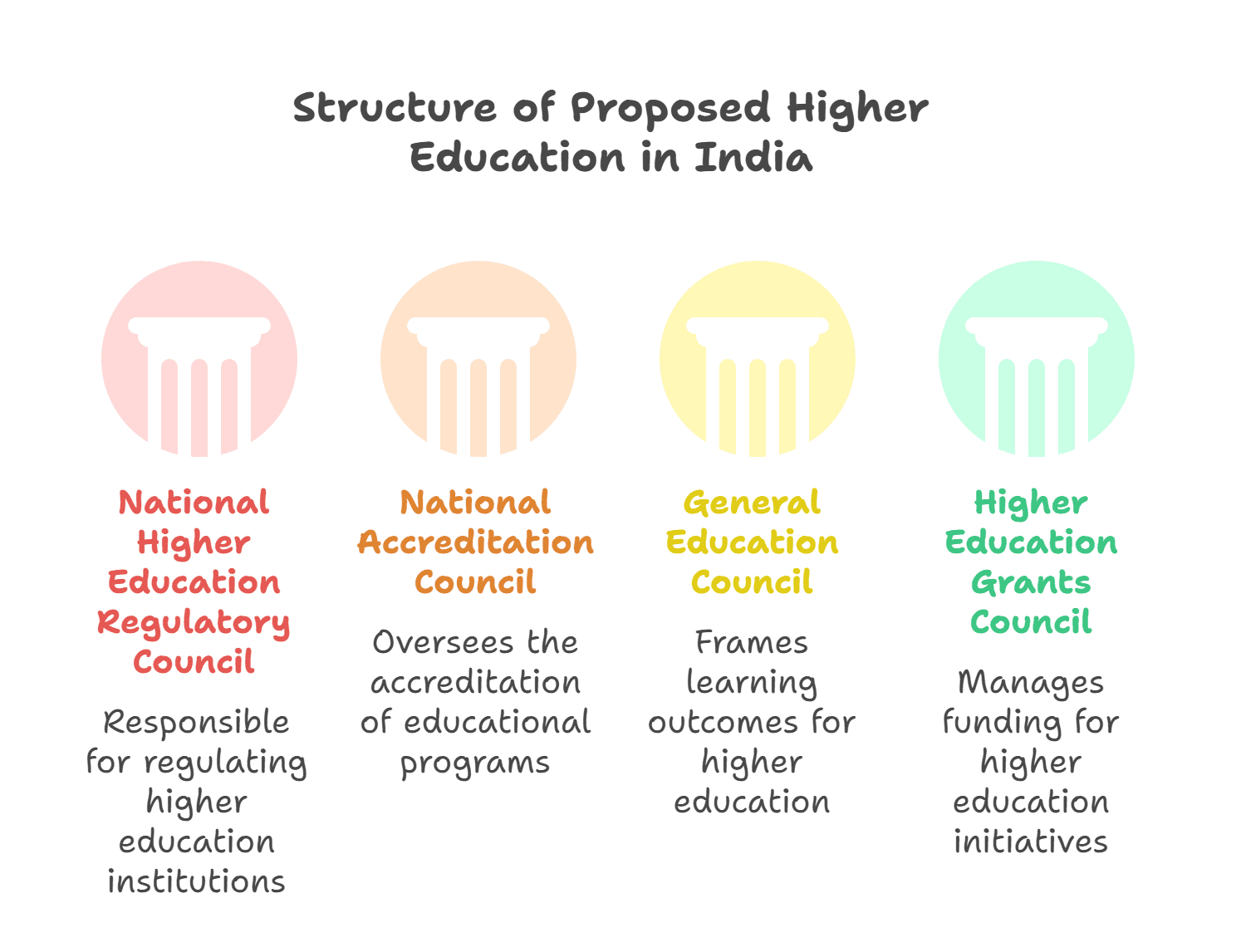
Structure of Proposed Higher Education in India.png
Key Concepts Involved:
- University Grants Commission (UGC): A statutory body responsible for the coordination, determination, and maintenance of standards of university education in India.
- National Education Policy (NEP) 2020: A comprehensive framework to transform the education system in India by 2040, focusing on accessibility, equity, quality, affordability, and accountability.
- All India Council for Technical Education (AICTE): A statutory body and a national-level council for technical education, responsible for planning, formulation, and maintenance of norms and standards.

SuperKalam is your personal mentor for UPSC preparation, guiding you at every step of the exam journey.
Download the App


STUDY RESOURCES
CONTACT US
ⓒ Snapstack Technologies Private Limited