GS 1: Physical GeographyGS 3: Disaster ManagementGS 2: GovernanceGS 2: International RelationsPrelims
Tragic evening, Pg6
Devastating 7.5 magnitude earthquake levels Caracas, killing hundreds; India must urgently re-evaluate its shelved seismic building codes amidst high vulnerability.
Practice MCQs
775 Students attempted
Key Highlights:
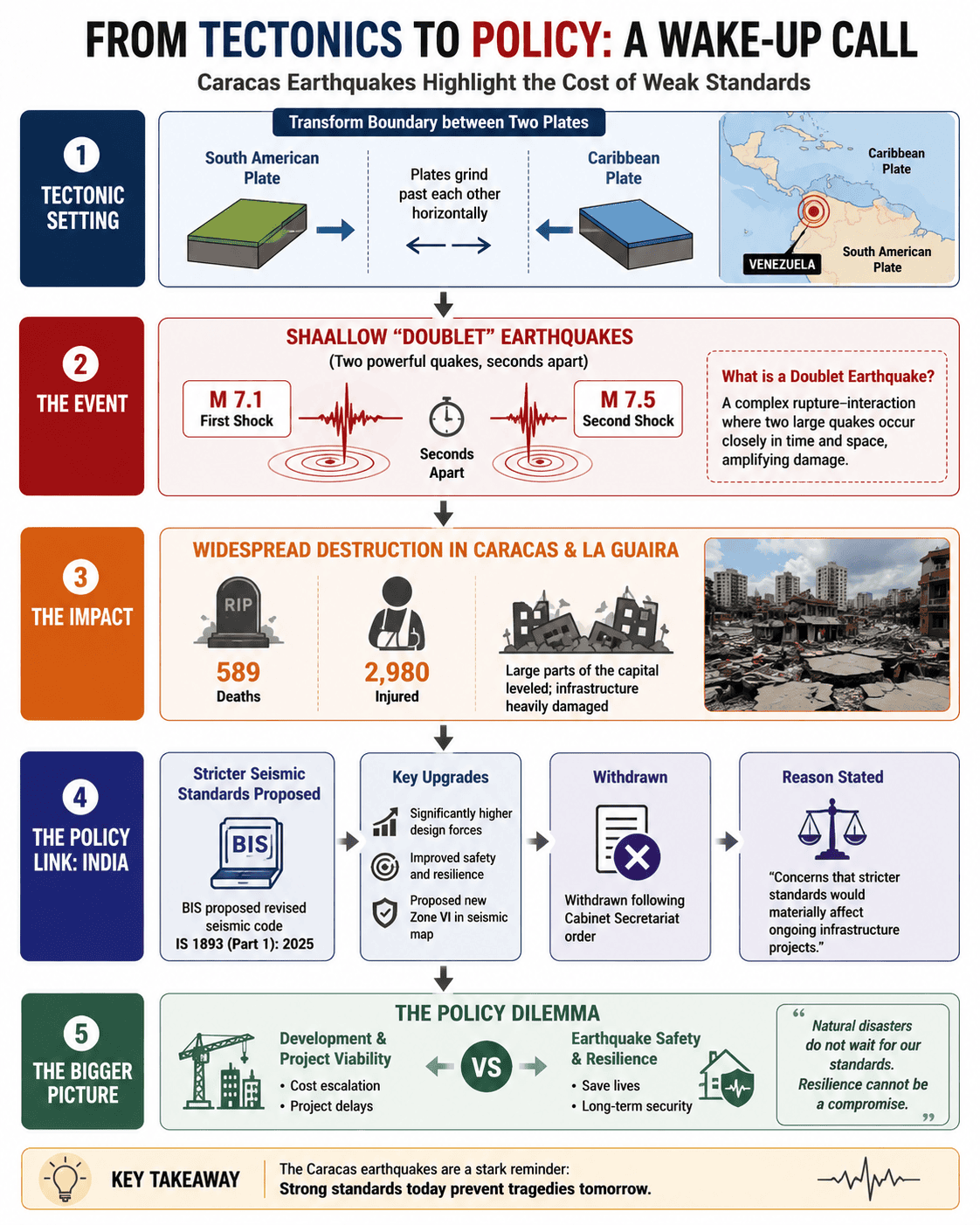
- Two powerful earthquakes, measuring magnitudes 7.1 and 7.5, struck Caracas, Venezuela, seconds apart on Wednesday, June 24, 2026.
- The quakes caused widespread destruction, leveling large parts of the capital and the state of La Guaira, resulting in 589 deaths and 2,980 injuries.
- Geologically, these were shallow "doublet" earthquakes, a complex rupture-interaction where the South American and Caribbean plates grind past each other.
- India's Bureau of Indian Standards (BIS) recently withdrew a revised seismic code (IS 1893 (Part 1): 2025) that would have significantly increased design forces and added a Zone VI to the seismic map.
- This withdrawal followed a Cabinet Secretariat order, citing concerns that the stricter standards would "materially affect" ongoing infrastructure projects.
Venezuala Earthquake.png
Detailed Insights:
- The Venezuelan earthquakes' shallow depth, under 30 kilometers, intensified their destructive impact on surface structures.
- The US Geological Survey (USGS) had flagged a plausible death toll exceeding 10,000 for the Venezuela event, indicating the severe potential of such quakes.
- The 2023 Türkiye-Syria earthquakes, which killed over 55,000 people, were also identified as "doublet" events with similar characteristics.
- The withdrawn Indian seismic code, based on a decade of research, aimed to align India's hazard assessment with global standards.
- India's current Zone V designs for 0.36g, significantly lower than the 0.75g in Pakistan and Nepal, or 1g in the US and Japan, for similar seismic regions.
- Approximately 79% of Indians reside in areas prone to moderate to severe seismic threats.
- A staggering 95% of earthquake-related fatalities in India occur in one- to three-storey houses, which often fall outside stringent building code enforcement.
- The shelving of the updated seismic code in India was partly due to concerns over potential cost increases for construction projects, ranging from 10% to 50%.
Key Concepts Involved:
- Doublet earthquake: A sequence of two distinct earthquakes of comparable magnitude occurring close in time and location, where both are considered mainshocks.
- Seismic design forces (g-force): A measure of the maximum ground acceleration, expressed as a fraction of the acceleration due to gravity, used to design earthquake-resistant structures.
- Bureau of Indian Standards (BIS): India's national body responsible for the development and implementation of standards, including those for earthquake-resistant construction.
- Cabinet Secretariat: The principal coordinating agency of the Government of India, responsible for assisting the Cabinet and ensuring inter-ministerial coordination.

SuperKalam is your personal mentor for UPSC preparation, guiding you at every step of the exam journey.
Download the App


STUDY RESOURCES
CONTACT US
ⓒ Snapstack Technologies Private Limited