GS 3: EconomyGS 2: International RelationsPrelims
India-New Zealand FTA, a modern trade partnership, Pg6
India-New Zealand FTA targets transforming modest $1.3 billion trade into a modern economic partnership, emphasizing services, compliance, and non-tariff barriers for growth.
Practice MCQs
775 Students attempted
Key Highlights:
- India and New Zealand are exploring a Free Trade Agreement (FTA) to enhance their currently modest bilateral trade.
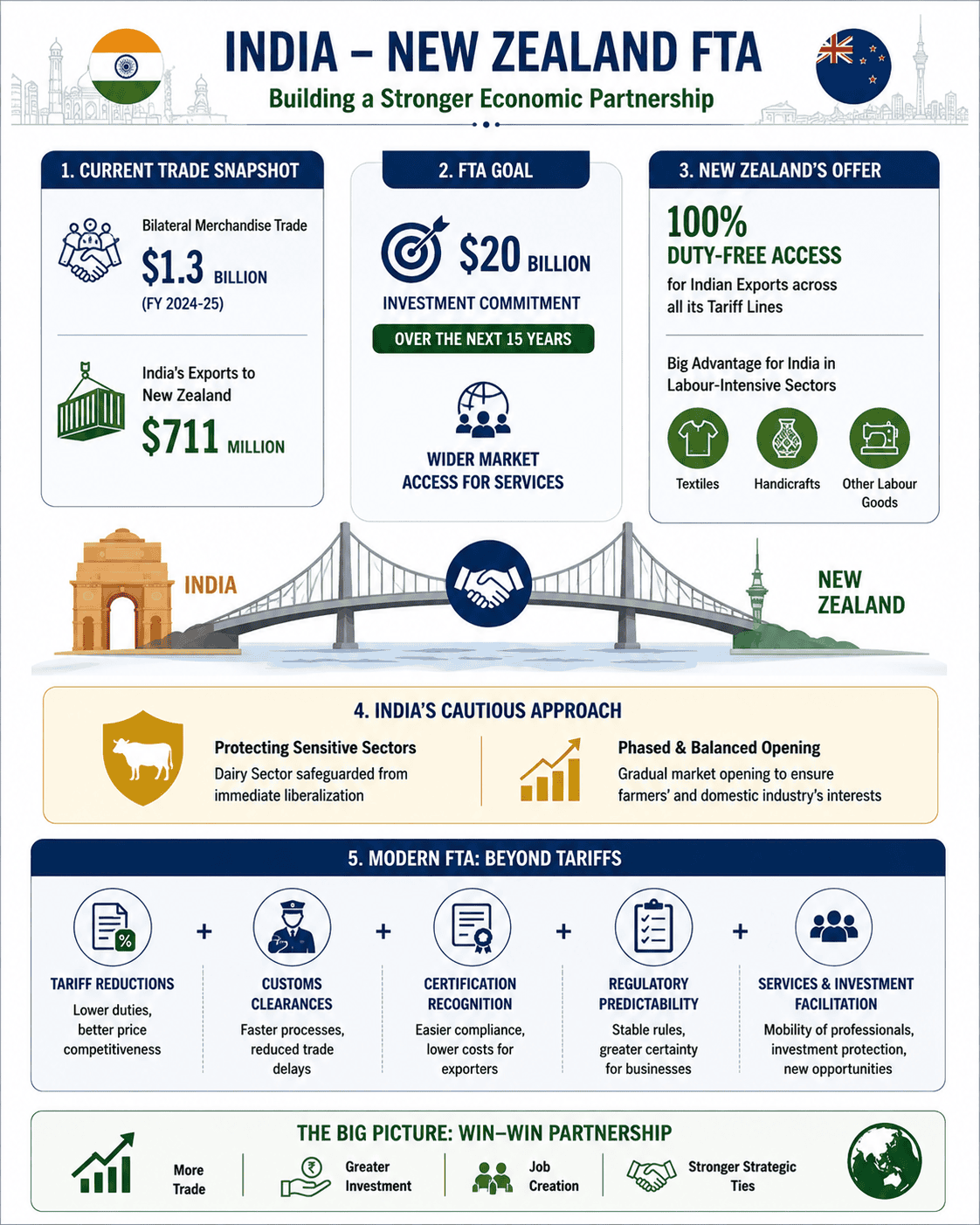
- Bilateral merchandise trade stood at approximately $1.3 billion in FY 2024-25, with India's exports to New Zealand accounting for around $711 million.
- The proposed FTA aims for a $20 billion investment commitment over the next 15 years and wider market access for services.
- New Zealand offers 100% duty-free access for Indian exports across all its tariff lines.
- India maintains a cautious approach, protecting sensitive sectors like dairy from immediate liberalization.
India-NZ.png
Detailed Insights:
- Modern trade agreements extend beyond tariff reductions to include factors like customs clearances, certification recognition, and regulatory predictability.
- New Zealand's duty-free access provides a significant pricing advantage for Indian exports in labor-intensive sectors like textiles and handicrafts.
- India's trade negotiation strategy increasingly focuses on opening new opportunities while safeguarding vulnerable domestic industries.
- Services, including technology, consulting, healthcare, and education, are expected to be major beneficiaries due to greater market access and professional mobility provisions.
- The Rules of Origin (RoO) framework is crucial, requiring businesses to demonstrate product origin to claim preferential treatment and prevent misuse.
- Trade facilitation measures, such as faster customs clearances and digital certification, aim to reduce transaction costs and improve supply chain efficiency.
- The agreement also seeks to address non-tariff barriers, particularly in sectors like pharmaceuticals and food processing, by streamlining regulatory approvals.
- This FTA signifies India's shift towards a facilitation-led trade policy, emphasizing reduced transaction costs and faster market access for businesses.
Key Concepts Involved:
- Free Trade Agreement (FTA): A pact between two or more countries to reduce barriers to imports and exports among them.
- Rules of Origin (RoO): Specific criteria used to determine the national source of a product, crucial for preferential trade agreements.
- Harmonised System (HS) classifications: An internationally standardized system of names and numbers for classifying traded products.

SuperKalam is your personal mentor for UPSC preparation, guiding you at every step of the exam journey.
Download the App


STUDY RESOURCES
CONTACT US
ⓒ Snapstack Technologies Private Limited