GS 2: PolityGS 2: GovernanceGS 1: Indian GeographyGS 3: Environment & EcologyPrelims
3 States close ranks on Tungabhadra basin, Pg1
Three states, Union Jal Shakti Minister forge historic consensus on Tungabhadra basin water management, initiating major desilting project.
Practice MCQs
767 Students attempted
Key Highlights:
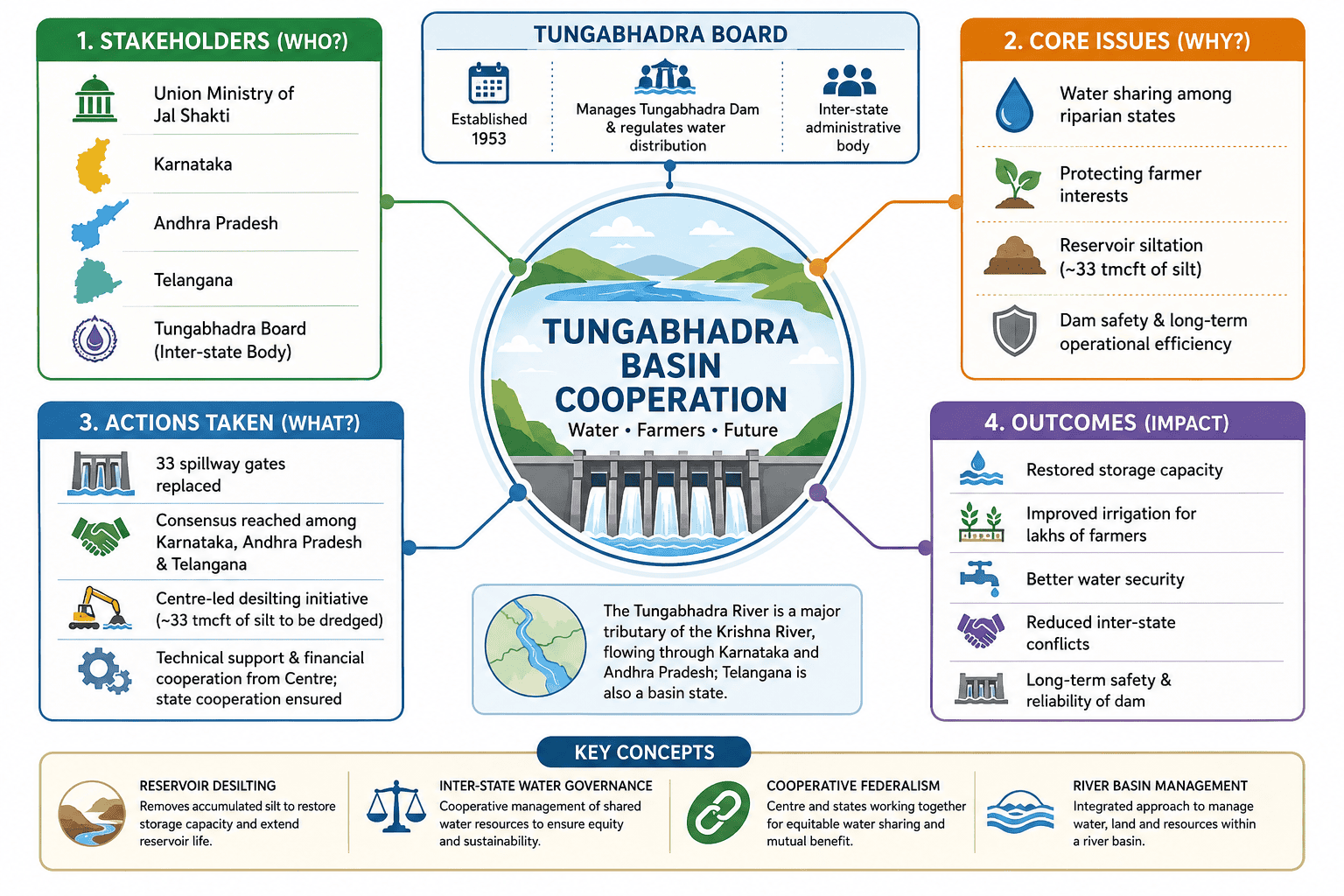
- Karnataka, Andhra Pradesh, and Telangana have reached a consensus on protecting farmer interests and addressing water-sharing issues in the Tungabhadra basin.
- The agreement was announced during the inauguration of 33 newly installed spillway gates of the Tungabhadra reservoir in Vijayanagara, Karnataka.
- Union Jal Shakti Minister C.R. Patil met with the Chief Ministers of the three states to discuss key irrigation matters, including the desilting of the Tungabhadra reservoir.
- The Union government plans to dredge the Tungabhadra dam to address an estimated 33 tmcft of accumulated silt, with technical support from the Centre and cooperation from the states.
TungaBhadra.png
Detailed Insights:
- The Tungabhadra River is a major tributary of the Krishna River, flowing through Karnataka and Andhra Pradesh, with Telangana also being a basin state.
- The Tungabhadra Board, an inter-state body established in 1953 under the Andhra State Act, 1953, manages the dam and water distribution among the riparian states.
- The replacement of the 33 spillway gates is crucial for the long-term safety and operational efficiency of the Tungabhadra dam.
- Silt accumulation significantly reduces the storage capacity of reservoirs, impacting irrigation and water availability for lakhs of farmers.
- The Ministry of Jal Shakti was formed in 2019 to address India's water challenges, including inter-state water disputes and water conservation efforts.
- While the Tungabhadra Project has historically seen fewer disputes due to the Tungabhadra Board, recent projects like the Upper Bhadra Project have raised concerns among downstream states.
Key Concepts Involved:
- Tungabhadra Board: An inter-state administrative body responsible for the regulation and maintenance of the Tungabhadra Dam and its water distribution.
- Reservoir Desilting: The process of removing accumulated sediment from a reservoir to restore its original storage capacity and prolong its operational life.
- Inter-State Water Disputes: Conflicts between states over the sharing and management of river waters, often resolved through tribunals or cooperative agreements.
- Ministry of Jal Shakti: A Union government ministry responsible for water resources management, drinking water supply, and sanitation across India.

SuperKalam is your personal mentor for UPSC preparation, guiding you at every step of the exam journey.
Download the App


STUDY RESOURCES
CONTACT US
ⓒ Snapstack Technologies Private Limited