GS 3: Environment & EcologyGS 2: GovernancePrelims
Scaling climate adaptation from policy to grassroots, Pg8
India grapples with $170 billion climate losses; Economic Survey highlights Tamil Nadu's Climate Resilient Villages for nationwide adaptation strategy.
Practice MCQs
739 Students attempted
Key Highlights:
- India ranks as the ninth most climate-vulnerable country, experiencing 430 extreme weather events between 1995 and 2024, causing $170 billion in losses and impacting 1.3 billion people.
- India's Nationally Determined Contributions (NDCs) for 2031-35 emphasize integrating climate resilience and adaptation into its development strategy, focusing on coastal resilience, infrastructure, and disaster preparedness.
- Tamil Nadu's Climate Resilient Villages (CRV) programme is recognized as a model practice in the Economic Survey for 2025-26, showcasing a holistic approach to climate adaptation.
- The UNEP Adaptation Gap Report 2025 indicates a $284-$339 billion annual financing gap for developing countries through 2035, highlighting the need for domestic resource mobilization in India.
Detailed Insights:
- India's updated NDCs align with global commitments to triple adaptation finance by 2035 and the adoption of Belém Adaptation Indicators at COP30, requiring sustained financing and institutionalization.
- The Indian Council of Agricultural Research (ICAR)’s National Innovations in Climate Resilient Agriculture (NICRA) pilot program maps risks in 651 districts, focusing on climate-smart agriculture and farmer capacity-building.
- Tamil Nadu's CRV programme, supported by WRI India, takes a holistic approach across 11 vulnerable districts, addressing water management, flood/drought mitigation, and renewable energy.
- While the Economic Survey 2025-26 estimates adaptation spending at 5.6% of GDP in FY22, the Union Budget 2026–27 is skewed toward mitigation, necessitating a clearer typology for adaptation finance.
- Quantifying adaptation benefits, such as avoidable losses and socio-economic advantages, can leverage private and international investment, with a WRI study estimating a ten-fold return on adaptation investment.
- Institutionalizing planning requires regular climate vulnerability assessments, integrating socio-economic factors, and leveraging existing State and district climate change cells with dedicated workforces.
- Locally Led Adaptation (LLA), emphasized at COP30, involves co-developing resilience planning with communities, applying place-based approaches, and raising climate awareness.
- Adaptation strategies should encompass skill development, alternative livelihoods, and rehabilitation guidelines, requiring capacity-building and behavioral change across multiple levels for a whole-of-systems approach.
Key Concepts Involved:
- Nationally Determined Contributions (NDCs): Commitments by countries to reduce national emissions and adapt to the impacts of climate change.
- Adaptation Finance: Financial resources allocated to projects and programs that help countries and communities adapt to the adverse effects of climate change.
- Climate Resilience: The capacity of social, economic, and ecosystems to cope with hazardous events and trends related to climate change.
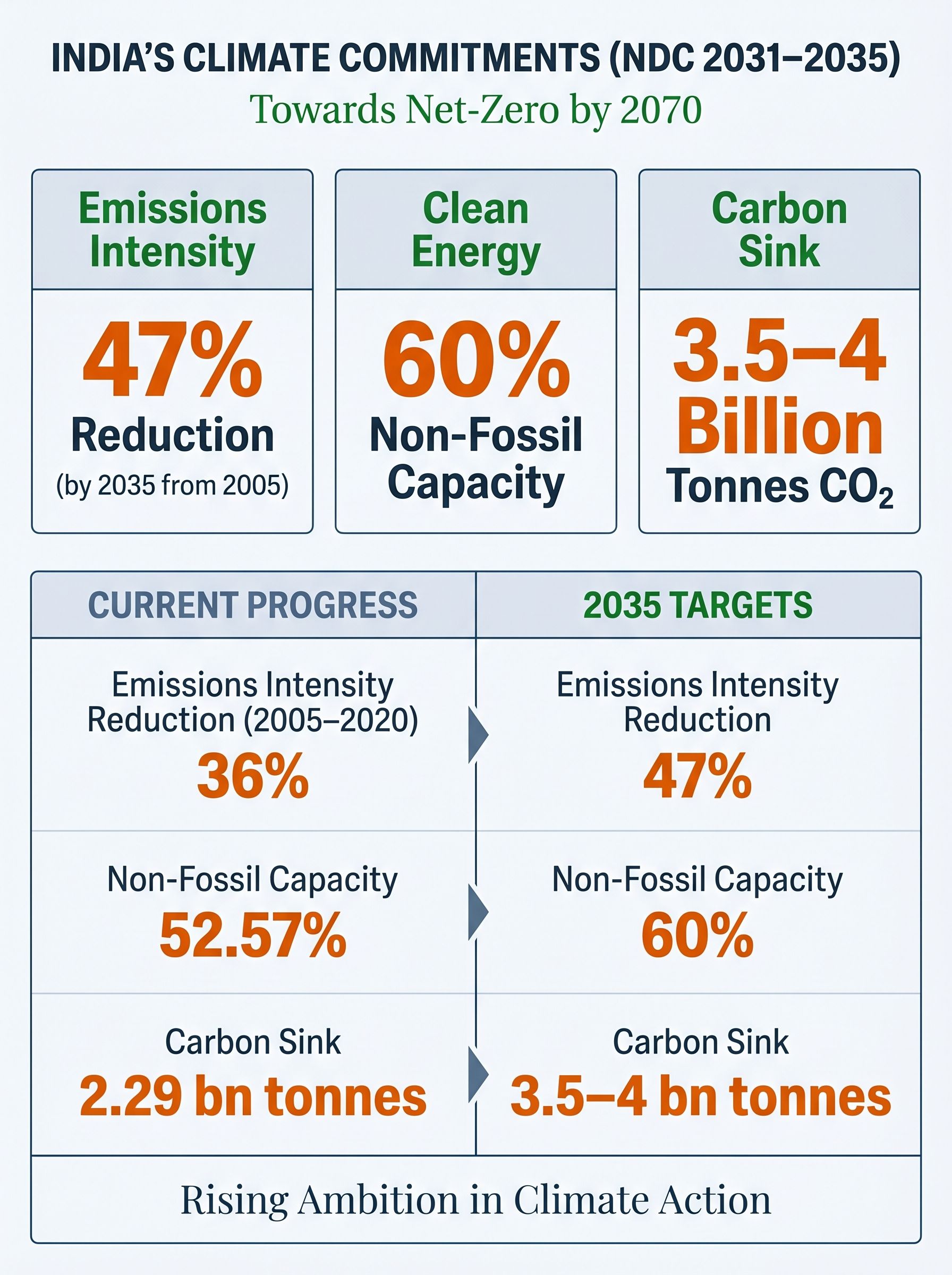
India's NDCs

SuperKalam is your personal mentor for UPSC preparation, guiding you at every step of the exam journey.
Download the App


STUDY RESOURCES
CONTACT US
ⓒ Snapstack Technologies Private Limited