GS 3: Science & TechnologyGS 3: Environment & EcologyPrelims
How proteins are being tweaked to be quantum sensors inside the body, PgII
Scientists modify fluorescent proteins into quantum sensors for detecting magnetic fields and radio waves inside living cells, revolutionizing biological studies.
Practice MCQs
898 Students attempted
Key Highlights:
- Fluorescent proteins can be modified to act as quantum sensors to detect magnetic fields and radio waves inside living cells.
- Researchers modified enhanced yellow fluorescent protein (EYFP) to manipulate its spin state using lasers and detect magnetic resonance signals inside cells.
- Scientists engineered MagLOV proteins from plant light-sensing proteins, exhibiting magnetic resonance in living bacterial cells at room temperature.
- These protein-based sensors can be genetically encoded, allowing cells to produce them naturally and be positioned at specific locations inside the cell.
Detailed Insights:
- Fluorescent proteins, known for their ability to glow under illumination, have been used for decades in biology to track molecules inside cells.
- The discovery challenges the assumption that quantum effects cannot exist in living cells due to their warm, crowded, and constantly moving conditions.
- Radical pairs, formed when an electron interacts with a nearby molecule inside the protein, are sensitive to weak magnetic influences, altering the protein's light emission.
- MagLOV proteins combine stability, sensitivity, and genetic compatibility, overcoming limitations of previous biological candidates for quantum sensors.
- Magnetic modulation can improve conventional fluorescence imaging by separating the MagLOV signal from background fluorescence, enhancing weak signals in noisy environments.
- Protein-based quantum sensors could enable nanoscale measurements of magnetic fields, electric fields, temperature, and chemical environments directly inside cells.
Scientific/Technical Concepts Involved:
- Quantum Sensors: Devices that use quantum mechanical properties to measure physical quantities with high precision.
- Fluorescent Protein: A protein that emits light when exposed to specific wavelengths, used for tracking molecules in cells.
- Radical Pair: Two molecules with unpaired electrons, whose interaction is sensitive to magnetic fields.
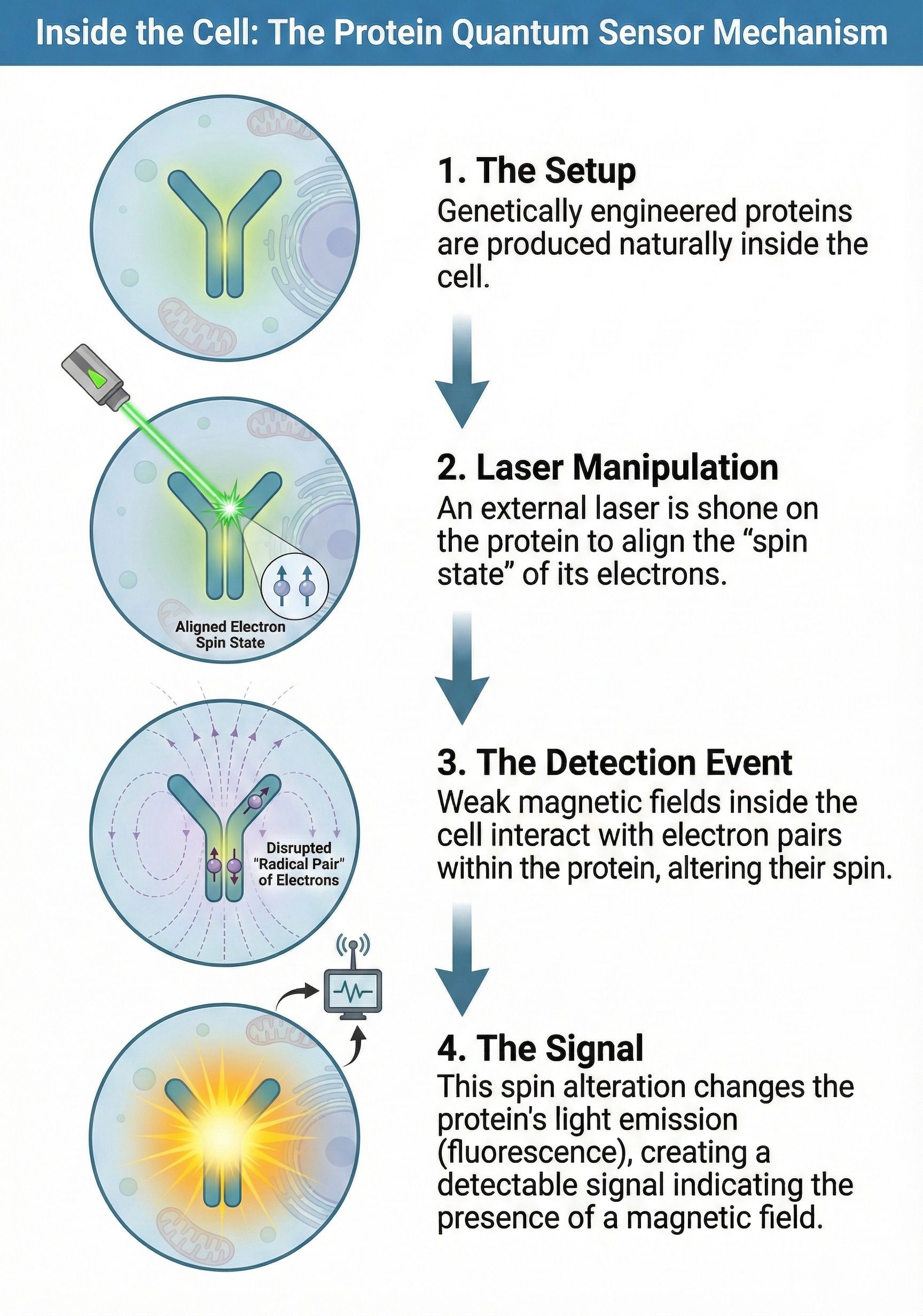
How Protein-Based Quantum Sensors Work Inside Cells
Previous10/10

SuperKalam is your personal mentor for UPSC preparation, guiding you at every step of the exam journey.
Download the App


STUDY RESOURCES
CONTACT US
ⓒ Snapstack Technologies Private Limited