GS 2: PolityGS 2: GovernanceGS 2: Social JusticeGS 3: Science & TechnologyPrelims
Ease of justice has brought legal system closer to people, Pg11
Government champions 'ease of justice' through digital transformation, legislative reforms, and institutional strengthening, bringing the legal system closer to 140 crore Indians.
Practice MCQs
739 Students attempted
Key Highlights:
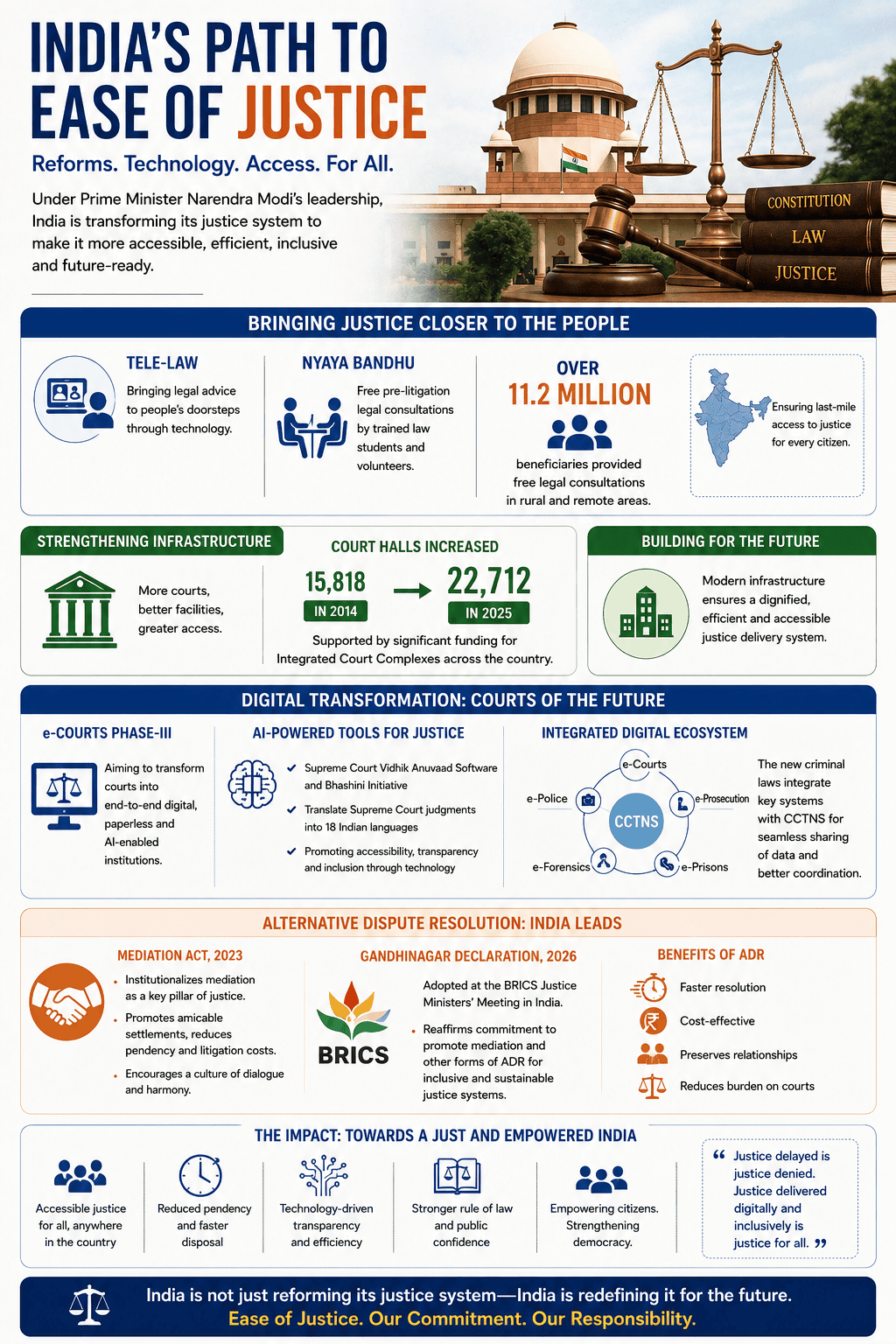
- India has focused on enhancing "ease of justice" through legislative modernization, institutional strengthening, and digital innovation under Prime Minister Narendra Modi's leadership.
- Initiatives like Tele-Law and Nyaya Bandhu have provided free pre-litigation legal consultations to over 11.2 million beneficiaries in rural and remote areas.
- The number of court halls has increased from 15,818 in 2014 to 22,712, supported by significant funding for integrated court complexes.
- The e-Courts Phase-III project aims to transform courts into end-to-end digital, paperless, and AI-enabled institutions for justice delivery.
- AI-powered tools such as Supreme Court Vidhik Anuvaad Software and Bhashini translate Supreme Court judgments into 18 Indian languages.
- New criminal laws integrate e-courts, e-prosecution, e-prisons, and e-forensics with the Crime and Criminal Tracking Network and Systems (CCTNS).
- The Mediation Act, 2023 and the Gandhinagar Declaration at the BRICS justice ministers’ meeting in 2026 underscore India's leadership in alternative dispute resolution.
Justice reforms.png
Detailed Insights:
- The "ease of justice" framework aims for ease of engagement for litigants, ease of working for advocates and judges, and ease of understanding for citizens.
- Designing Innovative Solutions for Holistic Access to Justice scheme promotes pro-bono work and makes justice delivery accessible and affordable.
- E-filing services and e-Seva Kendras have simplified interactions between litigants and the judicial ecosystem.
- The National Judicial Data Grid provides single-click access to information on over 340 million court orders, enhancing transparency.
- The Nyaya Shruti platform facilitates virtual appearances and recording of witness testimonies, streamlining processes like digital bail orders.
- The sanctioned strength of High Court judges increased from 906 to 1122, and Supreme Court judges from 31 to 38.
- Over 40,000 compliances were reduced, and 1,725 redundant colonial-era laws were repealed to improve ease of doing business.
- The establishment of institutions like the India International Arbitration Centre strengthens the arbitration framework.
- India is committed to building a resilient, innovative, and inclusive justice system to achieve the goal of Viksit Bharat by 2047.
Key Concepts Involved:
- Tele-Law: A government initiative providing free pre-litigation legal consultations to citizens, especially in rural areas, through digital platforms.
- e-Courts Project: A national mission to digitize and modernize the Indian judiciary, aiming for paperless and AI-enabled court processes.
- Alternative Dispute Resolution (ADR): Methods like mediation and arbitration used to resolve legal disputes outside traditional court litigation, promoting faster and more cost-effective solutions.
- Crime and Criminal Tracking Network and Systems (CCTNS): A national project to create a comprehensive and integrated system for effective policing and criminal justice administration.

SuperKalam is your personal mentor for UPSC preparation, guiding you at every step of the exam journey.
Download the App


STUDY RESOURCES
CONTACT US
ⓒ Snapstack Technologies Private Limited