GS 3: Environment & EcologyGS 2: GovernanceGS 3: EconomyPrelims
A 10 per cent rule for sustainable development, Pg11
Expert proposes a '10 per cent rule' for sustainable development, urging a policy pause if ecological costs exceed this threshold in critical tiger habitats.
Practice MCQs
739 Students attempted
Key Highlights:
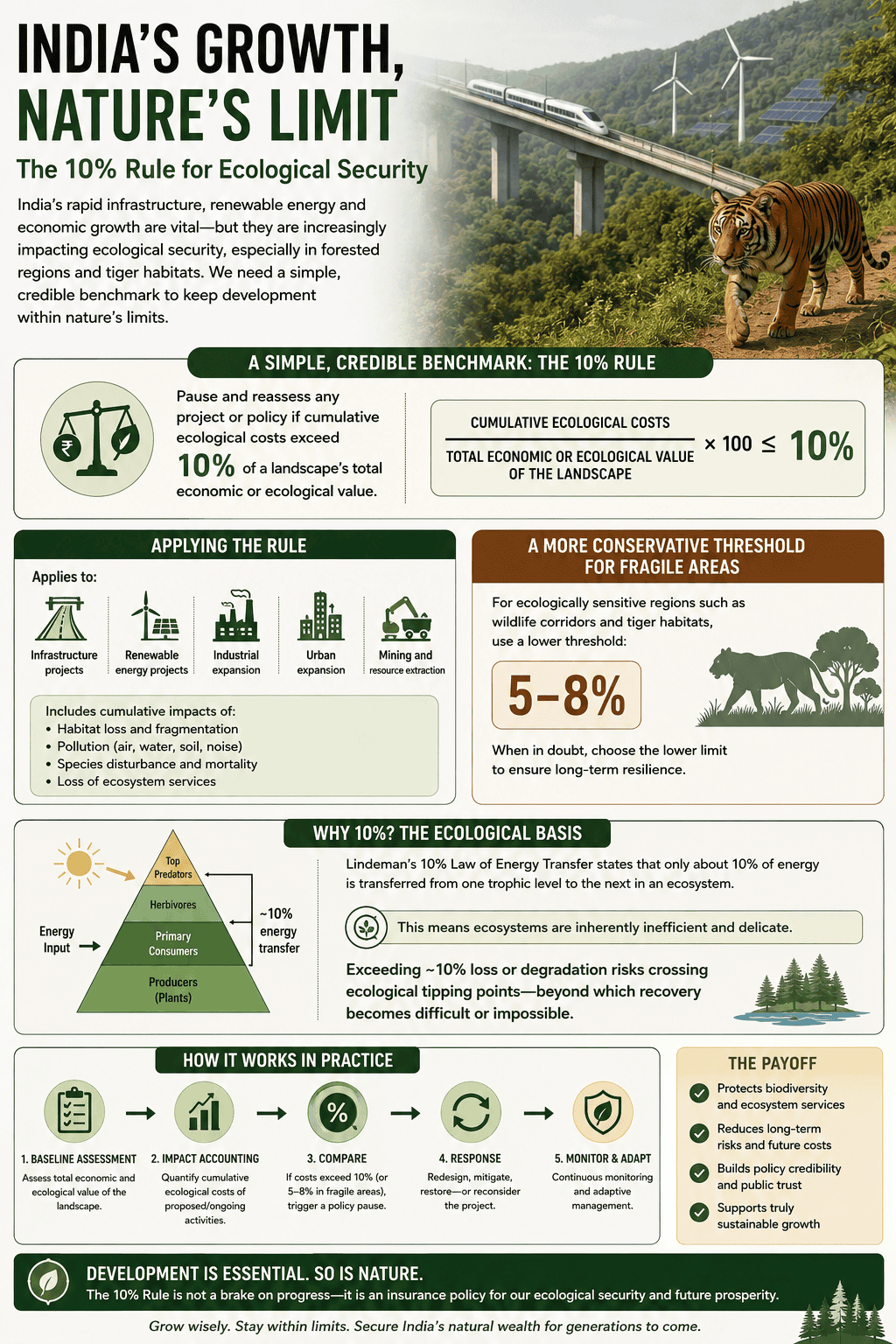
- India's rapid infrastructure, renewable energy, and economic growth are impacting ecological security, particularly in forested regions and tiger habitats.
- The article proposes a "10 per cent rule" as a simple, credible benchmark for sustainable development.
- This rule suggests a policy pause if cumulative ecological costs exceed 10% of a landscape's total economic or ecological value.
- For fragile wildlife corridors, a more conservative threshold of 5-8% is recommended.
- The principle is rooted in Lindeman's 10 per cent Law of energy transfer in ecosystems.
10 percent rule.png
Detailed Insights:
- Current regulatory instruments like Environmental Impact Assessments (EIA), forest clearances, and compensatory afforestation often lack clear decision thresholds.
- The concept of Green GDP, which adjusts economic output for environmental loss, also struggles with practical application.
- The "10 per cent rule" aims to provide a clear trigger for reassessing the scale, location, and design of development projects.
- It can be integrated into EIA processes, landscape-level planning for notified corridors, green accounting frameworks, and infrastructure design.
- Tiger landscapes are highlighted as particularly urgent due to their critical ecosystem services and tight ecological margins.
- Incremental pressures in these areas lead to human-wildlife conflict, habitat fragmentation, and stress on prey populations.
Key Concepts Involved:
- Lindeman's 10 per cent Law: An ecological principle stating that only about 10% of energy is transferred from one trophic level to the next in an ecosystem.
- Green GDP: An indicator of economic growth that accounts for the environmental consequences of that growth, such as resource depletion and pollution.
- Environmental Impact Assessment (EIA): A process used to identify the environmental, social, and economic impacts of a project prior to decision-making.
- Global Tiger Forum: An intergovernmental international body established to promote tiger conservation.

SuperKalam is your personal mentor for UPSC preparation, guiding you at every step of the exam journey.
Download the App


STUDY RESOURCES
CONTACT US
ⓒ Snapstack Technologies Private Limited