GS 2: PolityGS 2: GovernanceGS 2: Social JusticeGS 3: Science & TechnologyPrelims
The pressures of counting India, Pg7
India's first digital Census 2027 struggles with enumerator safety, connectivity, and alleged data manipulation, raising concerns for accurate policy planning.
Practice MCQs
724 Students attempted
Key Highlights:
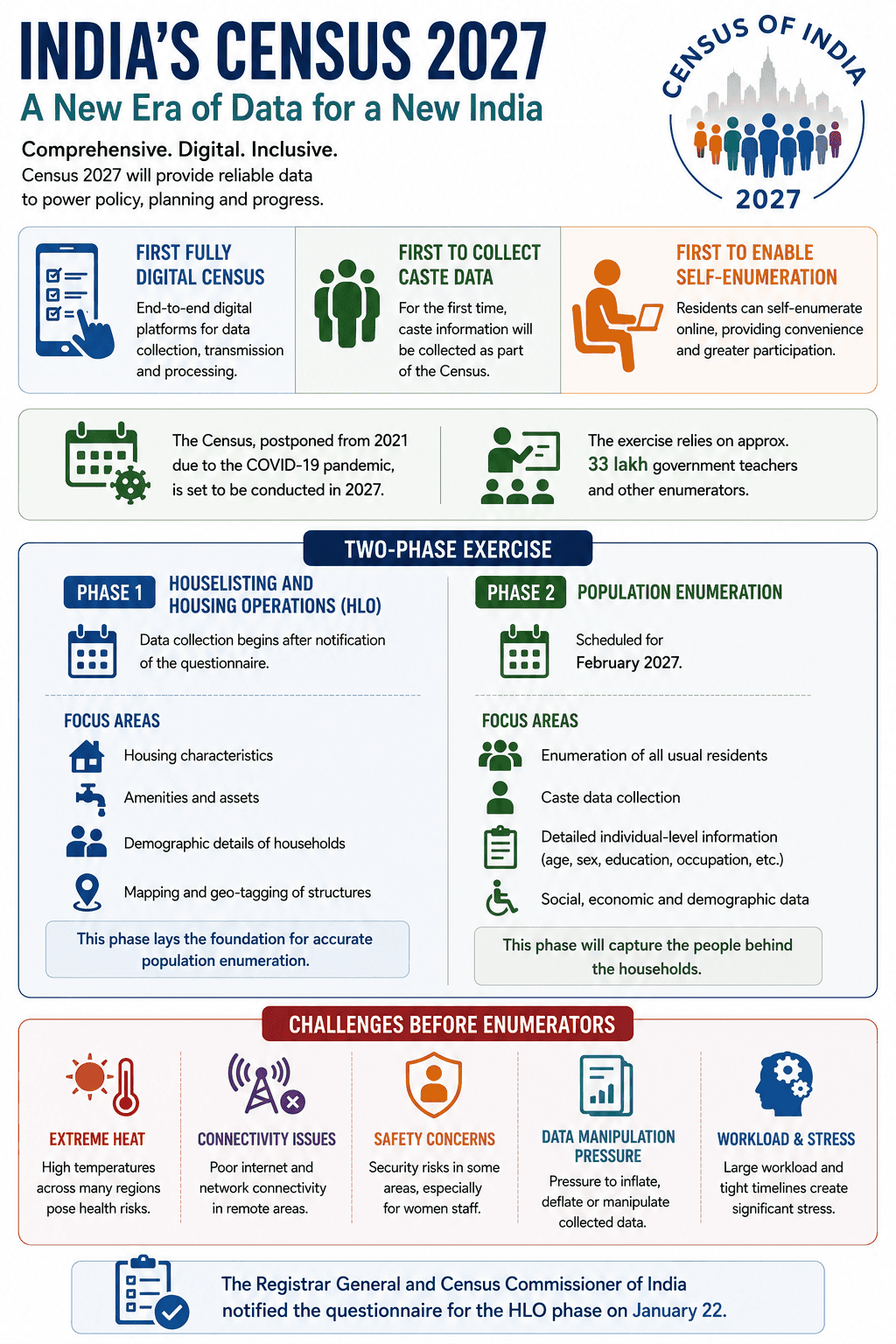
- India's Census 2027 is the first fully digital Census, the first to collect caste data, and the first to allow residents to self-enumerate.
- The exercise, postponed from 2021 due to the COVID-19 pandemic, relies on approximately 33 lakh government teachers and other enumerators.
- The first phase, Houselisting and Housing Operations (HLO), involves collecting data on housing, amenities, and demographics.
- The second phase, Population Enumeration, scheduled for February 2027, will enumerate caste and other detailed individual-level data.
- Enumerators face significant challenges including extreme heat, connectivity issues, safety concerns, and pressure to manipulate collected data.
- The Registrar General and Census Commissioner of India notified the questionnaire for the HLO phase on January 22.
Census.png
Detailed Insights:
- The Census 2027 is being conducted six years later than its decennial schedule, leading to continued reliance on 2011 Census data for policy planning and welfare programs.
- The HLO phase collects information on dwelling structures, access to water, sanitation, energy, ownership of consumer goods, and household composition.
- In Ladakh and snow-bound regions of Uttarakhand, Jammu and Kashmir, and Himachal Pradesh, both Census phases have a deadline of September 30, 2026, due to weather constraints.
- Enumerators receive an honorarium of ₹25,000 for completing their assigned tasks.
- The Census Act, 1948, Section 8(2), legally binds residents to answer Census-related questions to the best of their knowledge or belief.
- The Bombay High Court granted interim protection to private unaided schools, observing that the Census Act does not impose statutory obligations on them to provide staff for Census duties.
- The Census Management and Monitoring System (CMMS) portal enables real-time data monitoring, but enumerators reported pressure from supervisors to edit data, particularly concerning sanitation, water sources, and LPG connections.
- The Jal Jeevan Mission aims to provide tap water connections, and the article highlights instances of enumerators being asked to alter data to reflect treated tap water access despite ground realities.
- National LPG coverage, as per the Press Information Bureau, rose significantly from April 2014 to April 2026, yet enumerators observed households using traditional fuels despite having LPG connections.
Key Concepts Involved:
- Census: A comprehensive official count of a population, typically conducted periodically, to gather demographic and other socio-economic data.
- Houselisting and Housing Operations (HLO): The initial phase of the Census, focusing on collecting data related to housing conditions, household amenities, and assets.
- Population Enumeration: The second phase of the Census, involving the collection of detailed individual-level data, including demographics, caste, and religion.
- Registrar General and Census Commissioner of India: The statutory authority responsible for conducting the decennial Census and demographic surveys in India.
- Census Act, 1948: The primary legislation that provides the legal framework for the conduct of the Census in India, outlining duties and obligations of citizens and enumerators.
- Jal Jeevan Mission: A flagship government initiative aimed at providing safe and adequate drinking water through individual household tap connections to all rural households by 2024.

SuperKalam is your personal mentor for UPSC preparation, guiding you at every step of the exam journey.
Download the App


STUDY RESOURCES
CONTACT US
ⓒ Snapstack Technologies Private Limited