GS 3: EconomyPrelims
MPC minutes: Why central bank opted for status quo on repo rates, Pg23
RBI's MPC maintains repo rate at 5.25%, citing inflation vigilance amid West Asia conflict, monsoon risks, and lowering growth forecast to 6.6%.
Practice MCQs
724 Students attempted
Key Highlights:
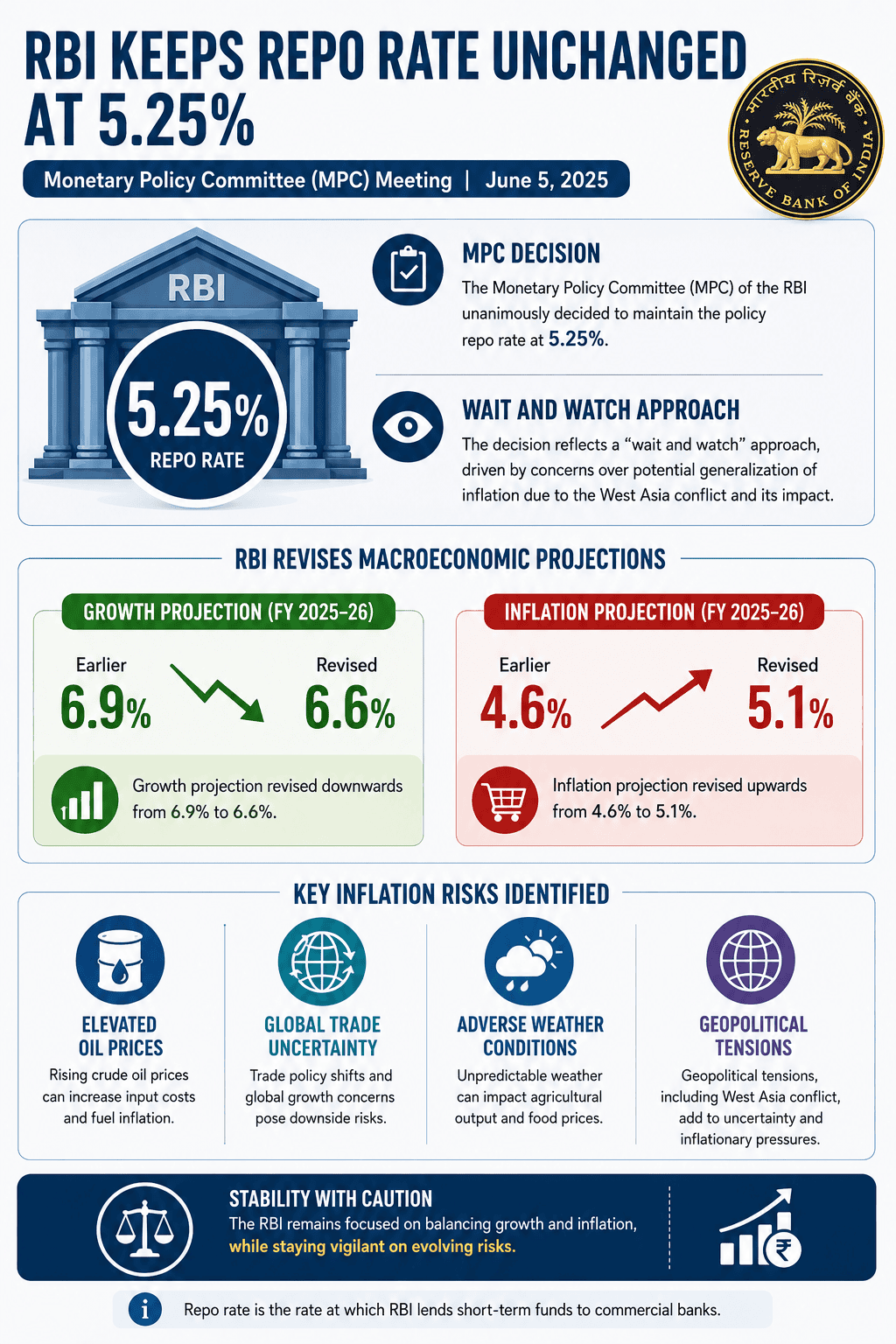
- The Monetary Policy Committee (MPC) of the Reserve Bank of India (RBI) unanimously decided to maintain the policy repo rate at 5.25% during its meeting on June 5.
- The decision reflected a "wait and watch" approach, driven by concerns over potential generalization of inflation due to the West Asia conflict and its impact.
- The RBI revised India's growth projection downwards from 6.9% to 6.6% and increased the inflation forecast from 4.6% to 5.1%.
- Key inflation risks identified included elevated oil prices, global trade uncertainty, adverse weather conditions, and geopolitical tensions.
RBI MPC.png
Detailed Insights:
- RBI Governor Sanjay Malhotra emphasized the need to remain data-dependent and vigilant against inflation unhinging expectations.
- The revision in retail prices of petrol and diesel in May is expected to contribute to higher fuel inflation in the coming months.
- While the near-term outlook for food prices was favorable due to a good rabi crop, risks from a below-normal monsoon and El Nino conditions were highlighted.
- The MPC maintained its monetary policy stance as 'neutral', indicating flexibility for future adjustments.
- Member Indranil Bhattacharya noted that while demand-pull inflation might warrant pre-emptive action, cost-push inflation from supply shocks requires greater caution.
- The Indian economy was described as strong and healthy compared to peers, being one of the fastest-growing major economies with benign inflation in the past year.
- Favorable resolution of inflation risks, stable food prices, global oil prices below $80 per barrel, and non-hawkish decisions by the Federal Reserve could provide room for growth-supportive policies.
Key Concepts Involved:
- Monetary Policy Committee (MPC): A statutory body in India responsible for fixing the benchmark interest rate to maintain price stability while keeping in mind the objective of growth.
- Repo Rate: The interest rate at which the Reserve Bank of India lends money to commercial banks in the event of any shortfall of funds.
- Inflation: The rate at which the general level of prices for goods and services is rising, and subsequently, purchasing power is falling.
- El Nino: A climate pattern describing the unusual warming of surface waters in the eastern tropical Pacific Ocean, often associated with altered weather patterns globally, including potential droughts in India.

SuperKalam is your personal mentor for UPSC preparation, guiding you at every step of the exam journey.
Download the App


STUDY RESOURCES
CONTACT US
ⓒ Snapstack Technologies Private Limited