GS 3: Internal SecurityGS 3: Science & TechnologyGS 3: EconomyGS 2: GovernancePrelims
Moving from drone purchases to drone partnerships, Pg6
India commits $2 billion to domestic drone procurement, pivoting from transactional purchases to strategic partnerships for rapid tech upgrades and indigenous defence.
Practice MCQs
724 Students attempted
Key Highlights:
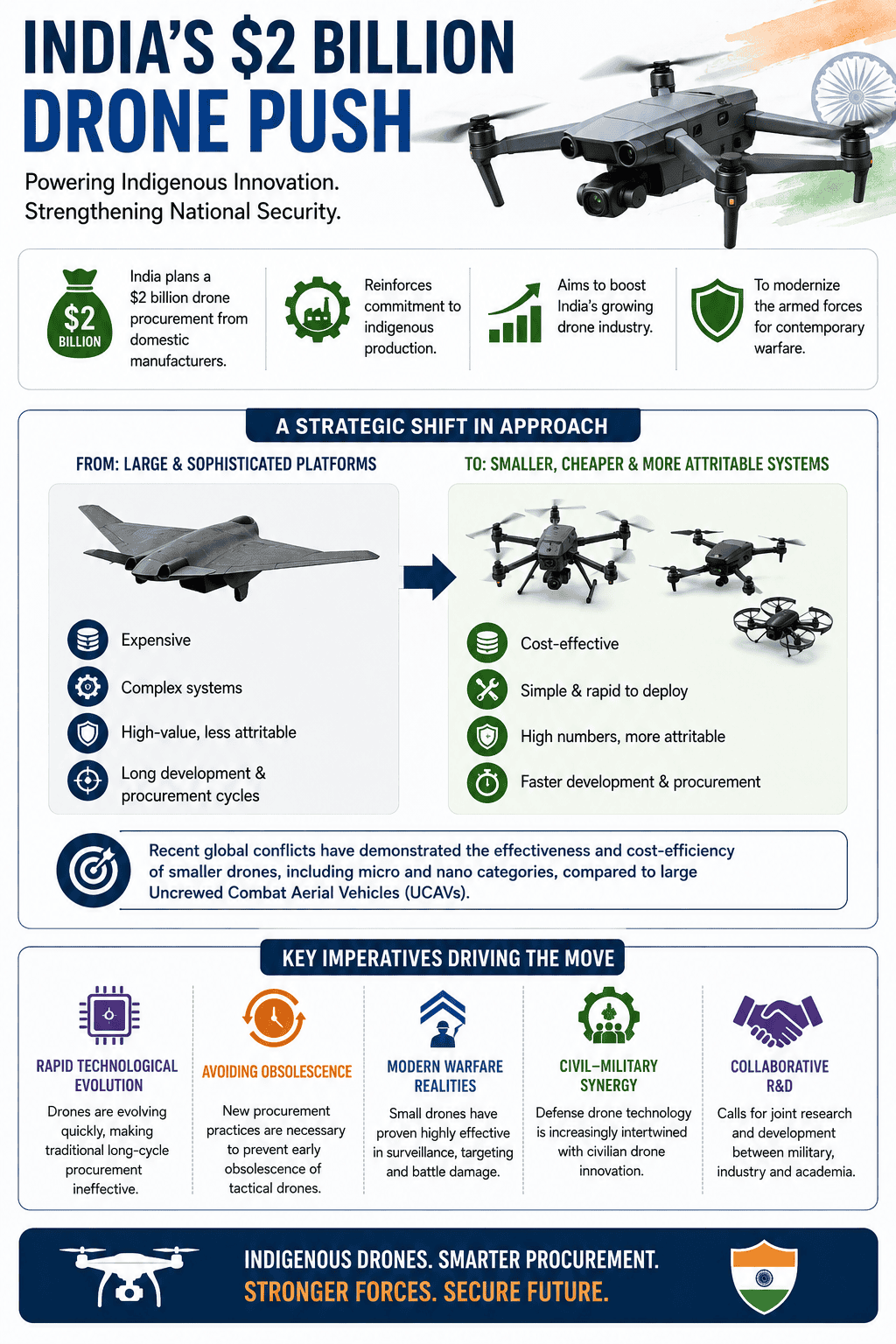
- India plans a $2 billion drone procurement from domestic manufacturers, reinforcing its commitment to indigenous production.
- This initiative marks a strategic shift from acquiring large, sophisticated platforms to smaller, cheaper, and more attritable systems.
- The move aims to boost India's growing drone industry and modernize the armed forces for contemporary warfare.
- New procurement practices are necessary to address the rapid technological evolution and potential obsolescence of tactical drones.
Drone push.png
Detailed Insights:
- Recent global conflicts have demonstrated the effectiveness and cost-efficiency of smaller drones, including micro and nano categories, compared to large Uncrewed Combat Aerial Vehicles (UCAVs).
- The development of defense drone technology is increasingly intertwined with civilian drone innovation, necessitating collaborative research and development (R&D) processes.
- Tactical drones face rapid obsolescence, potentially becoming outdated in 2-3 years due to advancements in enemy Electronic Warfare (EW) capabilities.
- India's Draft Defence Acquisition Procedure (DAP) facilitates the procurement of Commercial-Off-The-Shelf (COTS) systems and includes provisions for streamlining upgrades.
- The Defence Procurement Manual (DPM) allows for financial buffers to cover unforeseen repairs and upgrade costs, indicating a forward-looking approach.
- Current procurement frameworks are often transactional, which is inadequate for technologies requiring continuous iteration and improvement.
- A more effective model proposed is long-term managed service contracts, providing manufacturers with demand predictability and ensuring continuous upgrades and surge production capacity.
- Such partnerships would foster closer collaboration between the armed forces and industry, prioritizing sustained capability over one-off deliveries.
- The $2 billion commitment underscores the political will to support India's domestic drone industry, which possesses the technical foundation for this strategic shift.
Key Concepts Involved:
- Attritable Systems: Military systems designed to be cost-effective, reusable, and acceptable to lose in high-risk environments without significantly impacting the overall mission.
- Electronic Warfare (EW): Military actions involving the use of electromagnetic energy to control the electromagnetic spectrum or to attack an enemy.
- Commercial-Off-The-Shelf (COTS): Products or systems that are commercially available and can be integrated into military applications, offering cost and time efficiencies.
- Defence Acquisition Procedure (DAP): The comprehensive policy framework governing capital acquisitions for the Indian armed forces, emphasizing indigenization and modernization.
- Defence Procurement Manual (DPM): A document outlining the procedures and guidelines for revenue procurements, covering day-to-day functioning, maintenance, and operational readiness in the Ministry of Defence.

SuperKalam is your personal mentor for UPSC preparation, guiding you at every step of the exam journey.
Download the App


STUDY RESOURCES
CONTACT US
ⓒ Snapstack Technologies Private Limited