GS 1: Art & CultureGS 2: PolityGS 1: Modern History
First and foremost, Pg10
Madhya Pradesh High Court declares Bhojshala-Kamal Maula complex a Hindu temple, stirring debate on Places of Worship Act and historical claims.
Practice MCQs
898 Students attempted
Key Highlights:
- The Madhya Pradesh High Court ruled on May 15, 2024, that the Bhojshala-Kamal Maula complex in Dhar is a Hindu temple.
- The ruling was based on archaeological evidence, the "preponderance of probability" principle, and "faith and belief", referencing the 2019 Ayodhya judgment.
- The case bypassed the Places of Worship Act 1991 due to an exemption for "ancient and historical monuments" under the 1958 Act.
- The Supreme Court allowed the survey to proceed with safeguards.
Detailed Insights:
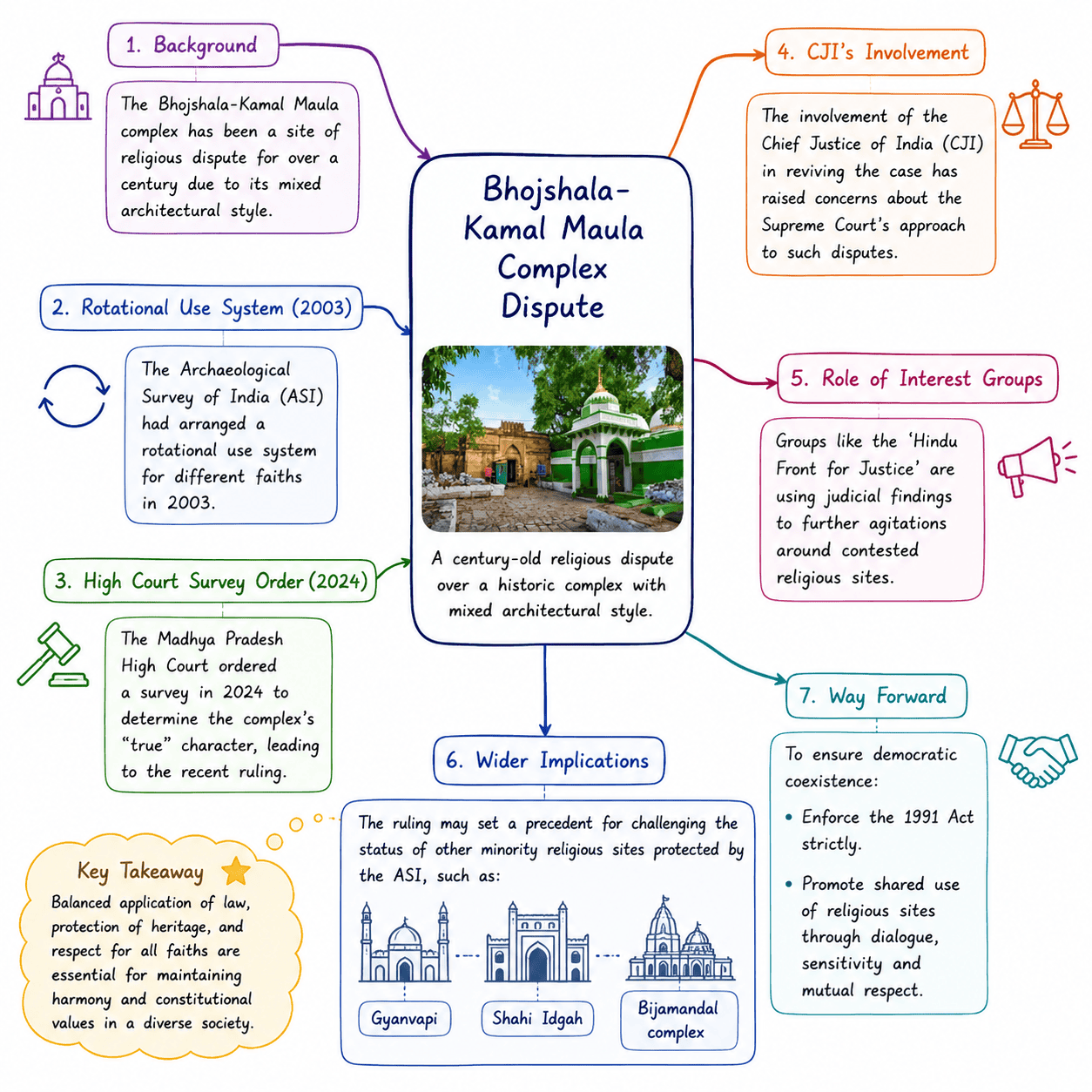
- The Bhojshala-Kamal Maula complex has been a site of religious dispute for over a century due to its mixed architectural style.
- The Archaeological Survey of India (ASI) had arranged a rotational use system for different faiths in 2003.
- The Madhya Pradesh High Court ordered a survey in 2024 to determine the complex's "true" character, leading to the recent ruling.
- The involvement of the Chief Justice of India (CJI) in reviving the case has raised concerns about the Supreme Court's approach to such disputes.
- Groups like the 'Hindu Front for Justice' are using judicial findings to further agitations around contested religious sites.
- The ruling may set a precedent for challenging the status of other minority religious sites protected by the ASI, such as Gyanvapi, Shahi Idgah, and the Bijamandal complex.
- Enforcing the 1991 Act strictly and promoting shared use of religious sites are suggested as ways to ensure democratic coexistence.
bhojshala.png
Key Concepts Involved:
- Places of Worship (Special Provisions) Act 1991: This act freezes the religious character of places of worship as they existed on August 15, 1947.
- Ancient Monuments and Archaeological Sites and Remains Act 1958: This act provides for the preservation of ancient and historical monuments and archaeological sites.
- Preponderance of Probability: A standard of proof based on which evidence is more likely than not to be true.

SuperKalam is your personal mentor for UPSC preparation, guiding you at every step of the exam journey.
Download the App


STUDY RESOURCES
CONTACT US
ⓒ Snapstack Technologies Private Limited