GS 2: International RelationsGS 3: Environment & EcologyGS 1: Indian GeographyGS 2: GovernancePrelims
Dhaka’s new Padma barrage will reshape water power in the region, Pg2
Dhaka's new Padma barrage, costing Rs 39,170 crore, aims to combat water scarcity for 6.5 crore people, intensifying India-Bangladesh water disputes and raising environmental concerns.
Practice MCQs
891 Students attempted
Key Highlights:
- Bangladesh has approved the construction of a new Padma Barrage on the Padma River, which is the Ganga in Bangladesh.
- The 2.1-km-long structure aims to store 2,900 million cubic meters of water to serve 6.5 crore people and abate seasonal water scarcity.
- The project is estimated to cost Tk 50,443 crore (Rs 39,170 crore) and will be located 180 km downstream of India's Farakka Barrage.
- The existing Ganges Water Treaty between India and Bangladesh, signed in 1996, is set to expire in December 2026.
Padma River.png
Detailed Insights:
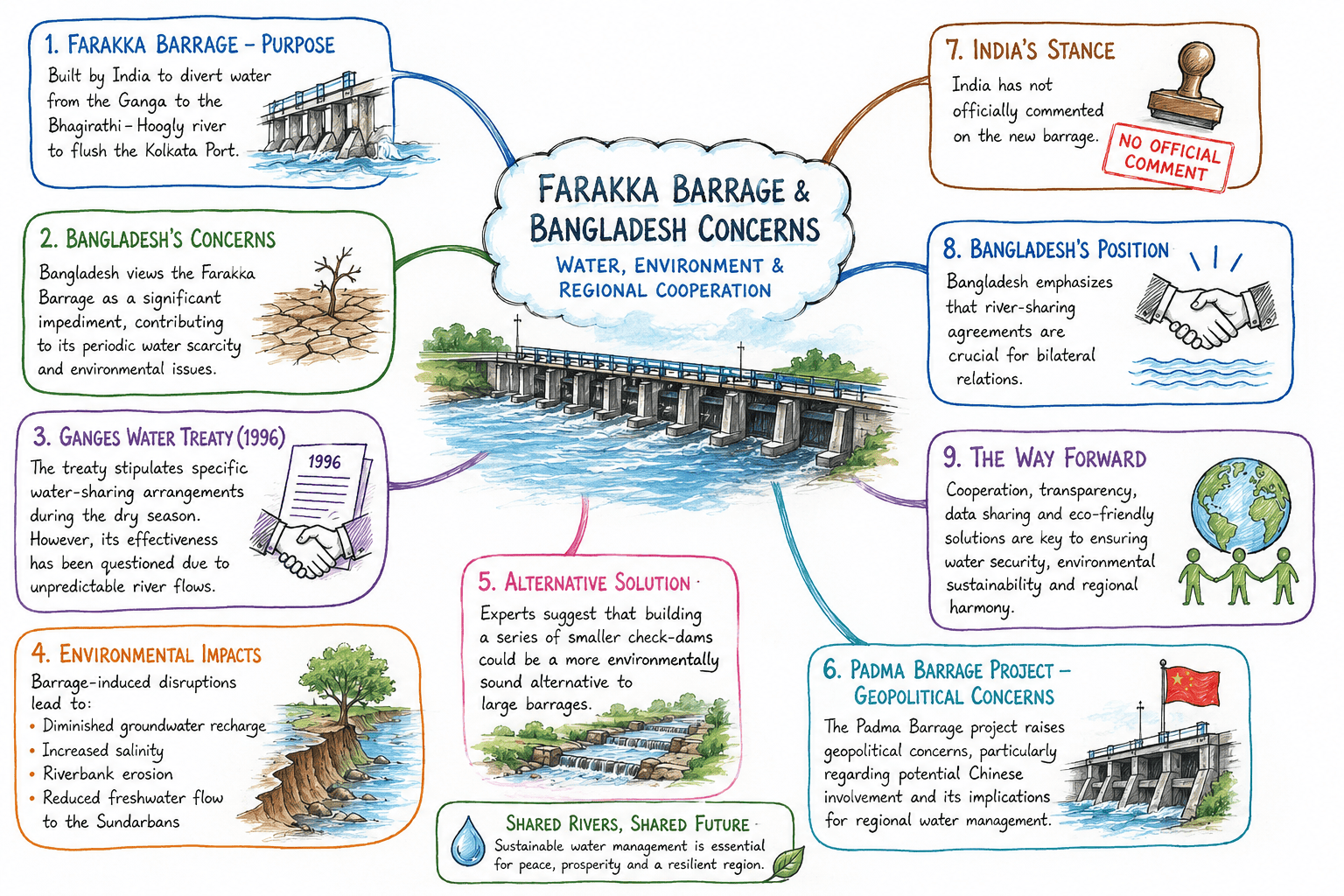
- The Farakka Barrage was built by India to divert water from the Ganga to the Bhagirathi-Hoogly river to flush the Kolkata Port.
- Bangladesh views the Farakka Barrage as a significant impediment, contributing to its periodic water scarcity and environmental issues.
- The Ganges Water Treaty (1996) stipulates specific water-sharing arrangements during the dry season, but its effectiveness has been questioned due to unpredictable river flows.
- Environmental impacts of barrages include diminished groundwater recharge, increased salinity, riverbank erosion, and reduced freshwater flow to the Sundarbans.
- Experts suggest that building a series of smaller check-dams could be a more environmentally sound alternative to large barrages.
- The Padma Barrage project raises geopolitical concerns, particularly regarding potential Chinese involvement and its implications for regional water management.
- India has not officially commented on the new barrage, while Bangladesh emphasizes that river-sharing agreements are crucial for bilateral relations.
Key Concepts Involved:
- Barrage: A low-head dam with a series of gates designed to divert water or regulate river flow.
- Lower Riparian State: A country or region situated downstream in a river basin, whose water supply is influenced by upstream activities.
- Ganges Water Treaty (1996): A bilateral agreement between India and Bangladesh governing the sharing of the Ganga River's waters at Farakka.
- Farakka Barrage: A major barrage constructed by India on the Ganga River in West Bengal for water diversion purposes.

SuperKalam is your personal mentor for UPSC preparation, guiding you at every step of the exam journey.
Download the App


STUDY RESOURCES
CONTACT US
ⓒ Snapstack Technologies Private Limited