GS 3: EconomyGS 2: International RelationsGS 2: GovernancePrelims
Amid West Asia conflict, bitumen woes hit India's road infrastructure push, Pg13
West Asia conflict disrupts India's bitumen supply, hiking prices and jeopardizing 10,000 km road target, impacting PMGSY and national highway projects.
Practice MCQs
891 Students attempted
Key Highlights:
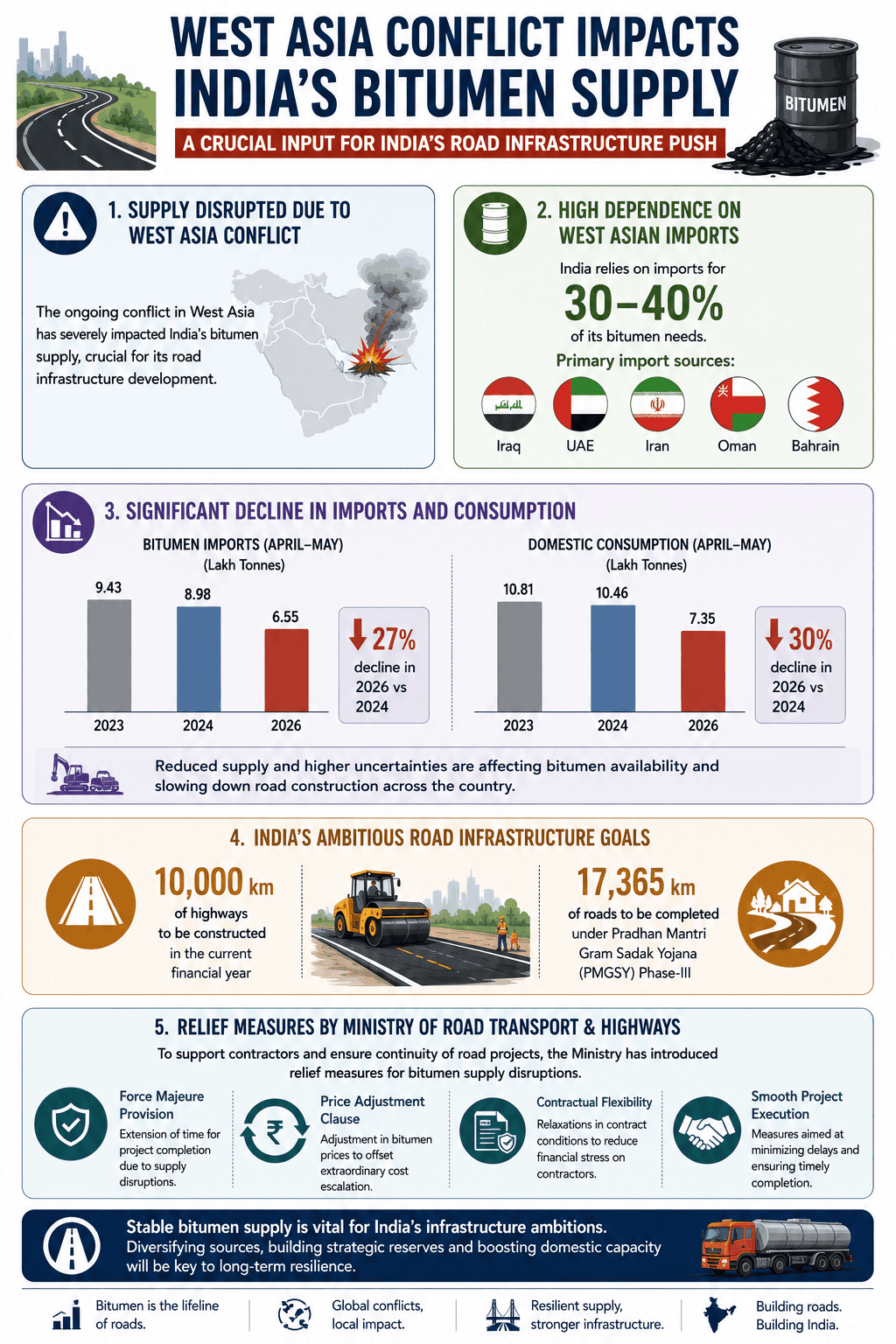
- The ongoing conflict in West Asia has severely impacted India's bitumen supply, crucial for its road infrastructure development.
- India relies on imports for 30-40% of its bitumen needs, primarily from West Asian countries like Iraq, UAE, Iran, Oman, and Bahrain.
- Bitumen imports and domestic consumption saw a significant decline in April-May 2026 compared to previous years, affecting road construction.
- India aims to construct 10,000 km of highways in the current financial year and complete 17,365 km under Pradhan Mantri Gram Sadak Yojana (PMGSY) Phase-III.
- The Ministry of Road Transport and Highways has introduced relief measures, including force majeure and price adjustment clauses, for affected contractors.
Bitumen Impact.png
Detailed Insights:
- India imported 2.36 lakh tonnes of bitumen in April 2026, a decrease from 2.97 lakh tonnes in April 2025 and 2.74 lakh tonnes in April 2024.
- Domestic bitumen consumption in April and May 2026 was 5.80 and 5.19 lakh tonnes respectively, approximately 33% lower than the same period in 2025.
- Annually, India requires about 90 lakh tonnes of bitumen, with domestic refineries like IndianOil and Bharat Petroleum producing around 54 lakh tonnes.
- Over 99% of India's bitumen imports originate from West Asian nations, making the region's stability critical for supply.
- The Strait of Hormuz is a vital maritime route for crude oil destined for Indian refineries, and its disruption impacts bitumen availability and pricing.
- India's increased dependence on bitumen imports is a result of ambitious road projects like Bharatmala Pariyojana and PMGSY over the last decade.
- National Highways have expanded by 61% since 2014, and expressways have seen substantial growth, driving up bitumen demand.
- Bitumen imports, which began around 9,000 tonnes in 2001-02, significantly increased in 2013-14 and doubled again by 2014-15.
- Contractors can claim a 2-4 month relaxation without penalty under force majeure for project delays directly linked to the conflict.
- A cost-escalation compensation mechanism is also available for rising fuel and construction material costs, but contractors cannot avail both reliefs simultaneously.
- Smaller contractors, particularly those involved in PMGSY and small Engineering, Procurement and Construction projects, face greater challenges due to price surges.
Key Concepts Involved:
- Bitumen: A black, sticky, viscous mixture of hydrocarbons, primarily used as a binder in asphalt for road construction.
- Force Majeure: A contractual clause that frees both parties from liability or obligation when an extraordinary event beyond their control prevents contract fulfillment.
- Strait of Hormuz: A narrow, strategically important strait connecting the Persian Gulf with the Gulf of Oman, vital for global oil shipments.
- Pradhan Mantri Gram Sadak Yojana (PMGSY): A centrally sponsored scheme aimed at providing all-weather road connectivity to unconnected rural habitations in India.

SuperKalam is your personal mentor for UPSC preparation, guiding you at every step of the exam journey.
Download the App


STUDY RESOURCES
CONTACT US
ⓒ Snapstack Technologies Private Limited