GS 2: International RelationsGS 3: Environment & EcologyGS 3: EconomyPrelims
Oslo summit must mark India’s northward turn, Pg6
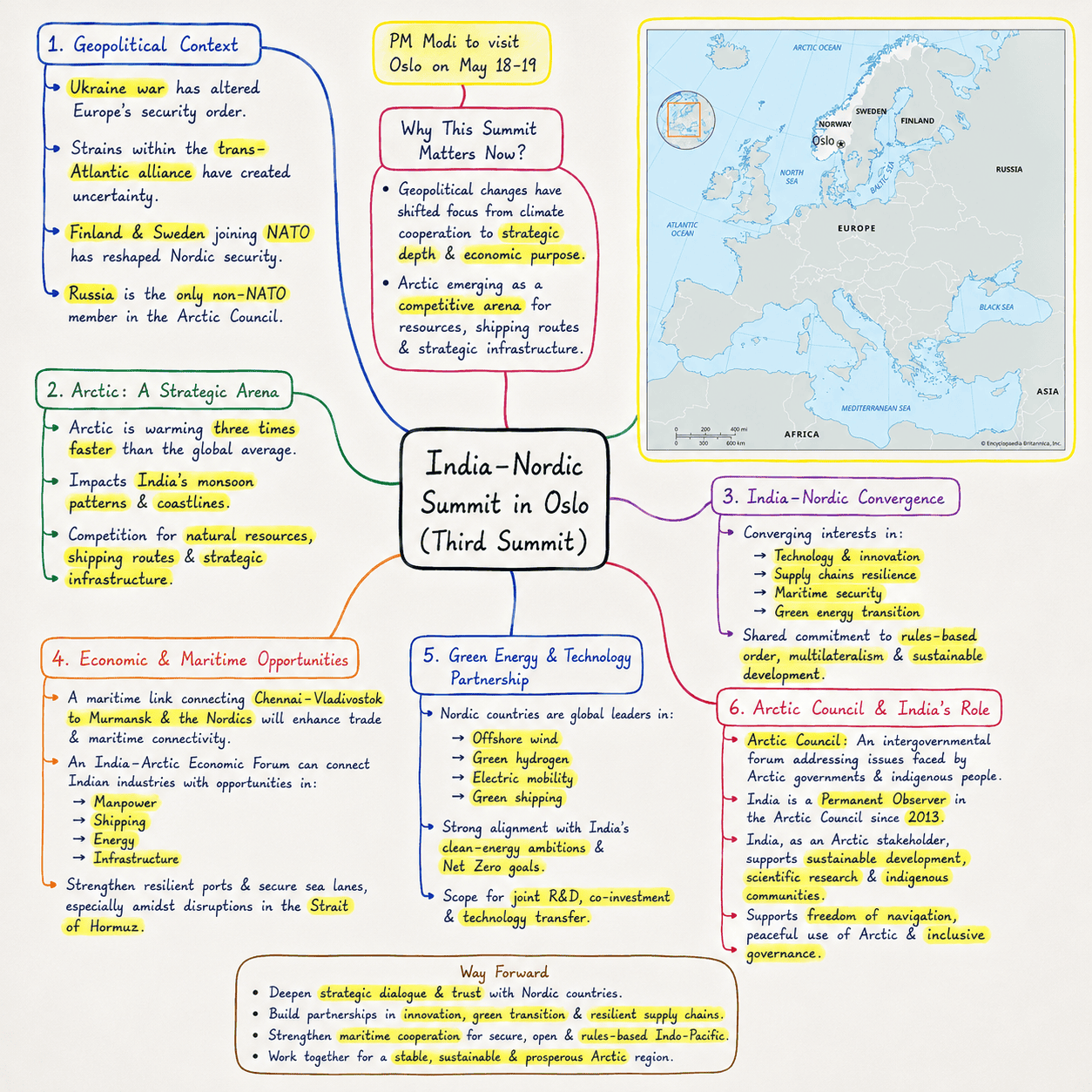
India-Nordic Summit in Oslo to address Arctic geopolitics, maritime security, and green energy cooperation amidst changing global dynamics.
Practice MCQs
883 Students attempted
Key Highlights:
- Prime Minister Modi will visit Oslo on May 18-19 for the third India-Nordic Summit.
- The summit's focus has shifted from climate cooperation to include strategic depth and economic purpose due to geopolitical changes.
- The Arctic is emerging as a competitive arena for resources, shipping routes, and strategic infrastructure.
- Finland and Sweden joining NATO has reshaped Nordic security, with Russia being the only non-NATO member in the Arctic Council.
Oslo.png
Detailed Insights:
- The Ukraine war has altered Europe's security order, and strains within the trans-Atlantic alliance have created uncertainty.
- Denmark, the current chair of the Arctic Council, faces pressure from the U.S. regarding Greenland and its strategic importance.
- India and the Nordic countries have converging interests in technology, supply chains, maritime security, and green energy.
- India, an Arctic stakeholder, observes that the Arctic is warming three times faster than the global average, impacting India's monsoon and coastlines.
- A maritime link connecting Chennai-Vladivostok to Murmansk and the Nordics would enhance trade and maritime connectivity.
- An India-Arctic Economic Forum could connect Indian industries with opportunities in manpower, shipping, energy and infrastructure.
- Nordic countries lead in offshore wind, hydrogen, electric mobility, and green shipping, aligning with India's clean-energy ambitions.
- Maritime cooperation is crucial for securing sea lanes and resilient ports, given disruptions in the Strait of Hormuz.
Key Concepts Involved:
- Arctic Council: An intergovernmental forum addressing issues faced by the Arctic governments and indigenous people.
- Blue Economy: Sustainable use of ocean resources for economic growth, improved livelihoods, and jobs while preserving the health of ocean ecosystem.
- Geopolitics: The influence of geography on politics and international relations.

SuperKalam is your personal mentor for UPSC preparation, guiding you at every step of the exam journey.
Download the App


STUDY RESOURCES
CONTACT US
ⓒ Snapstack Technologies Private Limited