GS 3: EconomyPrelims
The ‘discrepancies’ in India’s new GDP data, Pg14
India's new GDP series faces scrutiny as 'discrepancies' surge, raising concerns about data credibility and inflation measurement.
Practice MCQs
862 Students attempted
Key Highlights:
- The Ministry of Statistics and Programme Implementation (MoSPI) released a new series of GDP data, changing the base year from 2011-12 to a more recent period.
- Critics of the previous GDP series (base year 2011-12) claimed it overstated India's GDP growth, particularly concerning the inflation rate.
- A significant issue undermining the credibility of India's GDP data was the high level of "discrepancies" between GDP and Gross Value Added (GVA) calculations.
- In the new GDP series, "discrepancies" have increased substantially, reaching ₹3.5 lakh crore in FY25 and an estimated ₹4.9 lakh crore in FY26.
Detailed Insights:
- The base year for GDP calculation has been revised multiple times in independent India to reflect current economic realities; this revision is the eighth such change.
- GDP can be calculated in two ways: by adding up the monetary value of all goods and services produced (GVA) or by totaling all expenditures in the economy (GDP).
- Ideally, GDP should equal GVA plus net indirect taxes, but differences arise due to unavailable or late-reported data, leading to "statistical discrepancies."
- High levels of "discrepancies" can undermine the reliability of GDP data, ideally, this ratio should not exceed 2% of real GDP.
- The main components of India's GDP include Private Final Consumption Expenditure (PFCE), Gross Fixed Capital Accumulation (GFCA), and Government Final Consumption Expenditure (GFCE).
- The rise in "discrepancies" in the new GDP series is partly attributed to the move away from the base year (2022-23), which affects the quality of price information and deflators.
- MoSPI is using more deflators (600) in the new series to improve the calculation of real GDP, addressing concerns about the accuracy of inflation rate data.
Key Concepts Involved:
- GDP (Gross Domestic Product): The total monetary or market value of all the finished goods and services produced within a country’s borders in a specific time period.
- GVA (Gross Value Added): A measure of the total value of goods and services produced in an economy, calculated as the sum of all revenues minus the cost of raw materials and inputs.
- Base Year: The year used as a reference point for comparison in statistical data, particularly in calculating real GDP and economic growth rates.
- Deflators: Measures of inflation used to adjust nominal GDP to real GDP, reflecting changes in the price level of goods and services.
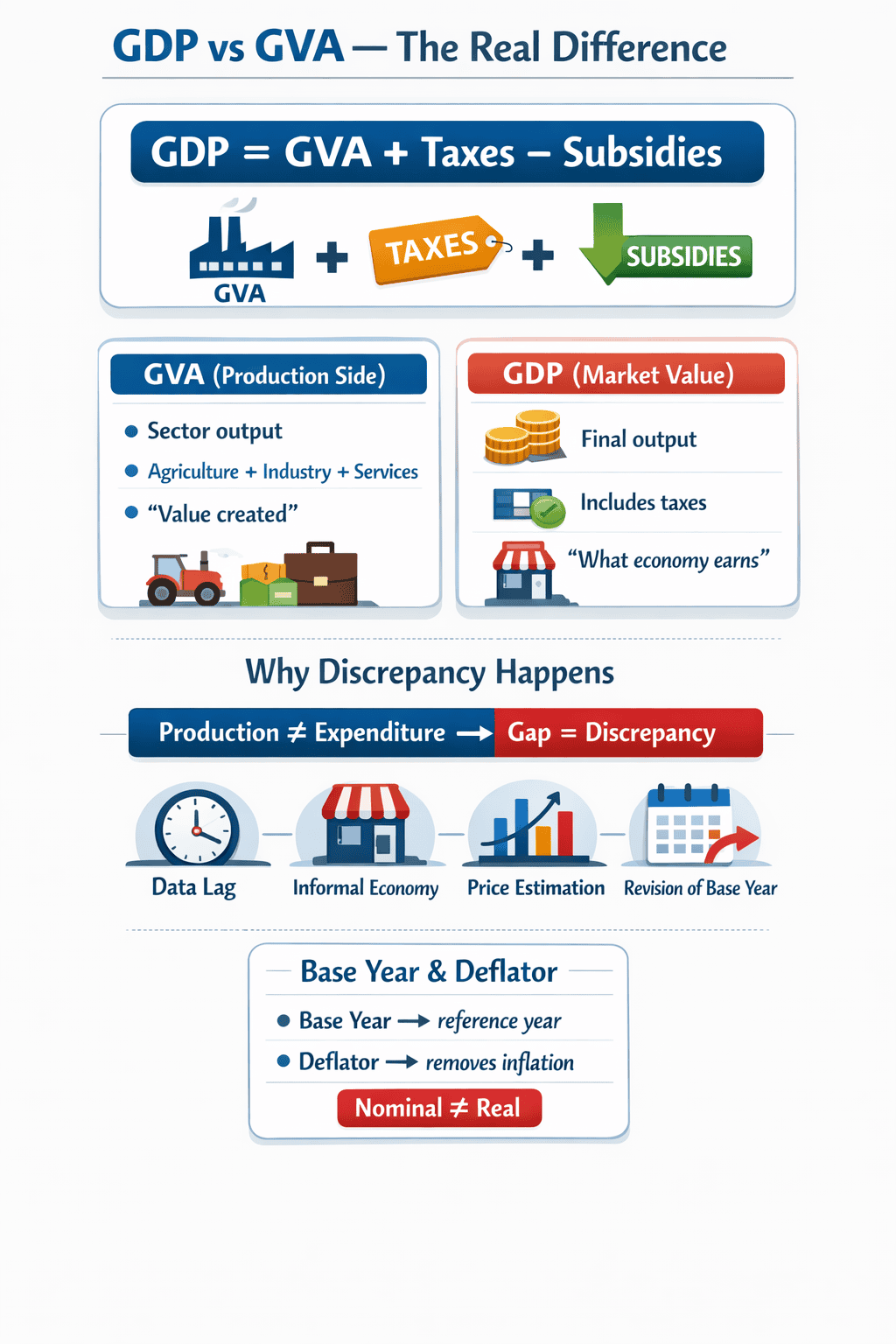
GDP vs GVA

SuperKalam is your personal mentor for UPSC preparation, guiding you at every step of the exam journey.
Download the App


STUDY RESOURCES
CONTACT US
ⓒ Snapstack Technologies Private Limited